8 Mistakes When Building an Online Store in Uzbekistan
We break down 8 critical mistakes when launching an online store in Uzbekistan: from Soliq fines for missing MXIK codes to slow hosting and abandoned checkouts.
Creating an online store with Tashkent agencies using a ready-made platform costs 10,000,000 – 15,000,000 UZS (so'm) in 2–4 weeks, while custom development with complex warehousing and 1C costs 30,000,000 – 50,000,000+ UZS (so'm) and takes 1.5–2 months (red-group.uz). Most stores lose sales not because of poor design, but due to technical bottlenecks: slow server response times, manual inventory tracking, tax penalties, and complicated checkout flows.
In brief
- Over 70–80% of online shoppers in Uzbekistan order via smartphones, and complicated email sign-ups increase cart abandonment rates to 60–75% (innovialabs.uz).
- Selling without fiscal receipts and MXIK (IKPU) codes carries fines ranging from 1,875,000 to 7,500,000 UZS (so'm) under Cabinet Resolution No. 943 and Law No. ZRU-792 (lex.uz).
- Servers hosted inside the Tas-IX network provide latency of 10–30 ms compared to 150–250 ms on overseas platforms, preventing crashes during major sales (shoha.uz).
- In 2026, 19.2% of consumer complaints targeted online stores due to delivery delays and stock discrepancies (uzdaily.uz).
8 critical mistakes when launching a store
1. Selling products that are out of stock
When a customer places an order only to be told by a sales rep that the item is unavailable, they immediately leave for a competitor. According to the Competition Promotion and Consumer Protection Committee of Uzbekistan, in 2026 e-commerce accounted for 19.2% (1,230 claims) of all complaints across retail and food services, with delivery issues and inventory discrepancies being the primary causes (uzdaily.uz).
Updating stock manually via spreadsheets inevitably fails during your first marketing promo. The real solution is automated two-way synchronization between your storefront and inventory system.
2. Missing fiscalization and MXIK (IKPU) codes
Operating an online store in Uzbekistan is regulated by the Law "On Electronic Commerce" No. ZRU-792 and Cabinet Resolution No. 943. Every sale requires an electronic fiscal receipt from a virtual cash register featuring valid MXIK (IKPU) codes for every item. Selling off the books or without issuing a receipt brings fines between 5 and 20 BCU — from 1,875,000 to 7,500,000 UZS (so'm) at a BCU of 375,000 UZS (so'm) (lex.uz).
Payment gateways like Payme, Click, and Uzum must be integrated in fiscal mode right from day one, mapping your catalog directly to tasnif.soliq.uz codes.
3. Hosting your store on slow overseas servers
Running a store on European or US servers causes a latency (ping) penalty of 150–250 ms for users in Uzbekistan. Hosting servers locally within the national Tas-IX network (UzCloud, Sarkor, Beeline Cloud) drops ping down to 10–30 ms (shoha.uz). During peak traffic days like 11.11 shopping festivals, slow foreign servers easily freeze under heavy traffic spikes.
4. Mandatory email registration and bloated checkout forms
Over 70–80% of online buyers in Uzbekistan place orders from their phones. Forcing mandatory email registration and verification links instead of a fast phone-number login pushes checkout abandonment up to 60–75% (innovialabs.uz).
Checkout is your final conversion gateway. To complete an order, asking for just a phone number, name, and delivery address is plenty. A smooth checkout journey should be baked in when designing website and app UX/UI design.
5. Custom development from scratch before validating demand
Entrepreneurs frequently invest in massive custom platforms before validating actual market demand. Custom engineering costs 30,000,000 – 50,000,000+ UZS (so'm) and takes 1.5–2 months (red-group.uz). If the niche is unproven, vital capital ends up locked in features your business doesn't need yet. When starting out, practical CMS solutions or catalog engines are far more cost-effective.
6. Omitting the Uzbek language version
An online storefront available only in Russian misses out on a massive segment of shoppers across regional Uzbekistan. True localization requires complete language versions for product titles, specifications, order statuses, and automated transactional alerts.
7. Total dependency on developers for catalog updates
If changing a product price, adding a sale banner, or listing a new item requires a developer's intervention every time, your business loses momentum. Content management should happen in an intuitive dashboard so your staff can update listings in minutes.
8. Slow mobile page loading times
Uncompressed multi-megabyte product images cause pages to load in 3–5 seconds or longer over mobile networks. Automated image compression and responsive layouts are non-negotiable fundamentals in modern e-commerce.
Comparing launch approaches
| Criteria | Turnkey CMS (OpenCart, WooCommerce) | Custom Development |
|---|---|---|
| Cost in Tashkent | 10,000,000 – 15,000,000 UZS (so'm) | 30,000,000 – 50,000,000+ UZS (so'm) |
| Time to launch | 2–4 weeks | 1.5–2 months |
| Best suited for | Initial launch, standard catalog under 5,000 products | Enterprise retail, bespoke warehouse logic and supply chains |
| Integrations | Standard payment gateways and cloud inventory | Complex integrations with 1C, ERP systems, and branch networks |
If you are just starting
At the initial stage, your priority is validating product demand and closing sales without overspending. Here are 4 concrete steps for this week:
- Assemble your catalog in a spreadsheet with standard columns: SKU, product name, retail price, stock level, and MXIK (IKPU) code from tasnif.soliq.uz.
- Choose a proven CMS solution with a predictable budget of 10,000,000 – 15,000,000 UZS (so'm) and a 2–4 week timeline (red-group.uz), hiring specialists for e-commerce website development without unnecessary bespoke overhead.
- Deploy on local Tas-IX hosting (Sarkor, UzCloud, or Beeline Cloud) to secure fast 10–30 ms latency (shoha.uz).
- Set up streamlined checkout requiring only a phone number with instant fiscal integration via Payme or Click, safeguarding your business from fines of 1,875,000 to 7,500,000 UZS (so'm) (lex.uz).
A real case: Online Team Trade
A Tashkent entrepreneur was launching an electronics store with tight initial capital while balancing a full-time job. The project faced real risks of delaying the launch and tying up operating capital in expensive custom software.
Instead of custom development, the store launched on a proven turnkey CMS. Warehouse management and inventory levels were synced simultaneously with the website and Uzum Market via MoySklad.
This agile launch produced a stable profit of $500–700 per month without cash flow shortages or inventory mismatches (moysklad.uz).
If your business is already running
When sales are already flowing in via Instagram or marketplaces, a website is built to unburden sales managers and automate inventory accounting. Steps for this week if your business is already active:
- Implement automated inventory syncing between your store and 1C so out-of-stock items are hidden automatically.
- Streamline your checkout screen: remove mandatory email fields, keeping just 3 inputs — phone number, recipient name, and delivery district.
- Introduce an Uzbek language version of your catalog to effectively convert shoppers from across the regions.
- Test mobile page load speeds and compress any product photos larger than 300 KB.
A real case: Asaxiy.uz
During a period of rapid growth, major online retailer Asaxiy.uz faced the risk of dropped orders due to manual order processing bottlenecks and inaccurate warehouse inventory during major campaigns.
The company streamlined its backend architecture: integrating two-way synchronization between its storefront and 1C, connecting its internal delivery fleet, and deploying a unified CRM system.
As a result, the retailer reliably handled tens of thousands of orders during peak season with minimal cancellation rates (spot.uz).
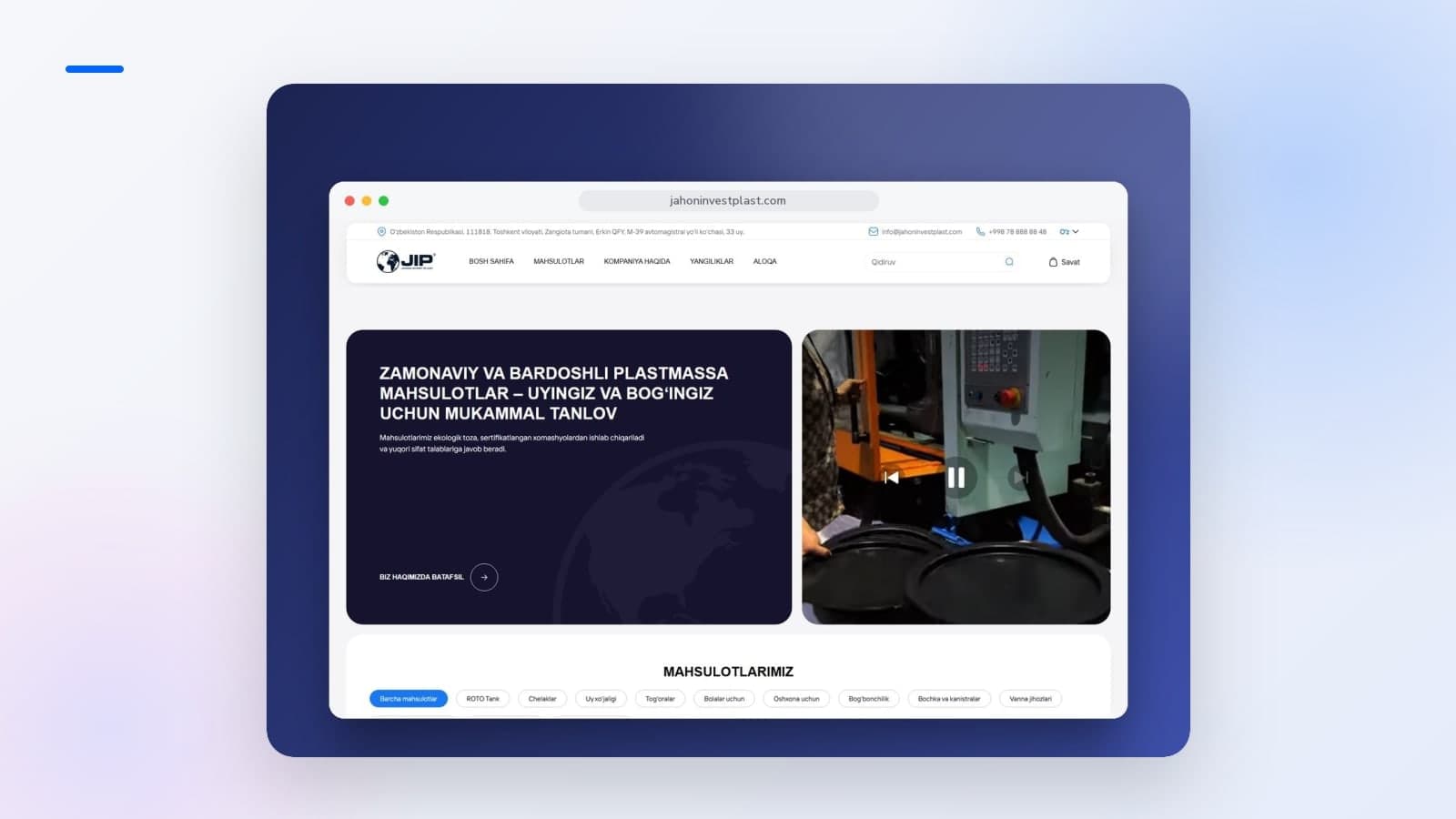
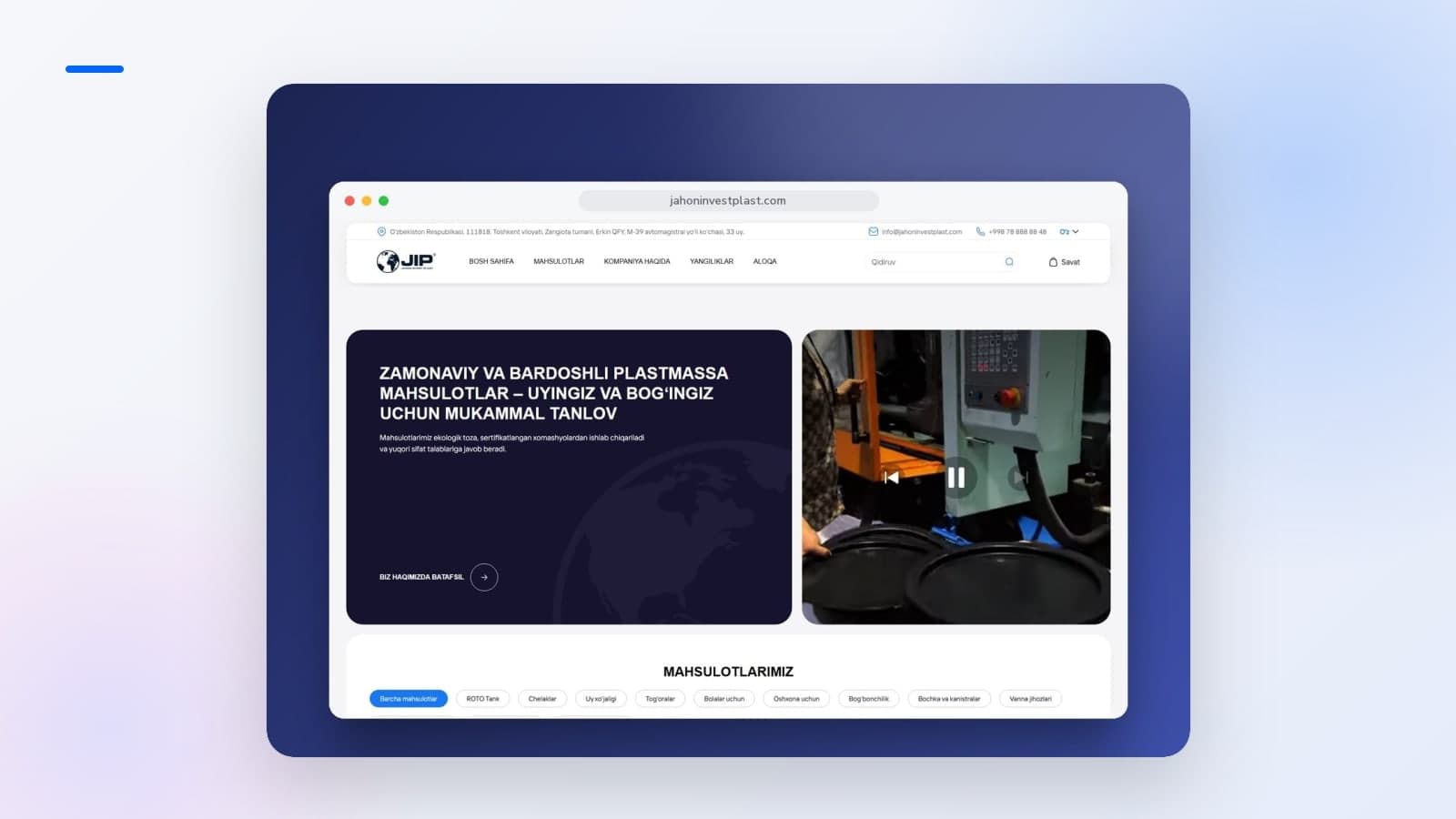
A real case: Jahon Invest Plast
Tashkent plastics manufacturer Jahon Invest Plast needed a clean way to showcase hundreds of home and garden products. Both wholesale and retail clients needed to browse items effortlessly, inspect dimensions, verify package quantities, and place orders in their preferred language.
We developed a comprehensive catalog website with intuitive categories, detailed specifications, and shopping cart functionality. The entire catalog and site content are managed via an easy dashboard in three languages: Uzbek, Russian, and English.
Live at jahoninvestplast.com, the site allows the manufacturer's managers to update product lines independently without hiring programmers.
Frequently asked questions
How much does it cost to launch an online store in Tashkent?
A store built on a turnkey CMS (OpenCart, WooCommerce) costs between 10,000,000 and 15,000,000 UZS (so'm) at Tashkent agencies, with a delivery timeframe of 2–4 weeks. A custom project with tailored architecture, 1C integration, and multi-warehouse logic ranges from 30,000,000 to 50,000,000+ UZS (so'm) and takes 1.5–2 months (red-group.uz).
Is fiscalization mandatory from day one?
Yes. Law No. ZRU-792 "On Electronic Commerce" and Cabinet Resolution No. 943 require generating virtual cash register fiscal receipts with MXIK (IKPU) codes for every sale. Operating without fiscalization risks fines from 1,875,000 to 7,500,000 UZS (so'm) (lex.uz).
Why is foreign hosting bad for an online store in Uzbekistan?
Overseas servers add high latency of 150–250 ms, whereas local data centers in the Tas-IX network deliver fast ping times of 10–30 ms (shoha.uz). High latency degrades mobile page speed and causes customers to leave during busy sales periods.
Does an online store really need an Uzbek language version?
Yes. Over 70–80% of online shoppers purchase using mobile devices (innovialabs.uz), and a large portion of this audience prefers interfaces in Uzbek. Lacking localization hurts conversions and lowers trust among customers across Uzbekistan's regions.
If you are planning to launch an online store or need to optimize an existing setup, reach out to us via contacts. We will review your catalog structure, demonstrate real working solutions, and help you grow sales without wasted budget.
Sources
- Online Team Trade (магазин электроники и техники, Ташкент) · moysklad.uz
- Asaxiy.uz (ритейлер книг, электроники и бытовой техники) · spot.uz
- Закон Республики Узбекистан «Об электронной коммерции» № ЗРУ-792 — Lex.uz
- Комитет по конкуренции выявил проблемы в электронной торговле — UzDaily.uz
- Ошибки при создании интернет-магазина в Узбекистане: 8 провалов — shoha.uz
- red-group.uz
- innovialabs.uz