7 Multilingual SEO Mistakes in Uzbekistan: Why Your Uzbek Pages Get Zero Traffic
Why does your bilingual website only bring in leads from Russian queries? Learn how to fix your Uzbek version without rebuilding your entire site from scratch.
A lack of organic search traffic in Uzbek is rarely caused by weak market demand. More often, it stems from technical issues: search engine crawlers cannot see pages generated by automatic translation scripts, get tripped up by incorrect language tags, or are completely blocked by forced geolocation redirects. Fixing these problems without rebuilding your platform from scratch typically requires a focused technical audit starting from 2,500,000 UZS (so'm) according to mxmedia.uz, setting up proper page URLs, and adapting content to real search habits—a process that takes about two to four weeks.
In Brief
- Auto-translation widgets do not create indexed pages: Google and Yandex only see your site's default language.
- Forced IP redirects keep out Googlebot crawlers, which scan the web from international data centers.
- In Uzbekistan's commercial niches, users type up to 40–50% of search queries in Cyrillic; ignoring both alphabets cuts off half of your potential reach.
- Without organic visibility, businesses often spend 2,400,000 to 4,000,000 UZS (so'm) monthly on ad management agencies, not including their actual ad spend.
- Core on-page optimization for a bilingual website typically runs from 2,500,000 to 10,000,000 UZS (so'm), depending on catalog size.
7 Critical Mistakes in Multilingual Website Architecture
When businesses launch a bilingual website, the Uzbek version is often treated as an afterthought. As a result, search crawlers fail to index the content properly, and potential buyers end up choosing your competitors. In our experience, most issues stem from these seven common pitfalls.
1. Relying on Dynamic JavaScript Translation Widgets Without Dedicated URLs
Real-time translation widgets swap text on the screen, but the page URL never changes. Search engine crawlers only index the HTML version originally served by your hosting server. To Google and Yandex, an Uzbek version simply does not exist. Every language version must live on its own permanent URL, such as a dedicated /uz/ subfolder.
2. Forcing Automatic Redirects Based on User IP Addresses
Trying to automatically route visitors to Uzbek or Russian based on where they are located breaks search engine crawling. According to digital agency Guard-IT, Googlebot crawls websites from servers located in the US and Europe. A forced geo-redirect will send the crawler straight to the Russian or English version, completely locking your Uzbek pages out of the index. Language selection should always be left to the user via a visible language toggle.
3. Broken Setups and Missing Self-References in hreflang Tags
The rel="alternate" hreflang tag tells search engines which page is intended for a specific language and region. A common mistake is pointing to the Uzbek page from the Russian page without adding a reciprocal link pointing back. Another frequent error is using incorrect language codes (you should stick to uz or uz-UZ). Without proper reciprocal links, search engines see these pages as disconnected, duplicate content.
4. Using Literal Machine Translation Instead of Native Keyword Research
Directly translating Russian meta tags and headings through automated tools misses how local buyers actually search. According to research by 101Digital, search habits in Tashkent differ significantly: Uzbek-speaking users frequently look up terms like terms, paperwork requirements, and licensing, whereas Russian-speaking audiences focus more on prices, locations, and reviews. Word-for-word translation will leave your pages out of commercial search results.
5. Completely Overlooking Uzbek Cyrillic
While official documentation is transitioning to the Latin alphabet, everyday search habits remain traditional. As noted by 101Digital, 40% to 50% of commercial search queries in Uzbek are still entered in Cyrillic. If your meta tags and page copy only cater to Latin script, you risk missing half of your target market. You can solve this naturally by weaving Cyrillic synonyms into snippets, FAQ sections, and category copy.
6. Partial Localization and Mixing Languages on One Page
It is common to see an Uzbek page where only a couple of introductory paragraphs are translated, leaving navigation menus, catalog filters, product specifications, and action buttons in Russian. Search algorithms inspect the overall linguistic makeup of a document. If more than 50% of the text on an Uzbek page is in Russian, crawlers treat it as a duplicate and drop its rankings.
7. Missing Unique Meta Tags and sitemap.xml Entries
Webmasters often forget to add unique title and description tags to Uzbek pages, simply copying them over from the Russian version. Additionally, localized pages are often left out of the sitemap.xml file. When that happens, search engines can take months to discover the new URLs and understand their relevance.
The Bottom-Line Cost for Your Business
When SEO falls flat on your Uzbek version, your company loses its most cost-effective source of regular inbound leads. To fill that gap, businesses are forced to rely solely on paid advertising. According to premium.uz, agency fees for managing paid search campaigns in Tashkent range from 2,400,000 to 4,000,000 UZS (so'm) per month, on top of direct ad spend (where a minimal testing budget on Yandex alone starts around 1,300,000 UZS (so'm)).
By comparison, data from NDC shows that full-service monthly SEO services for service companies in Tashkent run between 5,500,000 and 6,000,000 UZS (so'm) in 2026, and between 9,000,000 and 12,000,000 UZS (so'm) for online stores. Investing in a solid Uzbek version typically increases copywriting and semantic research costs by just 40–60%, while building a sustainable pipeline of incoming leads without paying for every single click.
| Type of Optimization Work | Price Range (UZS) | Timeline | Who It Is For |
|---|---|---|---|
| One-time technical multilingual audit | from 2,500,000 | 3–7 business days | Active websites where the Uzbek version is not ranking |
| One-time on-page SEO setup | 2,500,000 – 10,000,000 | 2–4 weeks | Service websites and small product catalogs |
| Monthly SEO for service businesses | 5,500,000 – 6,000,000 | from 3 months | Companies in competitive B2B and B2C markets |
| Monthly SEO for e-commerce | 9,000,000 – 12,000,000 | from 4 months | Large online stores with steady, broad demand |
If you are just starting
If your project is still in the planning phase, you can build a solid bilingual foundation from day one without paying extra down the road to fix avoidable mistakes.
- Plan your URL structure. Organize versions using subfolders: keep your primary domain for your main language and use the /uz/ prefix for Uzbek. Stay clear of script-based auto-translators.
- Build two independent keyword lists. Never simply translate your Russian keywords. Use keyword planners to see how customers phrase their queries in Uzbek, accounting for both Latin and Cyrillic script.
- Implement hreflang tags correctly. Ensure reciprocal cross-linking between equivalent language pages and configure the x-default attribute.
- Prepare clean page templates. Make sure global elements (headers, footers, and contact forms) are translated into Uzbek from top to bottom.
Laying these foundations early will not break your budget: initial on-page optimization for a catalog costs between 2,500,000 and 10,000,000 UZS (so'm) according to mxmedia.uz, taking about two to four weeks.
A real case: UZMALL
Ahead of a major real estate expo in Tashkent, the event needed a website ready for Uzbek, Russian, and international attendees. The team at Pickles agency architected a three-language SEO structure (RU/UZ/EN) without automated translation tools, using distinct URLs and researching user search intent for each audience segment. The result was a robust setup with proper hreflang connections, ensuring fast indexing across Google and Yandex for local commercial searches without duplicate content penalties.
If your business is already running
If your current website already brings in leads from Russian queries, handle any updates carefully to safeguard your rankings and avoid disrupting sales.
- Run a technical audit. Commission an audit (starting from 2,500,000 UZS (so'm) based on data from mxmedia.uz) to identify 404 errors, broken hreflang tags, and hidden IP-based redirects.
- Turn off forced redirects. Place a clean language switcher in the header and remember the visitor's choice using a cookie.
- Refine meta tags on key landing pages. Update templates for high-priority Uzbek pages using commercial phrases in both Latin and Cyrillic.
- Streamline your content management. Move your copy into an intuitive CMS so your marketing team can update Uzbek product descriptions without waiting on developers.
A real case: METERS.UZ
A bilingual online store selling utility meters in Tashkent with a catalog of 310 products struggled to gain traction after adding an Uzbek version. According to digital agency MX Media, the team performed core bilingual SEO optimization: they built comprehensive semantic databases for both Uzbek and Russian, optimized search snippets and meta tags, and boosted mobile load speeds. Within 28 days, the site generated 26,744 impressions on Google, earned 1,051 organic visits, and reached an average position of 6.2 across targeted product queries in both languages.
Insights from NDC Projects
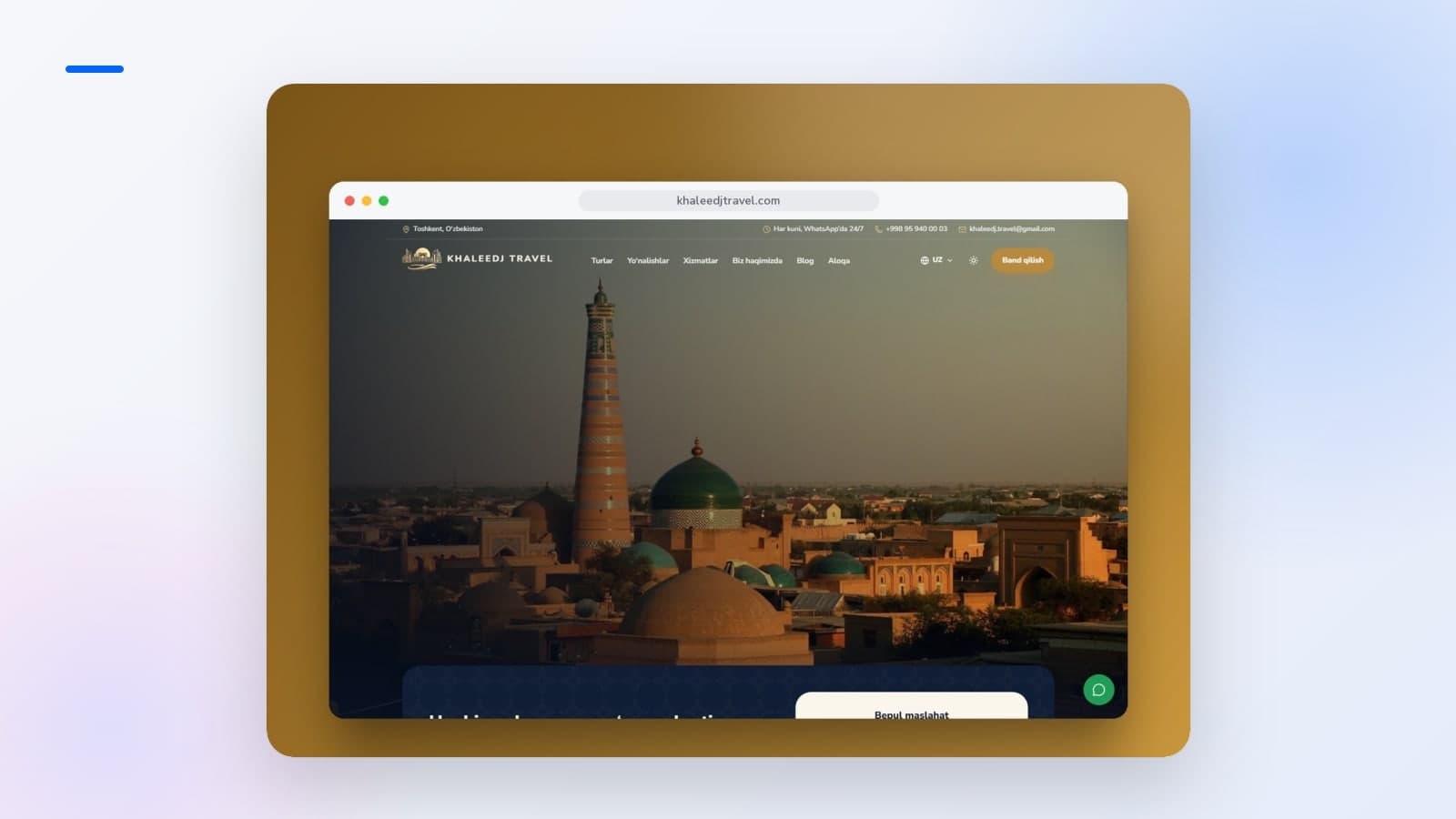
On our own projects, we prioritize making multilingual management simple for our clients' in-house teams. When building the corporate website for accounting outsourcing firm Financify, we set up independent content controls for service pages, tax schedules, and the blog in Uzbek, Russian, and English directly in the CMS. For travel company Khaleedj Travel, the tour catalog runs across five languages—including Uzbek and Arabic with right-to-left layout support—while incoming booking requests from all versions are sent straight to managers via Telegram.
Frequently Asked Questions
Why do Uzbek users search for products in Cyrillic?
A significant portion of purchasing-age adults is accustomed to Cyrillic keyboard layouts on desktop computers and smartphones. With up to 40–50% of search queries typed in Cyrillic, your meta tags and snippets should naturally incorporate both scripts.
Does the Google Translate plugin help with SEO?
No. Client-side translation scripts do not generate physical pages with unique URLs. Search crawlers only read your default server HTML, meaning translated content will never be indexed.
What is the correct language code for the Uzbek version in hreflang?
The standard language code is uz. If you are targeting users specifically within Uzbekistan, use uz-UZ. The key rule is reciprocity: your Uzbek page must link to the Russian equivalent, and the Russian page must link directly back.
How long does it take for an Uzbek site version to rank well on Google?
With sound technical optimization, the first organic visits typically arrive within 3–4 weeks of indexing, as seen on local projects. Earning stable top rankings in competitive niches usually takes at least three months.
If you are planning a multilingual project or want to establish a steady stream of Uzbek-speaking customers without rebuilding your existing platform, explore our corporate website development services or drop us a line via our contacts page.
Sources
- METERS.UZ · mxmedia.uz
- UZMALL · pickles.team
- SEO xizmati narxi 2026 — Toshkentda sayt ilgarilatish qancha turadi — NDC
- Мультиязычность — это не кнопка «перевести»: техническая структура сайта в Узбекистане — Guard-IT
- Продвижение сайта в Ташкенте: два языка, две поисковые системы — 101Digital
- Сайт на узбекском, русском и английском: как сделать многоязычность правильно — Esys Pro
- premium.uz