Your Own Website vs. Uzum Market: What to Choose for Sales in Uzbekistan
We compare launching a store on Uzum Market with building your own e-commerce website: commission rates, acquiring fees, customer data ownership, and payback periods.
For a quick start with minimal upfront investment, retail businesses in Uzbekistan often find it easier to launch on Uzum Market, which offers established logistics and an existing flow of buyers. Running an independent online store is more profitable for companies with high repeat purchases, broad catalogs, custom products, or B2B operations, where marketplace fees start eating away at profit margins. Developing a standard turnkey online store costs between 8,000,000 and 15,000,000 UZS (so'm), while launching a custom project takes 14 to 30 business days.
In brief
- Uzum Market takes a 3% to 35% commission on every sale plus a fixed delivery fee ranging from 2,000 to 20,000 UZS (so'm) per item.
- On your own website, you pay only payment gateway fees: processors like Click, Payme, or Uzum Pay charge 1.5–2.0% per transaction.
- The marketplace provides an established network of over 2,100 pickup points across 626 settlements, but it retains ownership of all customer data.
- An independent website requires spending on advertising and delivery logistics, but it protects your business from price wars and sudden account bans.
- The optimal strategy for mature retailers is omnichannel: selling on the marketplace while simultaneously building their own digital storefront.
Comparing both channels: marketplace vs. independent website
When a business decides to sell online, the choice usually comes down to two paths: register as a seller on a major platform or launch a branded website. These channels are not mutually exclusive, but they serve different goals and entail distinct cost structures.
| Parameter | Uzum Market | Independent Online Store |
|---|---|---|
| Initial IT investment | 0 UZS (so'm) (free registration) | From 8,000,000 to 15,000,000 UZS (so'm) for a turnkey solution; from 36,000,000 UZS (so'm) for custom development (Alfalab) |
| Launch timeline | 1–3 days for registration and product listings | From 14 to 30 business days (Alfalab) |
| Commission per sale | From 3% to 35% by category + a delivery fee of 2,000–20,000 UZS (so'm) (Spot.uz) | 1.5–2.0% for online payment processing (Payme, Click, Uzum Pay) (Spot.uz) |
| Basic infrastructure | Included under platform terms | .UZ domain: 25,000–35,000 UZS (so'm)/year; hosting: 40,000–150,000 UZS (so'm)/month (Spot.uz) |
| Logistics and fulfillment | Over 2,100 pickup points across 626 settlements (skillbox.ru) | In-house couriers or contracts with delivery providers (Yandex, BTS, Fargo) |
| Customer database | Owned by the marketplace | Fully owned by you (CRM, direct marketing) |
Unit economics: where margins get squeezed
The single largest recurring expense on a marketplace is the take rate on each transaction. Under the tariff structure effective since May 1, 2024, Uzum Market commissions range from 3% to 35% depending on the category, plus a per-item fulfillment fee between 2,000 and 20,000 UZS (so'm) (Spot.uz). If you sell an item for 100,000 UZS (so'm) in a 20% commission bracket with a 5,000 UZS (so'm) fulfillment charge, the platform retains 25,000 UZS (so'm) on every single unit.
With an independent online store, acquiring through Click, Payme, or Uzum Pay takes only 1.5–2.0% per transaction with no category-based markups (Spot.uz). A .UZ domain costs around 25,000–35,000 UZS (so'm) per year, and reliable local hosting runs from 40,000 to 150,000 UZS (so'm) per month (Spot.uz). However, an independent site shifts costs into customer acquisition: you must budget for search advertising via Google or Yandex and targeted ads on social channels to bring shoppers to your checkout funnel.
There is also a legal and tax consideration. Once an enterprise in Uzbekistan hits 1 billion UZS (so'm) in annual revenue, it is mandated to transition from the simplified turnover tax (4%) to the general tax regime with 12% VAT and a 15% corporate profit tax (Spot.uz). Because all sales on Uzum Market generate direct fiscal records, sellers cross the 1 billion UZS (so'm) threshold much faster than traditional brick-and-mortar retailers, making early margin modeling essential.
Customer base and brand control
On a marketplace, the buyer views themselves as a customer of the platform, not of your brand. You cannot re-engage them with targeted offers, send repeat purchase reminders via Telegram, or enroll them into your proprietary loyalty scheme. What is more, competing offers appear directly below your listings, routinely dragging you into margin-crushing price wars.
On your own website, you own the entire customer experience. You retain contact details, purchase history, and average order value metrics. For recurring consumption categories—such as cosmetics, pet food, baby products, or specialty coffee—repeat orders driven through your website cost a fraction of marketplace sales because you no longer pay to acquire that customer twice.
If you are just starting
If you are testing an unproven product with limited capital and little digital marketing experience, pouring your budget into custom software development right away rarely makes sense.
- Test demand on an existing audience. Sign up for Uzum Market, set up 5–10 product cards, and send in a trial batch. This will show you whether there is real market appetite and what your actual unit economics look like after platform deductions.
- Save on initial infrastructure. You do not need dedicated couriers, website maintenance, or complex merchant agreements on day one. The marketplace manages storage, pickup points, and payment handling for you.
- Channel your capital into inventory. The minimum budget required to start on a marketplace is simply the cost of your test batch and its packaging. If a product fails to sell, you only lose the time spent creating cards, not an entire IT development budget.
A real case: rapid growth without storefront costs
Kokand-based diaper brand Pipitto initially struggled to secure distribution in legacy retail chains and lacked the capital for a large-scale e-commerce platform and national ad campaigns (Spot.uz). In May 2023, the team opened a storefront on Uzum Market with an initial trial shipment worth just $200 (40 packs), relying on the marketplace's internal promotional tools (Spot.uz).
That initial batch quickly scaled into steady shipments of two Gazelle cargo trucks per month, earned Pipitto category-leading status, and enabled them to establish their own fulfillment center in Tashkent (Spot.uz).
If your business is already running
Companies with established sales volume, their own warehousing, or offline retail locations inevitably hit a ceiling on marketplaces: steep commissions erode net profits, while platform rules and fees can shift without notice. At this stage, developing an independent sales channel becomes a critical risk mitigation measure.
- Audit your product line. Identify your high-margin items and products with natural repeat demand. Migrating these SKUs to your own store is far more profitable, as payment processing fees take only 1.5–2.0% (Spot.uz).
- Launch a dedicated online store or digital catalog. Standard retail needs can be met by turnkey platforms for 8,000,000–15,000,000 UZS (so'm). Complex catalog hierarchies and B2B ordering require custom e-commerce website development, which in Tashkent begins at 36,000,000 UZS (so'm) with a delivery timeline of 14–30 business days (Alfalab). In our experience at NDC, this step calls for dedicated UX/UI design for websites and apps with a mobile-first focus, since over 80% of online purchases across Uzbekistan originate on smartphones.
- Integrate your catalog with inventory software. Set up automated two-way synchronization with 1C or platforms like MoySklad so stock levels reflect accurately without manual data entry from Excel sheets.
- Turn one-time marketplace buyers into repeat brand customers. Include package inserts and branded flyers with exclusive promo codes in marketplace orders to incentivize direct reorders via your own store.
A real case: scaling retail through an omnichannel model
Electronics retailer interBrands began as a brick-and-mortar shop in Tashkent’s Malika market and eventually hit a growth ceiling dictated by physical foot traffic (Spot.uz). Rather than investing heavily in a private courier fleet, the company joined Uzum Market in August 2022, listing goods directly from store shelves (Spot.uz). By synchronizing inventory across online and physical stores, the retailer grew to 16 branded shops on the platform, turning digital commerce into one of its primary revenue drivers (Spot.uz).
A real case from NDC: catalog with shopping cart for a manufacturer
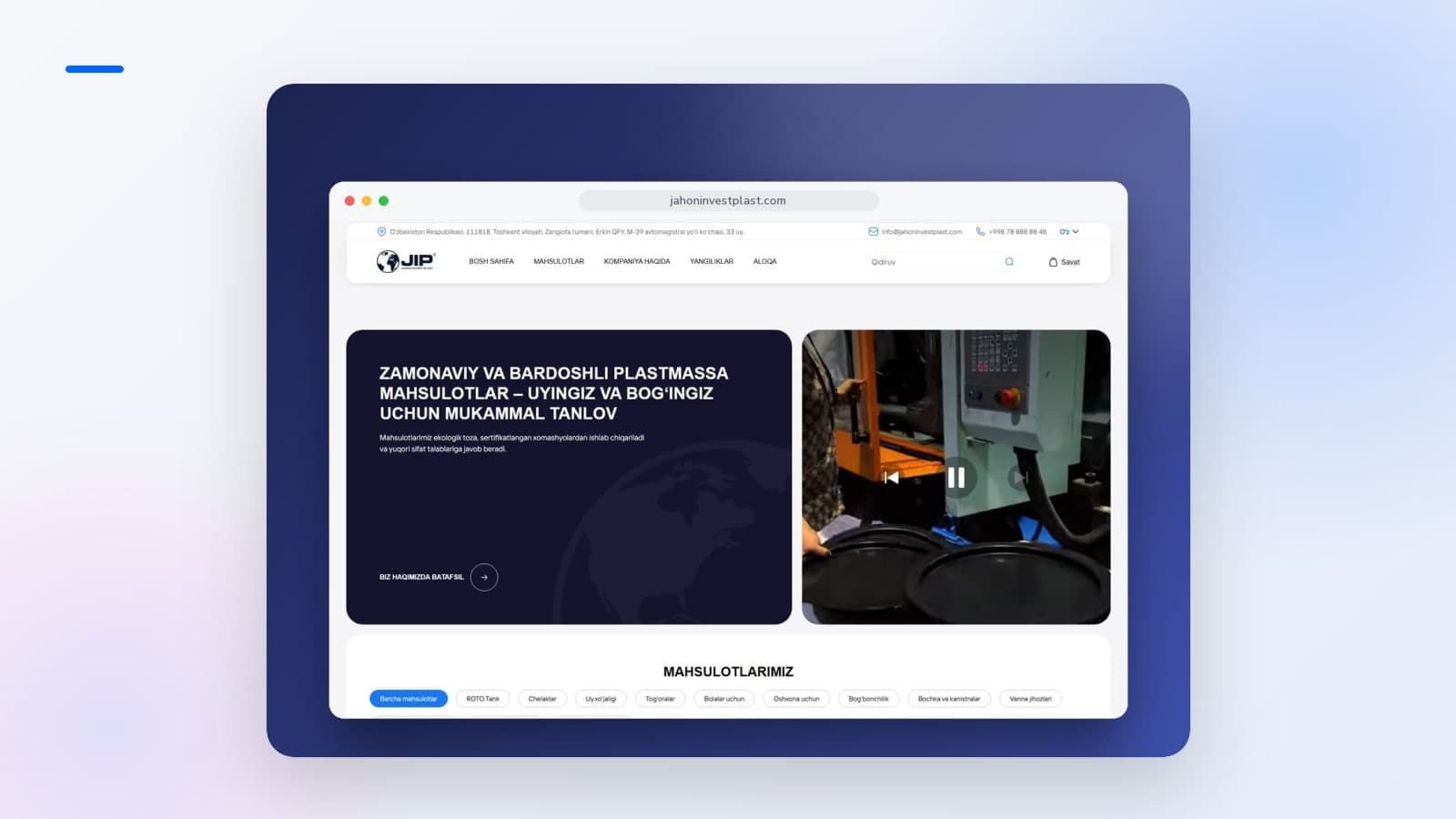
When product lines serve both wholesale buyers and retail customers ordering various batch volumes, standard marketplace structures fall short. For Jahon Invest Plast, a manufacturer of plastic goods for home, kitchen, and garden use, NDC designed a specialized catalog website with shopping cart functionality at jahoninvestplast.com. The company manufactures hundreds of items, ranging from small storage containers to outdoor furniture and industrial tanks. Wholesale and retail buyers needed clear visibility into dimensions, packaging units, and ordering steps in their preferred language. We deployed a multilingual catalog in Uzbek, Russian, and English that the client's internal team manages independently.
Specialized retail models frequently call for dedicated platforms. For example, on the Liboss project, the NDC team engineered a specialized marketplace mobile app for apparel on iOS and Android, complete with intuitive size filtering and vendor dashboards for live inventory management.
Frequently Asked Questions
Which is more profitable: a marketplace or an independent online store?
When starting out with smaller sales volumes, a marketplace is generally more cost-effective because you avoid upfront development expenses and advertising overhead. Once your monthly turnover reaches hundreds of millions of UZS (so'm), marketplace commissions of 3–35% begin to exceed the combined cost of website maintenance, acquiring (1.5–2%), and your own advertising, making an independent store significantly more profitable.
How much does it cost to launch an online store in Uzbekistan?
A basic e-commerce store built on a turnkey framework with Payme or Click integration runs between 8,000,000 and 15,000,000 UZS (so'm) (Alfalab). Custom website development featuring tailored architecture and 1C synchronization by agencies in Tashkent starts at 36,000,000 UZS (so'm) with a delivery timeline of 14 to 30 business days (Alfalab).
Can I sell on Uzum Market and my own website at the same time?
Yes, running both channels simultaneously is the most resilient model for an expanding business. The marketplace supplies an ongoing stream of new discovery traffic via its network of over 2,100 pickup points nationwide, while your independent website captures repeat orders without surrendering double-digit commissions.
If you are deciding whether your business is ready to build an independent web platform or should remain on third-party channels for now, reach out to us via our contacts. We will review your catalog structure, analyze your unit economics, and provide practical recommendations on the most profitable next step.
Sources
- Pipitto (производитель подгузников) · spot.uz
- interBrands (ритейлер электроники) · spot.uz
- С 1 мая Uzum Market перейдет к расчету комиссии по категориям товаров — Spot.uz
- Uzum Market sotuvchilar uchun komissiyalarni hisoblash mexanikasini o'zgartiradi — Uzum
- Цены на разработку сайтов и интернет-магазинов в Ташкенте — Alfalab
- Uzum taklifi: marketpleys sotuvchilari uchun QQS chegarasi — Spot.uz
- Sayt tayyorlash va tuzish narxlari Toshkentda — MXMedia
- skillbox.ru