How to Launch Lunch Delivery in Tashkent: OvqatGo Case Study
Using OvqatGo as an example, we break down how to launch lunch delivery in Tashkent: daily menus, kitchen delivery radiuses, online payments, and an Android app.
To set up lunch delivery for catering kitchens with rotating daily menus, businesses need a platform featuring fast daily item updates, customer geolocation filtering, and local payment acceptance. Based on our project experience, developing a specialized web service with local payment integrations takes 6 to 10 weeks, with a mobile app adding another 4–8 weeks.
Key Takeaways
- In Uzbekistan food service, ready-meal delivery accounts for 20–30% of all orders, according to Spot.uz.
- Commissions charged by general delivery aggregators in Tashkent reach 20–30% per order, per Alphacon.uz.
- Catering services can't rely on static catalogs: menus change every morning, and portions are cooked for specific lunch delivery windows.
- Geozones ensure customers only see kitchens capable of delivering hot meals to their area on time.
- Building your own service or niche marketplace pays off for recurring corporate and individual orders by eliminating heavy aggregator fees.
The Catering Challenge in Tashkent's Delivery Market
Tashkent's food delivery market is booming, yet small catering kitchens and home-style meal providers face serious friction on standard platforms. Mainstream aggregators are designed for restaurants with static menus and citywide delivery via a shared courier fleet. For homemade food kitchens and caterers, this model often falls short.
First, commissions from major Tashkent aggregators range from 20% to 28–30% per check (Alphacon.uz). With the modest margins on set business lunches, giving away a third of revenue eats up all profit. Second, catering menus change every morning: today it's mastava and plov, tomorrow meatball soup and mashed potatoes. Manually updating aggregator catalogs through lengthy moderation queues is unfeasible. Third, small commercial kitchens struggle with food quality control when couriers haul orders across the city during peak rush hours. Each kitchen needs a strict operating radius around its location.
What We Built: The OvqatGo Project
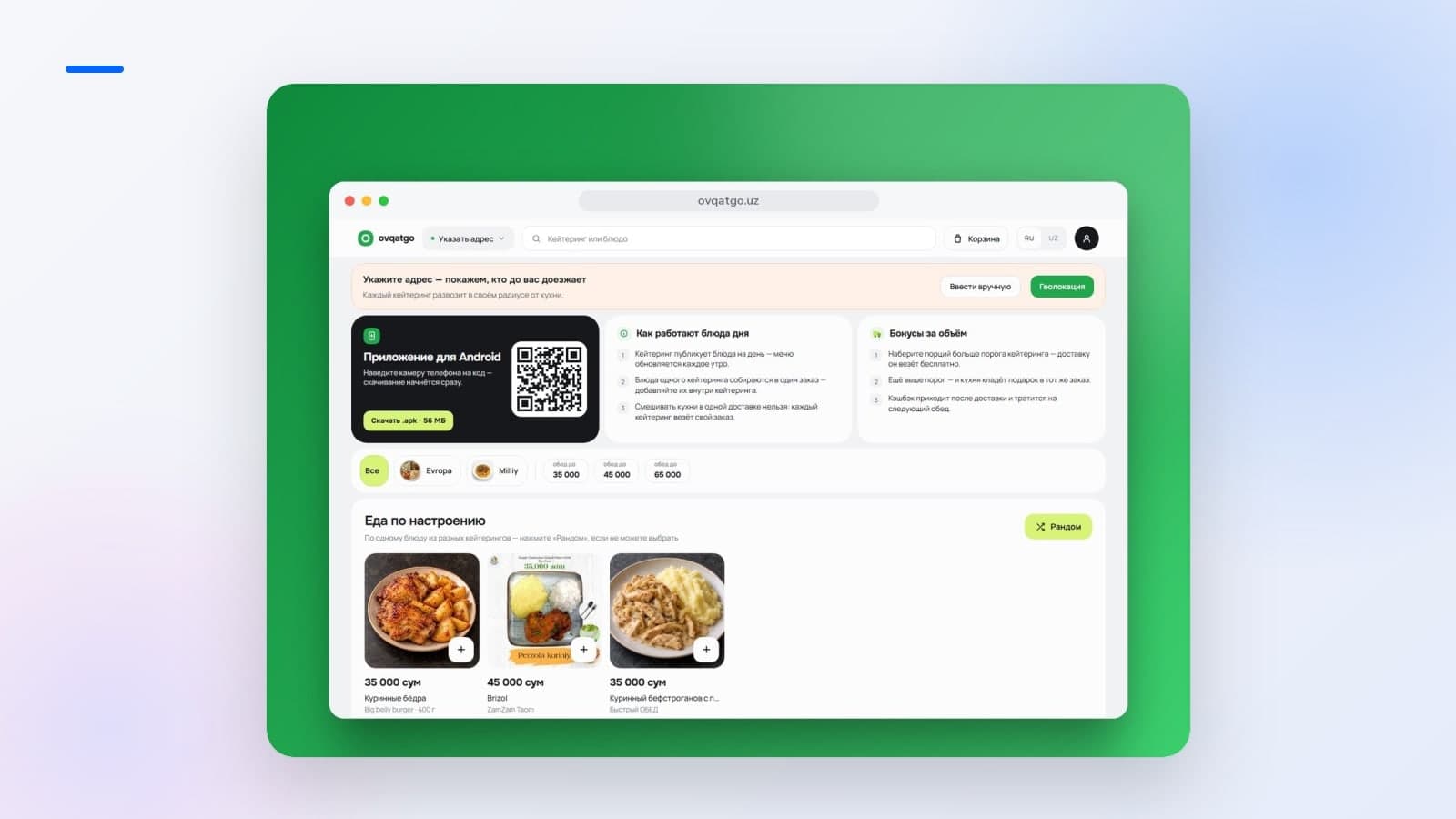
To tackle these challenges, the NDC team built a proprietary product: OvqatGo. It is a specialized lunch delivery marketplace in Tashkent tailored specifically for home-style kitchens and catering providers.
The platform runs in two languages (Uzbek and Russian) across two channels: a responsive website and a customer Android app. Here is how the service operates on ovqatgo.uz:
- Kitchen portals: Chefs or kitchen managers publish the daily menu in just a few clicks each morning and specify available portion caps.
- Geolocation and delivery radiuses: Each kitchen outlines its own delivery perimeter. Customers drop a pin or enter their address and see only the kitchens capable of delivering to their exact location.
- Smooth cart and checkout: Customers assemble their lunch combos (soups, mains, salads) and select payment via Payme, Click, or cash on delivery.
This approach protects kitchens from out-of-reach orders while guaranteeing customers receive hot meals right on time for their lunch break.
Own Platform, Aggregator, or Telegram Bot: Comparing the Options
Entrepreneurs planning to start lunch delivery in the capital typically evaluate three routes: joining aggregators, launching a simple bot, or building a custom platform. Here is how they stack up:
| Parameter | Major Aggregators | Telegram Bot | Custom Marketplace / Website |
|---|---|---|---|
| Order commission | 20–30% per check (Alphacon.uz) | 0% (standard 1–2% acquiring only) | 0% (standard 1–2% acquiring only) |
| Rotating daily menu | Difficult, slow moderation | Yes, via admin panel | Yes, flexible meal scheduling |
| Delivery radiuses | Aggregator-defined zones | Manual address check only | Automated pin-based calculation |
| Launch timeline | 1–3 weeks for moderation | 2–4 weeks (based on NDC experience) | 6–12 weeks (based on NDC experience) |
| Best suited for | Restaurants with fixed menus | Single kitchens with a Telegram user base | Catering networks and delivery services |
In our experience, if you run a single kitchen serving a dozen nearby offices, a basic bot or simple website section will do. But if you want to unite multiple kitchens, cover the entire city district by district, and build a scalable brand, you need dedicated infrastructure. In these cases, we build custom web platforms using corporate websites with complex business logic or launch native mobile applications.
Steps to Launching a Food Delivery Service
Setting up the technical infrastructure for a lunch delivery service involves four key steps:
- Designing order logic and delivery windows. Lunch delivery operates on strict schedules (typically 12:00 PM to 2:00 PM). The system must close same-day order acceptance on time and support pre-orders for the next day.
- Configuring geolocation and kitchen radiuses. System algorithms calculate distances from preparation points to customer locations, filtering out unfulfillable orders before checkout.
- Integrating payment gateways. Connecting national payment systems Payme and Click with automated fiscal receipt generation.
- Testing kitchen and courier workflows. Ensuring fast status updates: "accepted," "cooking," "dispatched." At this stage, integrating a CRM and business automation module helps managers avoid tracking orders on paper.
Common Mistakes When Starting a Lunch Delivery Business
We routinely encounter the same missteps in new food service ventures:
- No cutoff time for incoming orders. If a customer orders a combo lunch at 1:40 PM, the kitchen simply cannot prepare and deliver it on time. Rigid ordering cutoff windows are essential.
- Starting with an oversized delivery radius. Trying to dispatch orders from Chilanzar to Yunusabad using in-house couriers during peak lunch traffic leads to cold food and cancellations.
- Overlooking mobile users. Over 80% of office workers order from their smartphones. The mobile web interface must be as fast and responsive as a standalone app.
Frequently Asked Questions
How much does food delivery website development cost in Tashkent?
The cost depends on scope: vendor portals, courier delivery radiuses, payment acquiring integration. Based on our team's project experience, building a functional food delivery website or full e-commerce store starts at 20–25 million UZS (so'm) (at 2024–2025 pricing), while complex multi-vendor marketplaces with mobile apps are quoted individually.
Why does a lunch delivery service need its own Android app?
The app saves customer addresses and payment cards while sending free push notifications when today's daily menu goes live. Users don't have to log in repeatedly via a browser—reordering lunch to their office takes under 30 seconds.
How do catering kitchens update their menus daily?
In the OvqatGo project, we created a streamlined management dashboard: a chef or manager accesses the panel from a phone or laptop, selects today's prepared items with checkboxes, sets available portions, and taps "Publish." The dishes instantly appear in the catalog for customers within the delivery zone.
If you are planning to launch a lunch delivery service or build a dedicated platform in Tashkent, reach out via our contacts page. We will analyze your business model, help you avoid unnecessary launch costs, and tailor the right technical solution.