How to Order a Website in Tashkent: From Scope and Contract to Launch
A step-by-step guide to working with a web agency in Uzbekistan: defining requirements, secure milestone payments, IP transfer, and phased acceptance.
To successfully commission a website in Tashkent and launch on schedule before your peak season, your business needs a transparent roadmap: a well-defined technical scope, a solid contract transferring all intellectual property rights, and a phased payment schedule. On average, market launch times range from 7–14 business days for a landing page to 20–45 business days for an e-commerce store, with budgets scaling based on site architecture and third-party integrations.
Key Takeaways
- Custom web development rates in Tashkent start from 3,000,000 UZS (so'm) for landing pages and reach 25,000,000+ UZS (so'm) for online stores.
- The safest payment framework is milestone-based: 30% upfront, 40% after frontend build and backend integrations, and 30% upon final acceptance.
- Exclusive rights to code and design mockups remain with the contractor unless an explicit transfer clause is written into the contract under Article 1035 of the Civil Code of the Republic of Uzbekistan.
- Always register your .UZ domain name and hosting under your own legal entity or passport, never in the developer's name.
How Much Does Web Development Cost and How Long Does It Take?
Development costs among local agencies depend on project format, page volume, and third-party system integrations. According to market data from Innosoft, baseline pricing falls into three standard tiers:
| Project Type | Tashkent Market Rate | Turnaround Time | Best Suited For |
|---|---|---|---|
| Landing Page | From 3,000,000 to 6,000,000 UZS (so'm) | 7–14 business days | Single product launches, testing demand, marketing promos |
| Corporate Website | From 7,000,000 to 15,500,000 UZS (so'm) | 15–30 business days | B2B companies, manufacturers, service providers, multi-language sites |
| E-commerce Store with Integrations | From 12,000,000 to 25,000,000+ UZS (so'm) | 20–45 business days | Retail sales featuring digital catalogs and online payments |
According to agency data from iCORP, standard local delivery timelines range from 7–14 business days for landing pages to 20–45 business days for feature-rich online stores with complex catalogs. In our experience, schedule overruns are almost always caused by delays in delivering text copy, product photography, or timely feedback from the client's side.
Step 1. Defining Requirements and Initial Technical Scope
A technical brief is not a generic wish list; it is a clear record of how your site must function. Before contacting an agency, outline the following essentials:
- Core business goal: direct lead generation, direct digital sales, or presenting complex B2B services.
- Page structure: catalog categories, blog, calculators, or dedicated corporate service pages.
- Language versions: websites in Uzbekistan generally require at least two language versions (Uzbek and Russian), often with an optional English version.
- Required integrations: analytics tools, local payment gateways, or ERP/inventory sync.
For complex platforms, it makes sense to commission standalone UX/UI design and wireframing first, allowing you to validate user flows before developers write any code.
Step 2. Drafting the Legal Contract and IP Transfer
A sound contract protects both your budget and your delivery milestones. In Uzbekistan, the biggest legal vulnerability for clients involves intellectual property ownership. Under Article 1035 of the Civil Code of the Republic of Uzbekistan, rights to intellectual property that are not explicitly assigned in writing are presumed retained by the author. This means: if your agreement lacks a specific clause assigning full exclusive property rights to you, the source code and visual assets remain the legal property of the agency or freelancer.
Essential clauses every contract must include:
- Explicit transfer of exclusive property rights to the source code, database architecture, and visual design assets upon signing the final acceptance certificate.
- Staged milestones with concrete completion dates and penalties for unapproved delays. Document signing can be streamlined through local electronic document management platforms, similar to our workflow design for Hesap.
- A post-launch warranty: developer-covered bug fixes and troubleshooting (typically covering 30 to 90 days after going live).
Step 3. Registering the Domain and Choosing Hosting
Never let an external vendor register your domain name through their personal or agency account. According to Eskiz.uz, an accredited registrar for the .UZ ccTLD, the domain must be registered directly to your corporate legal entity or the business owner's personal passport. If the domain is owned by an agency, you risk losing access to your brand's primary digital asset if you ever switch service providers.
Similarly, hosting accounts or local cloud servers in Uzbekistan should always be registered under your business name, granting developers temporary administrative credentials only.
Step 4. Development Milestones and Safe Payment Structure
Paying 100% upfront is a major liability for the business, yet working with zero advance payment is impractical for established agencies. As outlined in local industry benchmarks by iCORP, the standard, time-tested payment model relies on three installments:
- 30% advance: paid before architectural scoping, information layout, and wireframing commence.
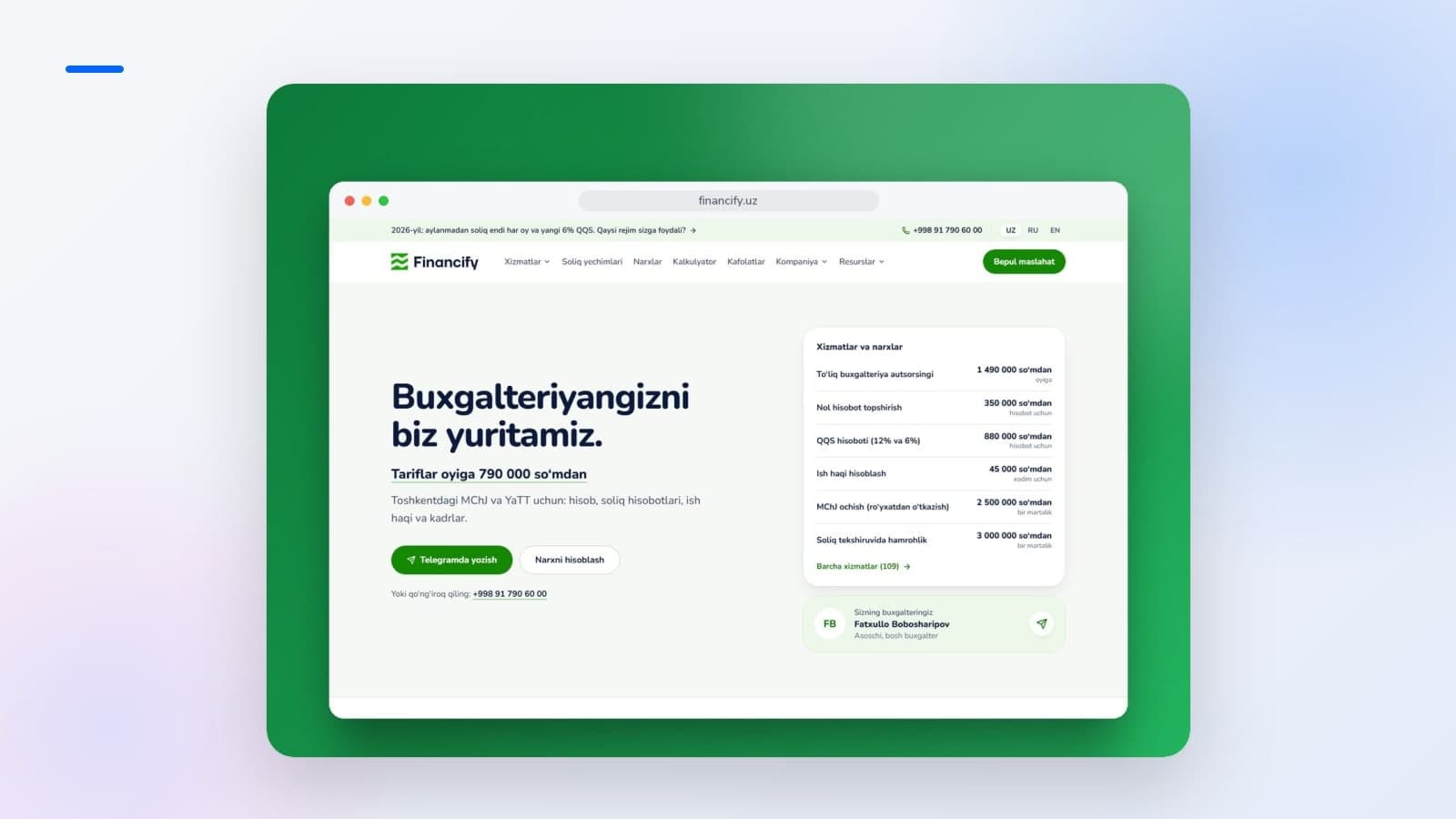
- 40% interim milestone: released after approving the final visual design, frontend markup, and content management system integrations. This is the exact staged model we used to build the platform for Financify.
- 30% final balance: paid strictly after the site is deployed to your live server, thoroughly tested, and signed off in the formal acceptance certificate.
Step 5. Quality Acceptance and Launch Checklist
Before signing the final acceptance certificate, audit your project against this operational checklist:
- Responsiveness: test the site across smartphones of varying screen sizes. Navigation menus, action buttons, and contact forms must stay perfectly aligned.
- Lead forms: submit test inquiries across every contact form and confirm that alerts route instantly to your corporate email or Telegram bot.
- Localization: ensure that text and product data do not break when switching between languages, as executed on our project for Khaleedj Travel.
- Load speed: verify that pages open rapidly even over mobile networks in Uzbekistan.
- Asset handoff: make sure you receive full CMS superadmin rights, source Figma UI files, hosting credentials, and access to the Git source code repository.
If your enterprise needs a platform to support corporate procurement and partner tenders, explore how scalable corporate websites are built for manufacturing and industrial distribution, as demonstrated in our case study for Precision Technology.
Frequently Asked Questions
How much does it cost to build a website in Tashkent?
Market rates for custom development across Tashkent web studios typically range from 3,000,000 to 6,000,000 UZS (so'm) for landing pages, from 7,000,000 to 15,500,000 UZS (so'm) for corporate websites, and from 12,000,000 to 25,000,000+ UZS (so'm) for online stores with inventory catalogs.
Who owns the website code after delivery?
Under Article 1035 of the Civil Code of the Republic of Uzbekistan, all intellectual property rights not explicitly transferred in writing remain with the developer. To own your website and source code outright, your agreement must contain an explicit clause transferring exclusive rights to your company.
Who should own the .UZ domain name registration?
A .UZ domain name must be registered strictly in your company's legal name or to the business founder's personal passport. Registering it under an agency's personal account puts your company at risk of losing domain ownership if a dispute arises.
How long does custom website development take from scratch?
Standard delivery timelines across Tashkent agencies range from 7–14 business days for a landing page to 20–45 business days for a complete e-commerce store. Actual delivery schedules depend heavily on how quickly the client provides source copy, images, and review feedback.
If you are planning an upcoming project and want to review technical architecture, estimates, or legal contracting terms without unexpected costs, get in touch with us via our contacts page.