Manufacturing Accounting in Uzbekistan: MoySklad, 1C:UNF, or 1C:ERP
We compare three production accounting systems for workshops and factories in Uzbekistan: cloud-based MoySklad, 1C:Company Management (UNF), and 1C:ERP. A detailed breakdown of features, implementation timelines, and pricing in UZS.
For a small assembly workshop in Uzbekistan, MoySklad is enough. A mid-sized business with several production stages and piece-rate pay needs 1C:Company Management (UNF), and a large plant with continuous production lines needs 1C:ERP. A basic launch starts at 10.2 million soums for a cloud service and runs to hundreds of millions of soums for a full-scale ERP rollout. Implementation takes anywhere from two weeks to six months.
In brief
- MoySklad suits simple assembly and packing operations without complex routing. The Production module costs 196 000 soums per month.
- 1C:Company Management 8 for Uzbekistan covers job-order costing, bills of materials and piece-rate payroll. Licences start at 4 814 000 soums per user.
- 1C:ERP is necessary when overheads must be allocated across workshops and production is planned across multiple stages. Licences start at 106 390 000 soums.
- Raw-material write-offs and actual cost calculation are governed by NAS No. 4 and accounts 2010, 2510 and 2610.
Comparing MoySklad, 1C:UNF and 1C:ERP
When a production business outgrows notebooks and Excel spreadsheets, the key is not to overpay for functionality you will not use. The software should do one job well: show the real unit cost of your product, taking into account scrap, raw materials and the piece-rate labour of your craftsmen.
| Criterion | MoySklad | 1C:Company Management (UNF) | 1C:ERP 2 |
|---|---|---|---|
| Type of business | Small workshop, packing, simple assembly | Workshop or factory with 10–100 workstations | Large plant, holding company, branch network |
| Software cost | From 196 000 soums/month for the production module | 4 814 000 soums (1 user) / 8 855 000 soums (5 users) | From 106 390 000 to 197 437 000 soums |
| Support and ITS | Included in the plan | From 1 484 500 soums for 6 months | Individual support agreement |
| Bills of materials and routings | Single-level production recipes | Multi-level bills of materials, routing sheets | Parametric bills of materials, workshop schedules |
| Piece-rate pay | Basic payroll | Piece-rate work orders, tracking of craftsmen's output | Complex pay scales, team work orders |
| Launch time | 1–3 weeks | 1–2 months | From 6 months |
How cost calculation differs
The main difference between these systems is how deeply they track production costs. Under national accounting standards (lex.uz), a company must keep strict records of direct costs on account 2010 and assign production and general overheads to accounts 2510 and 2610.
- MoySklad calculates cost on a "materials plus a fixed overhead amount" basis. If one order takes longer to assemble than another, or a machine part breaks, the system cannot allocate those extra costs dynamically.
- 1C:Company Management supports job-order costing, lets you issue piece-rate work orders to workers, and includes actual electricity or workshop rental costs in the cost of a specific batch (1solution.uz).
- 1C:ERP allocates costs across semi-finished products from different production stages, and accounts for equipment downtime, scrap at each stage and the standard labour intensity of technological operations (1cba.uz).
If you are just starting out
If you have a single workshop, a standard product range and up to 10 employees, there is no need to buy a heavyweight accounting suite. Surplus interface fields will only slow your team down.
- Digitise your bills of materials. Record in a table the exact consumption rates of raw materials and packaging per unit of finished product.
- Choose a simple solution. Connect a cloud service. According to moysklad.uz, the production module costs 196 000 soums per month, while basic setup by integrators starts at 10.2 million soums ($800), with a launch time of 1–2 weeks.
- Connect inventory and orders. To stop your sales team from selling products for which there is no raw material, it helps to set up an online storefront or launch an online store development project with a catalogue of your products.
Case study: an order storefront for a packaging manufacturer
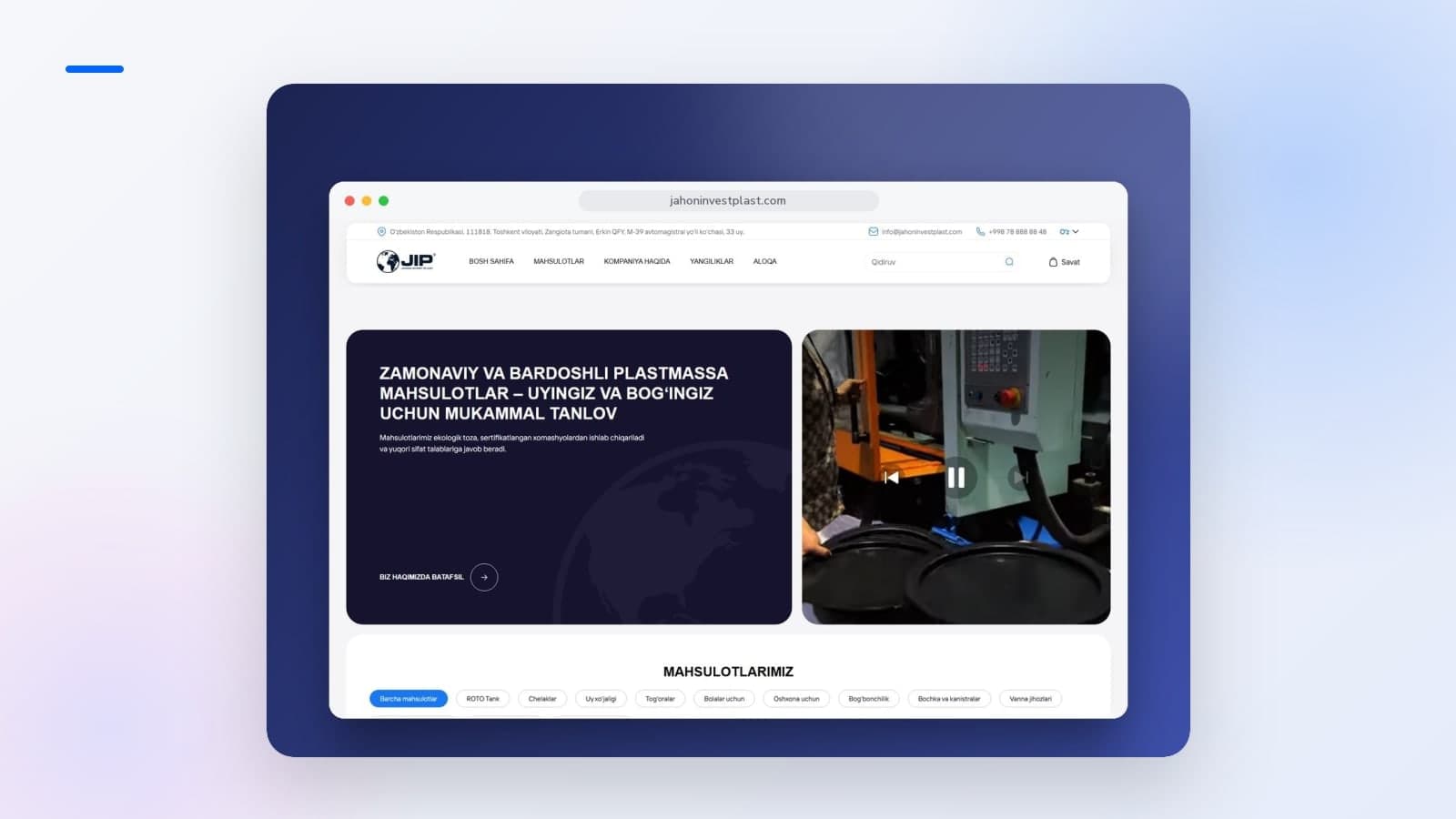
Jahon Invest Plast, a manufacturer of plastic products for home and garden, needed a convenient way to take orders across hundreds of items. The NDC team developed a catalogue website with product cards, packaging details and a shopping cart in Uzbek, Russian and English. It spared managers from sending price lists by hand and sped up the handover of completed orders to the warehouse and production. See the project: Jahon Invest Plast.
If your business is already up and running
Once a factory has several divisions (for example, a machining shop, casting, painting and an assembly area), "pooled" cost accounting leads to financial losses. Management cannot tell which order brought a profit and which ran at a loss because of material overuse.
- Switch to job-order planning. Record the transfer of semi-finished products between workshops through internal transfer notes.
- Buy the localised version of 1C. The 1C:Company Management 8 for Uzbekistan package for 5 workstations costs 8 855 000 soums (1solution.uz). Updates to reporting forms require an ITS subscription, which costs 2 842 000 soums per year.
- Automate shift work-order tracking. Replace manual logbooks with piece-rate work orders, so that pay is calculated on the actual output of good products. To coordinate logistics and customer requests, companies often also introduce a full CRM development and implementation project.
Case study: KY PNEUMATIC
KY PNEUMATIC, a manufacturer of furniture hardware, grew from a single small workshop into five divisions: machining, laser cutting, plastic moulding, assembly and a central warehouse. The growth led to cash gaps, because it was impossible to calculate the cost of products accurately at each production stage (1c.ru). The company implemented 1C:Company Management, configuring production recipes, raw-material write-offs by workshop and automatic calculation of craftsmen's piece-rate pay. As a result, all five workshops now run in a single database, and the company gets an accurate actual cost for every product it makes.
Case study: Uzcotton textile production
Uzcotton faced discrepancies between warehouse stocks of yarn and finished knitwear, as well as difficulties with batches and the traceability of labelled products (alexrovich.ru). The plant moved its production and warehouse operations to a comprehensive ERP system, with bin-level storage and batch accounting of raw materials. This eliminated duplicated operations between the workshops and the dispatch warehouse and made batch picking error-free.
Common mistakes in production automation
- Implementing 1C:ERP "for future growth". Buying software priced from 106 390 000 soums (1cba.uz) for a 15-person workshop paralyses the business. Implementation takes six months or more, requires dedicated specialists and wastes budget.
- Ignoring write-off norms. If production has no approved bills of materials with a technological loss percentage, no software will show a correct cost.
- A gap between sales and the workshop. When orders are collected in Telegram while production goes its own way, shipment deadlines slip. To manage the flow of customers, the accounting system needs to be connected to your website, where corporate website development with personal customer accounts is a useful addition.
Frequently asked questions
What is the difference between 1C:Accounting and 1C:UNF for manufacturing?
1C:Accounting is built for statutory accounting and tax reporting under Uzbekistan's standards. It is not well suited to planning machine load, issuing shift tasks or keeping operational job-order records. 1C:UNF (Company Management) is aimed at managers: it calculates the margin of each order, piece-rate pay and stock of materials in real time.
Is MoySklad enough for textile or garment production?
MoySklad suits a small tailoring studio or sewing workshop with standard cutting. But if you need to track fabric by the roll with scrap control, keep batch records of trims by colour and size, and generate routing sheets for seamstresses, the service will no longer be enough and you will need to move to 1C:Company Management.
How long does it take to implement production accounting?
Based on our own projects and those of local integrators, a basic MoySklad launch for a small workshop takes 1 to 3 weeks. Setting up 1C:Company Management with production recipes and staff training usually takes 1 to 3 months. Comprehensive 1C:ERP projects at large enterprises take from 6 months to a year.
If you are choosing a system to automate your workshop or warehouse, get in touch via our contacts page. We will help you map your production chains, estimate costs and select the right configuration without overpaying.
Sources
- KY PNEUMATIC · 1c.ru
- Uzcotton · alexrovich.ru
- 1С:Управление компанией (1С:УНФ) для Узбекистана: возможности и цены
- Тарифы и опции облачного сервиса МойСклад в Узбекистане
- Цены на продукты и лицензии 1С в Узбекистане — Business Automatization
- Конфигурации 1С для Узбекистана: какую выбрать и сколько стоит в 2026
- Настройка учета производства в 1С:Бухгалтерия 8.3 в Узбекистане
- lex.uz