Web Studio or Freelancer in Tashkent: Which to Choose for Your Website
We examine 10 key questions for business owners: how much website development costs with freelancers vs agencies in Tashkent, contracting rules, and protecting source code.
To quickly launch a simple one-page site to test a business hypothesis in Tashkent, hiring an independent contractor is often enough. For a multi-page corporate portal or an online store, partnering with an agency is far more reliable. A basic landing page built by a freelancer costs between 2,000,000 and 5,000,000 UZS (so'm), whereas team-based agency development ranges from 8,000,000 to 50,000,000 UZS (so'm) with a delivery timeline of 3 to 6 weeks.
In brief
- A landing page built by a freelancer in Tashkent in 2026 costs 2,000,000 – 5,000,000 UZS (so'm), while a studio charges from 5,000,000 to 8,000,000 UZS (so'm).
- A corporate website from an agency costs 8,000,000 – 25,000,000 UZS (so'm), and an e-commerce store runs from 15,000,000 to 50,000,000 UZS (so'm).
- Official B2B payments to a freelancer require self-employed status registered via Soliq with an annual revenue cap of 100 million UZS (so'm), or individual entrepreneur status with closing documents processed through Didox.
- Over 70% of project failures with solo developers occur due to the lack of a team, missing complementary skills, and lost access to the source code repository.
10 Questions Business Owners Ask When Choosing a Contractor
1. What is the fundamental difference between a web studio and a freelancer?
A freelancer is a single professional attempting to juggle the roles of UI designer, front-end developer, backend programmer, and QA tester. An agency provides an assembled, specialized team where an art director, UI/UX designer, developers, and a dedicated project manager work in parallel. If a freelancer falls ill or takes another full-time job, your project grinds to a halt; an agency relies on documented processes and seamless task handoffs between in-house specialists.
2. How much do different types of websites cost in Tashkent in 2026?
According to analytical data from aivagroup.uz, developing a basic landing page with a freelancer costs on average 2,000,000 – 5,000,000 UZS (so'm), while studios charge starting from 5,000,000 to 8,000,000 UZS (so'm), including responsive layouts and baseline SEO setup. Turnkey corporate website development by an agency ranges between 8,000,000 and 25,000,000 UZS (so'm), whereas an online store with a full product catalog and integrated payment gateways costs from 15,000,000 to 50,000,000 UZS (so'm), based on benchmarks from orio.uz.
| Project Type | Freelancer (UZS (so'm)) | Web Studio (UZS (so'm)) | Timeline |
|---|---|---|---|
| Basic Landing Page | 2,000,000 – 5,000,000 | 5,000,000 – 8,000,000 | 1–2 weeks |
| Corporate Website | 5,000,000 – 12,000,000 | 8,000,000 – 25,000,000 | 3–6 weeks |
| Online Store (E-commerce) | 10,000,000 – 25,000,000 | 15,000,000 – 50,000,000 | 4–8 weeks |
3. How do you legally pay an independent contractor in Uzbekistan?
For your company to record web development as a legitimate business expense and reduce its taxable base, the freelancer must be legally registered. According to the legal portal kadry.uz, formal settlements between an Uzbek legal entity and an independent contractor require the specialist to be registered as self-employed via the Soliq app (with an annual income cap of up to 100 million UZS (so'm)) or as an individual entrepreneur (YTT). The contract, technical brief, and electronic invoices must be exchanged via Didox or Faktura.uz in compliance with the Tax Code of Uzbekistan and Law No. ZRU-1108. With digital agencies, corporate clients work via standard bank transfers with or without VAT.
4. What is the "bus factor" and why is it dangerous?
The bus factor measures the risk of your project stalling if a single key person becomes unavailable. According to digital agency markdev.uz, more than 70% of setbacks when working with solo freelancers stem directly from the absence of a team: a freelancer might abruptly stop responding, fail to hand over Git repository credentials, or struggle with complex catalog architecture. In a web studio, project assets and architecture reside securely on corporate servers, and the agency takes full responsibility for staff redundancy.
5. Who must own the code, server, and domain name?
All core infrastructure accounts must be registered under your business or company director. Always register your .UZ domain name and hosting accounts using your own legal credentials or passport details. The service contract must explicitly state that exclusive intellectual property rights to the source code and Figma master files transfer to the client upon signing the final acceptance certificate.
6. How do you maintain control over development stages?
Never pay 100% upfront. Based on our project experience at NDC, the ideal approach divides the scope into four logical milestones with tied interim payments:
- Discovery, prototyping, and site architecture (25%).
- UX/UI design for websites and apps with clickable prototype sign-off (25%).
- Frontend coding and CMS/backend integration on a staging server (25%).
- Content population, QA testing, server migration, and final acceptance certificate sign-off (25%).
7. Why do solo developers frequently miss deadlines?
A solo freelancer has to pitch new leads, handle client communication, create visual designs, and write code simultaneously. Any unexpected bug or technical roadblock throws off their entire calendar because there is no junior colleague to delegate routine tasks to. In an agency, a dedicated project manager actively oversees deadlines and protects project milestones.
8. What happens post-launch: warranties and maintenance?
Once live, any website requires ongoing security patches, routine backups, and gradual feature improvements. After receiving the final installment, solo contractors often move on to their next large gig and decline minor support requests. Studios formalize a post-launch warranty period in the agreement (typically 1 to 3 months) to fix hidden bugs at no extra charge, and provide structured monthly SLAs for technical maintenance.
9. Can you hire a freelancer for design and an agency for coding?
While this is a common practice, it often introduces hidden overhead. Freelance visual designers do not always understand technical development constraints and can create layouts that are unnecessarily complex or expensive to build. When an agency inherits external design files, it must spend billable hours auditing components and restructuring layout grids.
10. When is hiring a freelancer smarter than hiring an agency?
A freelancer is a practical choice when you need a standard page assembled on a website builder, need quick bug fixes on an existing site, or want to validate a new business concept before allocating substantial capital. For enterprise catalogs, tailored client portals, and integrated B2B workflows, choosing corporate website development with a structured team is the safer, more durable route.
If you are just starting
When testing a new business model, avoid sinking significant working capital into long, custom engineering cycles. Your initial objective is generating leads and validating demand with minimal overhead.
- Define a single, compelling value proposition and compile your customers' most common questions into a clear brief.
- Hire a verified self-employed freelancer to build a clean landing page using a modern website builder. Budget 2,000,000 to 5,000,000 UZS (so'm) for this stage, with a targeted turnaround of 1–2 weeks.
- Route incoming order notifications directly into your corporate Telegram group, set up targeted search ads, and measure customer demand without complex back-office integrations.
A real case: scaling from solo contracting to an agency
The founder of Monday Labs started out taking private website commissions for boutique hotels for $250–$400, managing every step from visual aesthetics to back-end logic alone. Hitting the natural ceiling of solo capacity and recognizing client demand for comprehensive products backed by corporate accountability, he transitioned to an agency model combining custom engineering and IT education. This shift led to the establishment of Monday Labs and the Monday Academy training center, as featured by spot.uz.
If your business is already running
An established company carrying extensive inventory and employing a sales team requires an enterprise-grade digital foundation integrated with internal ERPs and CRMs.
- Audit your existing product data: export live stock inventories from 1C or Excel sheets, organize comprehensive technical descriptions, and document standard operating procedures for incoming leads.
- Draft a detailed functional specification for a multi-page portal or product catalog with clear separation of duties: UI/UX design, frontend layout, database architecture, and SEO. Plan for a budget between 8,000,000 and 25,000,000 UZS (so'm) for a corporate site, or 15,000,000 to 50,000,000 UZS (so'm) for an e-commerce platform, allowing a delivery window of 3–6 weeks.
- Sign a corporate service agreement registered via Didox, detailing milestone payments and mandatory transfer of master source repositories to your internal Git environment.
A real case: an industrial equipment catalog
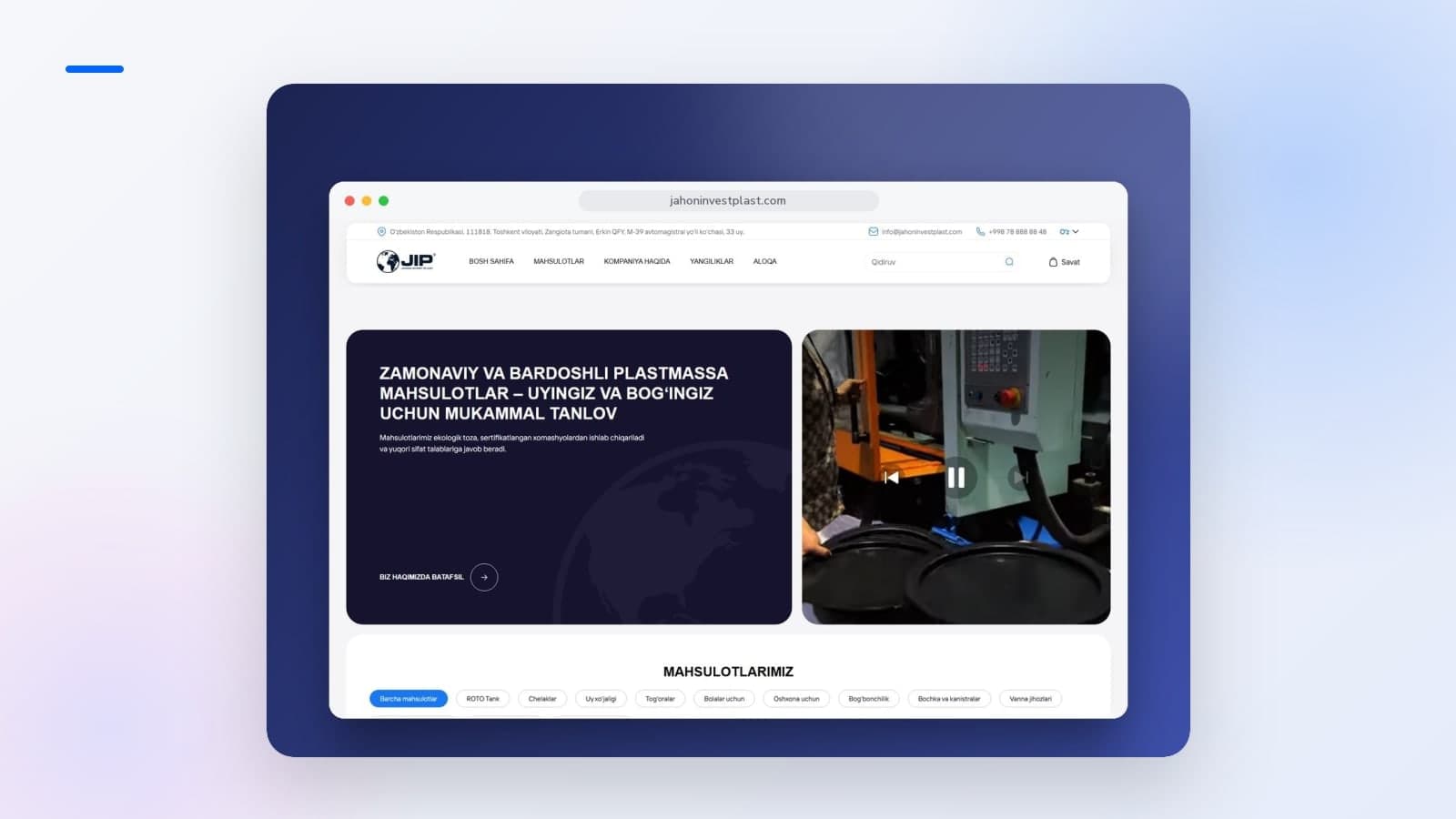
Tashkent industrial supplier Precision Technology equips manufacturing plants with CNC machinery, laser systems, specialized tools, and industrial software. Their product catalog is extensive—spanning metalworking machinery to precision testing equipment—serving industrial engineers and plant directors who need to quickly locate product lines and manufacturer brands. The NDC team designed and engineered the Precision Technology corporate website: we categorized the complex catalog by industrial sectors, segregated turnkey services, partner brands, and enterprise case studies into dedicated sections, and integrated an intuitive admin panel. Operating smoothly at ptech.uz, the website serves as a reliable inbound lead pipeline for wholesale factory procurement.
A real case: shifting from patchwork fixes to scalable e-commerce
Ikarvon, a prominent distributor of professional tools and machinery in Uzbekistan, realized that ad-hoc adjustments made by isolated freelancers were insufficient to support a catalog containing tens of thousands of SKUs. The enterprise engaged a dedicated digital studio to design and deploy a full-featured e-commerce platform equipped with faceted search, item filters, customer accounts, and real-time inventory synchronization. This strategic shift produced a dependable online store capable of processing orders seamlessly nationwide across Uzbekistan, as documented by alfalab.uz.
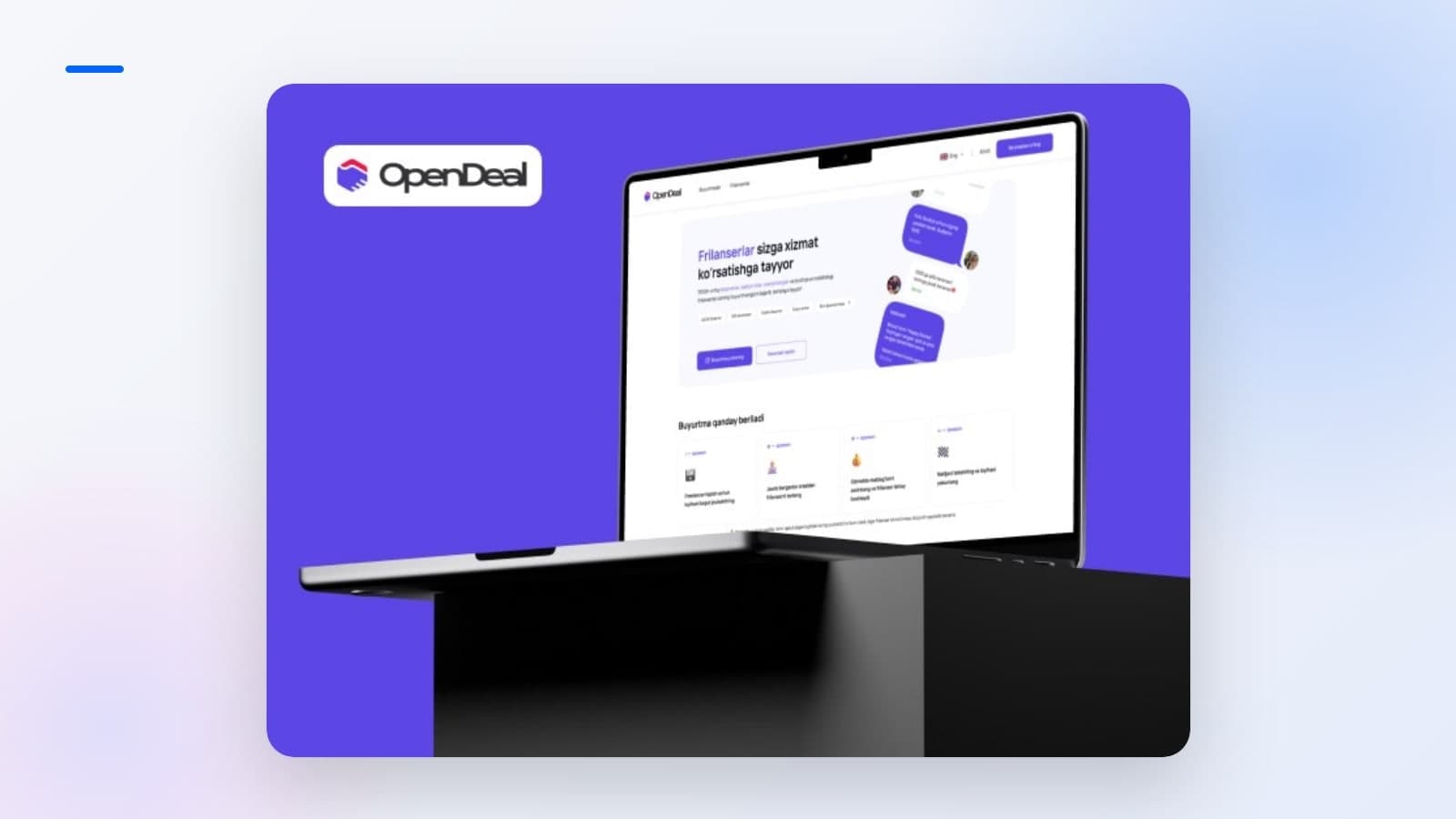
For platforms connecting clients and vendors, sound system architecture is equally vital. For instance, for the OpenDeal platform, the NDC team engineered and rolled out a complete freelance marketplace featuring separate account dashboards for clients and talent, an indexed service directory, and an internal moderation console.
Frequently Asked Questions
How can I safely pay an upfront deposit to a freelancer?
Never transfer funds directly to personal debit cards without supporting paperwork. Execute an electronic service agreement through Didox, verify the contractor's self-employed record via Soliq, and disburse payments in milestones tied to verifiable deliverables.
Is it cheaper to rebuild an old site with an agency or have a freelancer patch it?
If the legacy codebase is outdated and the original developer left no technical documentation, ongoing ad-hoc fixes frequently end up costing more than a clean rebuild. A ground-up build with a studio provides clean code architecture, reliable mobile responsiveness, and strong cybersecurity out of the box.
How long does an agency take to build a website?
A standard landing page is typically completed by an agency in 1–2 weeks. A multi-page corporate website takes 3 to 6 weeks, while a full e-commerce store with catalog filtering and online checkout takes 4 to 8 weeks. The majority of this time is dedicated to validating user flow, prototyping interfaces, and populating actual commercial product data.
If you are deciding on the best development format for your commercial goals, get in touch through our NDC contact form. We will provide an honest assessment of your project, suggest optimal architecture, and outline realistic delivery timelines.
Sources
- Ikarvon (Ikarvon.uz) · alfalab.uz
- Monday Labs / Monday Academy · spot.uz
- Цены на разные типы сайтов в 2026 году — Orio.uz
- Как выбрать веб-студию в Ташкенте: 10 вопросов подрядчику — AIVA Group
- В чём разница между студией и фрилансером при заказе сайта — Markdev.uz
- Самозанятые в Узбекистане: статус через Soliq, налоги и лимиты — Kadry.uz