Checklist: How to Launch an Online Store in Uzbekistan for the Peak Season
A step-by-step checklist for launching an online store in Uzbekistan: legal compliance, costs in UZS (so'm), payment gateways, and contractor questions.
To launch an online store in Uzbekistan in time for the high sales season, plan anywhere from 3–4 weeks for a turnkey CMS platform to 2–3 months for custom development with deep warehouse and ERP integration. A standard CMS store from Tashkent web agencies costs between 10,000,000 and 15,000,000 UZS (so'm), while custom turnkey solutions range from 30,000,000 to 40,000,000+ UZS (so'm), alongside an annual .UZ domain registration fee of 24,000 to 29,000 UZS (so'm). A smooth rollout hinges far less on writing code than on catalog preparation, legal compliance, and pre-launch stress testing before peak traffic hits.
Quick Take
- Registering a .UZ domain name costs 24,000 – 29,000 UZS (so'm) per year.
- A standard CMS store costs 10,000,000 – 15,000,000 UZS (so'm) (3–4 weeks), while a custom build starts at 30,000,000 – 40,000,000+ UZS (so'm) (2–3 months).
- Customer databases must be physically hosted within Uzbekistan under the requirements of Law No. ZRU-547.
- Preparing product photography, descriptions, and finalizing merchant acquiring contracts can take up to half the project timeline.
- Load testing before promotions go live is the only reliable way to ensure your site survives surges in simultaneous checkouts.
Choosing a Format: Turnkey Platform or Custom Development
Before kicking off development, take a realistic look at your catalog size and day-to-day business workflows. According to 2025–2026 market reviews by Tashkent agencies UProject and ITSpace, local web development budgets and turnaround times break down into two core tiers:
| Parameter | Store on an Existing CMS | Custom Build with Integrations |
|---|---|---|
| Cost | 10,000,000 to 15,000,000 UZS (so'm) | 30,000,000 to 40,000,000+ UZS (so'm) |
| Launch Timeline | 3–4 weeks | 2–3 months |
| Best For | Compact catalogs, standard cart flows, quick launch for an upcoming promo | Complex inventory, thousands of SKUs, bi-directional 1C and ERP sync |
| Store Management | Standard admin dashboard | Bespoke workflows tailored to internal operations |
If your immediate goal is to capitalize on a major sale next month, committing to full custom development is a massive risk. A smarter move is deploying a fast, lean store or ordering dedicated UX/UI design for key promotional landing pages first, leaving complex multi-tier supply chain automations for phase two.
1. Domain, Hosting, and Legal Compliance
Your technical infrastructure must not only deliver high speed, but also remain fully compliant within Uzbekistan's legal framework.
- .UZ Domain. Your official storefront address must be purchased through an accredited registrar. According to current pricing from Eskiz.uz, registering or renewing a domain for 2023–2026 runs between 24,000 and 29,000 UZS (so'm) per year.
- Customer Data Localization. Customers provide phone numbers, full names, and shipping addresses at checkout. Storing and processing this data is governed by the Law of the Republic of Uzbekistan "On Personal Data" No. ZRU-547, amended by Law No. ZRU-1125 dated March 26, 2026 (Articles 20 and 27-1), accessible via Lex.uz. The law explicitly requires server databases containing the personal data of Uzbek citizens to be physically located inside Uzbekistan and adhere to established cybersecurity standards.
- TAS-IX Hosting. Deploying your site within the local TAS-IX network ensures minimal latency and fast load times for shoppers browsing on mobile networks across Uzbekistan.
What you need to provide: Corporate registration documents (LLC or sole proprietorship certificate), director's passport copy, and company billing details so the domain and hosting are owned by your business, not a freelance developer.
Questions to ask your agency: "Where are your hosting servers physically located?", "Does this setup satisfy Law No. ZRU-547 regarding storing customer databases inside Uzbekistan?", "Are automated daily backups and a free SSL certificate included in the setup?"
2. Catalog, Content, and Architecture
Shoppers rarely leave an online store because of understated visual design; they leave when product specifications are missing, stock levels are outdated, or photos are poor.
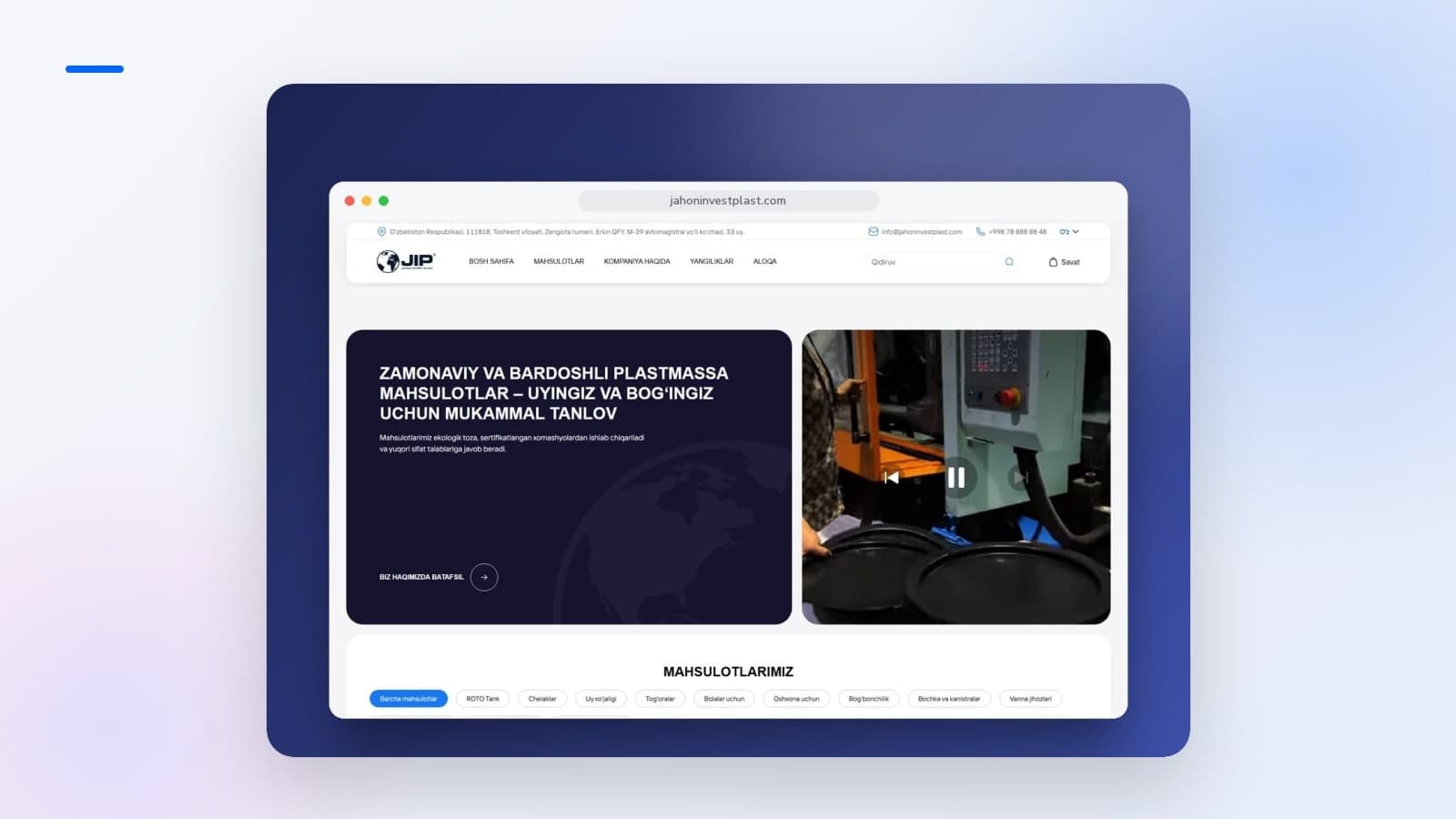
- Category Hierarchy. Build an intuitive navigation structure: no more than 3 clicks from the homepage to an individual product page. In our experience building the catalog for manufacturing brand Jahon Invest Plast, organizing items by application scenarios with clear faceted filters significantly shortens the path from search to checkout.
- Product Cards. Unified photography formatted in lightweight WebP (faster than standard JPEG), unique SKUs, precise dimensions, shipping weight, and selectable product variants (color, size).
- Multilingual Support. Uzbek and Russian language versions are standard practice for e-commerce in Uzbekistan. Translations of product names, UI labels, and cart notification templates should be ready before moving to the production server.
What you need to provide: A clean spreadsheet (Excel/CSV) containing SKUs, pricing, stock quantities, and specs; folders of optimized product images; and drafted copy for "About Us," "Returns Policy," and your "Public Offer" (Terms of Service).
Questions to ask your agency: "How does bulk catalog importing work—can our team update prices from a spreadsheet in 2 minutes?", "Are structured schema markup and search engine meta tags generated automatically for category and product pages?"
3. Payments and Fiscal Integration
When peak traffic arrives, customers should never encounter payment errors whether they use Uzcard, Humo, Visa, or Mastercard.
- Payment Gateways. Opening merchant accounts directly with payment providers like Payme, Click, and Uzum Pay involves corporate security vetting, which typically takes 3 to 10 business days.
- Fiscal Receipts and Online Cash Registers. For online card payments, your system must automatically issue a compliant digital fiscal receipt with a valid QR code in accordance with local tax regulations.
- Alternative Methods. Offering cash-on-delivery or card terminal payments upon courier arrival, as well as integrating popular buy-now-pay-later (BNPL) installment widgets.
What you need to provide: An active local corporate bank account, a digital signature key (ERI/EDS), and signed merchant acquiring agreements with your chosen payment gateways.
Questions to ask your agency: "Is fiscal receipt generation fully automated immediately upon successful payment authorization?", "What fallback screen does a customer see if their bank card is declined?", "How does the system handle partial and complete refunds?"
4. Fulfillment and Order Management
An e-commerce website is simply a storefront; real revenue only materializes when products arrive promptly at the customer's doorstep.
- Delivery Rates. Configurable flat rates within city limits, free shipping thresholds based on order value, or dynamic API rate calculations with partner courier fleets.
- Order Alerts. Instant push notifications sent to your team's internal Telegram bot for every new order, paired with automated transactional SMS updates for customers as delivery milestones change.
- Stock Inventory Sync. Real-time inventory reservation to prevent backorders on items that are physically out of stock.
What you need to provide: Warehouse picking and packing SOPs, delivery zone boundaries on the map, and an assigned list of dispatchers with active phone numbers.
Questions to ask your agency: "How quickly does a manager receive an alert after an order is placed?", "Is stock reserved the second an item enters the shopping cart or only after payment clears?"
5. Traffic Spikes and Reliability Testing
During major sales events, concurrent site traffic can spike 5x to 10x above normal levels. Inadequate shared hosting setups frequently crash right when paid ads are generating peak demand.
- Server Caching. Configuring server-side memory caching for static assets and high-traffic page components so that database queries are not triggered on every single pageview.
- Database Optimization. Indexing product and category tables so search filtering doesn't lock your server under hundreds of simultaneous queries.
- Load Testing. Running simulated traffic spikes against a staging environment to uncover bottlenecks long before promotional campaigns begin.
What you need to provide: Traffic projections (estimated peak concurrent visitors based on your ad spend and campaign schedule).
Questions to ask your agency: "How many concurrent active shoppers can our current hosting tier reliably handle?", "Has the checkout pipeline been stress-tested under simulated load?", "Will an on-call engineer be available during the first 48 hours of our campaign to handle unexpected issues?"
Step-by-Step Launch Timeline
- Finalize legal entity registration, register your .UZ domain, and provision local hosting inside Uzbekistan (1–3 days).
- Format, verify, and clean up your product catalog: images, specs, inventory, and pricing (3–7 days).
- Develop your storefront UI, shopping cart, and product pages (from 3 weeks for CMS setups, from 2 months for custom builds). At NDC, we architect scalable online stores tailored to these exact milestones.
- Submit merchant documents and integrate local payment gateways (5 to 10 business days, handled alongside development).
- Execute end-to-end checkout test runs: from entering delivery addresses to charging test amounts in UZS (so'm) and confirming fiscal receipt delivery.
- Run load stress tests, make final server adjustments, and release to production.
Frequently Asked Questions
How much does it cost to build an online store in Tashkent?
Building a standard online store on a commercial CMS typically ranges from 10,000,000 to 15,000,000 UZS (so'm). If your project requires custom architecture, personalized customer accounts, and real-time 1C inventory integration, budgets start from 30,000,000 to 40,000,000+ UZS (so'm), based on benchmarks from UProject and ITSpace.
How long does it take to launch before a sales season?
A standard CMS store can be deployed in 3–4 weeks provided your product catalog, descriptions, and media assets are prepared in advance. A custom build featuring complex operational logic needs 2 to 3 months, meaning planning must begin well ahead of seasonal market surges.
What laws govern e-commerce operations in Uzbekistan?
The primary legal standard is the Law of the Republic of Uzbekistan "On Personal Data" No. ZRU-547 (including updates from Law No. ZRU-1125 dated March 26, 2026). It mandates that customer databases containing personal information be hosted on servers physically located inside Uzbekistan and comply with national cybersecurity regulations.
What happens if the website crashes on the first day of a sale?
To prevent downtime, your agency must carry out pre-launch stress testing and configure robust server-side caching. In addition, an emergency on-call support agreement should be locked in before ads launch, giving engineers the access needed to reboot server processes or scale RAM and CPU resources immediately.
If you are gearing up for the upcoming shopping season and want an accurate technical estimate without paying for unnecessary extras, reach out via our contacts page. We will audit your inventory requirements, recommend the best tech stack, and deliver an actionable launch roadmap.