Food Delivery CRM: Ready-Made Platforms vs. Custom Systems
A practical guide to choosing a food delivery and catering CRM in Uzbekistan: turnkey software vs custom development, pricing, and integrations.
For most restaurants, dark kitchens, and catering businesses in Uzbekistan, the best choice is a turnkey cloud CRM or specialized delivery platform. These launch in 7–14 business days and cost between 570,000 and 3,600,000 UZS (so'm) per month. Custom software development makes sense only for large chains and non-standard catering operations, where off-the-shelf pipelines cannot support complex logistics or multi-stage estimate approvals.
Key Takeaways
- Food aggregators charge 20% to 30% per order, making direct sales via websites and Telegram bots much more profitable for restaurants.
- Basic cloud POS with a delivery module starts at $44 (~570,000 UZS (so'm)) per month, while dedicated delivery management platforms start from 1,300,000 UZS (so'm) per month.
- A ready-made SaaS platform is configured in 1–2 weeks, whereas custom development requires 2–3 months or more.
- Build a proprietary system only when standard tools cap your chain’s expansion or hinder mobile catering workflows.
Why Food Delivery and Catering Need a Dedicated System
While an outlet handles only 15–20 orders a day, an administrator can easily field phone calls, copy addresses out of Telegram, and dispatch couriers through a chat room. As volume builds, this manual approach collapses: operators mix up ingredients, the kitchen gets backlogged, and couriers deliver meals to the wrong locations.
A second challenge is reliance on third-party aggregators. Food delivery marketplaces in Uzbekistan (Uzum Tezkor, Yandex Eats, Express24) charge commissions ranging from 20% to 30% on each receipt, according to tech outlet the-tech.kz. To protect operating margins, food service brands must build direct channels: a branded website, a Telegram bot, or a Mini App. To prevent these orders from falling through the cracks, everything needs to flow into a single unified workspace.
Essential Features for a Food Delivery CRM
- Single Order Feed: Consolidating incoming orders from Telegram, online sites, phone calls, and food aggregators onto one dispatch screen.
- Kitchen & POS Sync: Instant order forwarding to the kitchen display system (KDS) or automated receipt printing at the checkout counter.
- Courier Dispatch: Fee calculation by delivery zones or distance, job allocation, and status tracking through a courier mobile app.
- Inventory & Recipe Cards: Automatic ingredient deduction upon receipt closure.
- Fiscal Compliance: Native MXIK (IKPU) code support and registration of payments via Payme, Click, or Uzum.
Market Options: Feature and Cost Breakdown
| Solution | Monthly Running Cost | Setup Time | Best Suited For |
|---|---|---|---|
| Poster POS (POS + delivery add-on) | From $44 (~570,000 UZS (so'm)) | 3–7 days | Small cafes, pizzerias, local dark kitchens |
| iiko (delivery management tiers) | From $40–$54 up to $108 (Enterprise) | 7–14 days | Dine-in restaurants with high delivery volume |
| Delever (specialized SaaS) | 1,300,000 – 13,000,000 UZS (so'm) | 7–14 days | Multi-branch chains, delivery operators with in-house call centers |
| Custom CRM (bespoke development) | Infrastructure from 300,000 UZS (so'm) | From 8–12 weeks | Large food service chains, enterprise event catering |
According to joinposter.com, the Poster POS platform starts at $44 per month and handles fiscal compliance in Uzbekistan via E-POS Communicator with MXIK codes for card transactions and payment gateways. Specialized iiko tiers featuring delivery stage control and call-center tools reach up to $108 per month, as shown on iikosoftware.uz.
The delever.uz platform offers tiered plans based on order volume: the Start tier (up to 1,000 orders) costs 1,300,000 UZS (so'm) per month, Medium (up to 3,000 orders) is 3,600,000 UZS (so'm), and Enterprise (up to 10,000 orders) runs 13,000,000 UZS (so'm) per month. Extra tickets beyond the quota are billed at 1,000 to 1,950 UZS (so'm) per receipt, and a branded white-label mobile app requires a one-time fee of 13,000,000 UZS (so'm). According to delever.io, standard deployment for such a cloud system takes between 7 and 14 business days.
If you are just starting
If you are launching a ghost kitchen or a small food outlet, do not start with bespoke software. Complex custom features will only pull time, capital, and focus away from your food quality and marketing.
- Adopt a proven cloud POS setup that already supports local Uzbek fiscalization rules.
- Deploy a Telegram bot or web order form to collect direct customer sales. If you need an online presence for your menu, explore corporate website development and catalog solutions.
- Establish 2–3 primary delivery zones so your dispatcher does not have to calculate rates manually on a map.
- Train kitchen staff and delivery couriers to mark order progress and departures in real time.
A real case: Automating receipt intake at Mahmood Kebab
Fast-food brand Mahmood Kebab in Tashkent handled delivery orders manually through phone calls and messenger chats. During rush hours, this caused ticket confusion, kitchen holdups, and dropped customer inquiries. The management adopted Delever, a specialized delivery management system featuring a unified order queue, automated ticket printing, and courier tracking. This gave the business an automated pipeline without hiring additional dispatch staff, reports industry publication the-tech.kz.
If your business is already running
Once you operate more than three branches and process hundreds of tickets daily, standard turnkey setups may show their limits. Catering brings even more operational complexity: preparing custom commercial bids, scheduling rental equipment, calculating staff hourly rates, and approving banquet menus with corporate clients.
- Run an audit across all sales channels: measure order ratios coming from aggregators, Telegram, and your website.
- Connect your core operating tools: link back-office inventory in 1C with your order feed via API.
- Automate routing: introduce automated driver assignment based on open delivery slots and efficient travel routes.
- When distinct operational logic is required, consider phased custom development. In our experience, businesses design a custom proprietary core while leaving checkout and fiscal compliance to certified POS devices. Professional CRM development and integration brings scattered operational puzzle pieces into one dashboard.
A real case: Scaling delivery operations across MaxWay
Fast-food chain MaxWay in Tashkent found that its vendor-provided delivery box software received infrequent updates, struggled under call-center loads, and slowed down branch openings. Led by the former head of the chain's call center, the team built a tailored proprietary platform combining an operator console, map zoning, a courier mobile app, and POS integrations. This internal system subsequently evolved into the scalable B2B platform Delever, which now manages more than 10,000 orders every day across Uzbekistan and Kazakhstan, as highlighted by the-tech.kz.
The NDC Experience: Logistics architecture and Telegram alerts
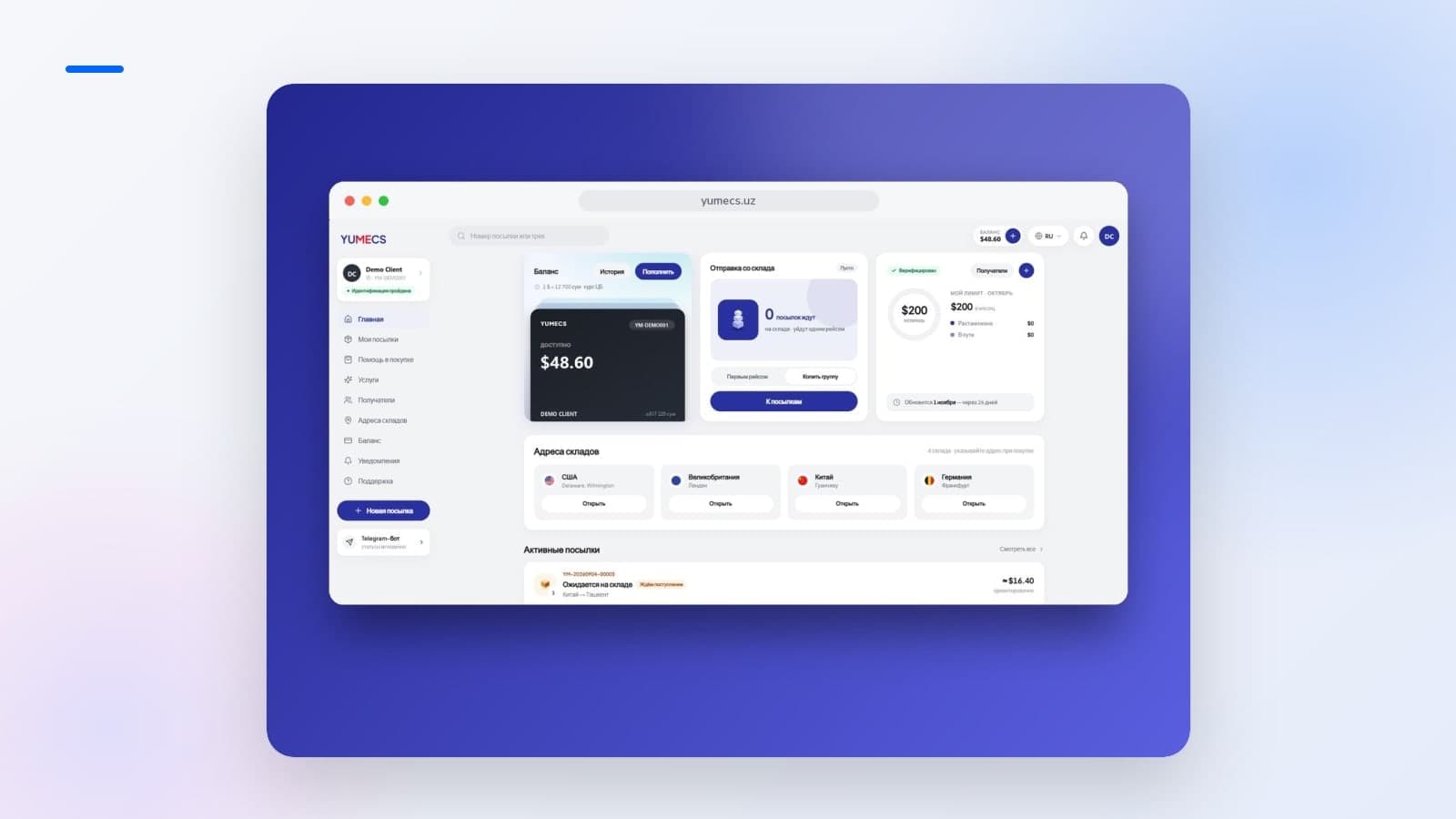
On the YUMECS international parcel shipping project, our team resolved a similar support bottleneck. Customers were continually messaging to ask about account balances, parcel locations, and warehouse addresses. We engineered an online portal and an internal staff hub where package statuses are automatically pushed directly to the user via a Telegram bot. Customers get live updates without calling a manager. The food delivery industry benefits from the exact same architecture: automated updates on kitchen preparation and courier handover eliminate up to half of all inbound calls.
Mistakes to Avoid When Choosing and Deploying Software
- Building everything from scratch on day one. Coding a proprietary cash register, inventory module, and courier app for a single kitchen branch never pays off.
- Ignoring fiscal requirements. Bypassing fiscal cash registers or E-POS modules triggers heavy fines during your first tax audit.
- Skipping courier status updates. If couriers do not check in upon departure and delivery, dispatchers waste valuable time tracking them down over the phone.
- Overcomplicating the kitchen interface. A cook's kitchen tablet should only have essential action buttons: "Accepted", "Cooking", and "Packed".
Frequently Asked Questions
Should I choose ready-made food delivery software or custom development?
For 90% of cafes, cloud kitchens, and restaurants in Tashkent, a ready-made platform like Delever, Poster, or iiko is more than enough. Building custom software makes sense only if you manage a high-volume chain or run complex event catering involving equipment rentals, dishware tracking, and specialized staffing schedules.
How much does it cost to implement a food delivery CRM in Tashkent?
Basic cloud POS systems with delivery modules start around $44 (~570,000 UZS (so'm)) per month. Dedicated platforms offering routing and courier apps run from 1,300,000 to 3,600,000 UZS (so'm) per month. In our experience, custom solutions require tailored budgets and provide a viable return on investment only at chain scale.
How do I combine Telegram and website orders into a single feed?
Most modern delivery platforms provide open APIs or prebuilt integration connectors. Your Telegram bot and website connect to a single gateway: new orders land directly on the dispatcher screen and print automatically in the kitchen with sequential numbering.
How does a catering CRM differ from standard food delivery software?
Standard delivery software focuses on packaging speed and short courier trips within 40–60 minutes. Catering CRM software handles long-cycle deals: banquet date reservations, per-guest menu calculations, rental gear tracking, estimate approvals, and upfront deposits.
If you are evaluating platforms to automate delivery or want to integrate Telegram and website orders with your back office, reach out via our contacts. We will review your workflows and help determine whether a turnkey platform or a custom build is the best fit.