Inventory Management for Online Stores in Tashkent: Sync & Software
A practical guide to choosing inventory software and syncing stock across websites, Telegram, and Uzum Market in Tashkent without overselling.
To link your warehouse operations with online sales in Tashkent and prevent selling out-of-stock items during seasonal peaks, your e-commerce business needs a unified cloud inventory system with real-time stock reservation. Subscriptions to specialized software start from 145,600 UZS (so'm) per month, while end-to-end implementation by system integrators takes 2 to 6 weeks with budgets ranging from 10.2 to 38.5 million UZS (so'm).
In brief
- Excel breaks down as soon as orders flow in parallel across your website, Telegram, and marketplaces.
- The MoySklad cloud platform in Uzbekistan costs from 145,600 to 979,800 UZS (so'm) per month, with sales channel connectors priced between 75,000 and 98,000 UZS (so'm) monthly.
- To prevent overselling on Uzum Market, automated connectors sync real-time available stock and process customer returns instantly.
- The system must support Tasnif catalogue MXIK (IKPU) codes and Asl Belgisi digital track-and-trace marking to generate valid fiscal receipts.
Why manual spreadsheet tracking fails in e-commerce
When orders come only via phone calls or a single chat, keeping track of items in a notebook or spreadsheet is manageable. Problems emerge when you add multiple sales channels: your own website, the Uzum Market marketplace, and an automated ordering bot. If two customers buy the exact same sweater on your website and marketplace simultaneously, warehouse staff cannot update figures by hand fast enough. This triggers overselling—selling items you do not actually have in stock. The result: canceled orders, plummeting store ratings, and penalties from online marketplaces.
Inventory software options: a comparison
When automating retail operations in Uzbekistan, merchants typically evaluate built-in e-commerce platform modules, ready-made cloud systems, and comprehensive enterprise solutions.
| Solution | Cost (late 2026 estimates) | Launch timeline | Best fit |
|---|---|---|---|
| Built-in platform inventory (e.g., Shopiuz) | 249,000 – 590,000 UZS (so'm)/mo | 2–4 days | Small single-brand stores without external marketplaces |
| Cloud service (MoySklad) | from 145,600 UZS (so'm)/mo + channels 75,000 – 98,000 UZS (so'm)/mo | 2–4 weeks | Stores selling via website, Telegram, and Uzum Market |
| On-premise 1C (UT / UNF) | Licenses from 5–15M UZS (so'm) + custom development | 1–3 months | Large wholesale and retail chains with complex batch tracking |
For most growing online retailers, cloud software has become the industry benchmark. According to moysklad.uz, official MoySklad subscription plans in Uzbekistan range from 145,600 UZS (so'm) per month (discounted Basic plan) to 979,800 UZS (so'm) per month (Corporate plan), while add-on sync modules for websites and marketplaces cost between 75,000 and 98,000 UZS (so'm) per channel per month.
How to sync your website, Telegram bot, and Uzum Market
To avoid stock discrepancies, your inventory software acts as the single source of truth. Physical stock counts are modified exclusively at the warehouse level (during receiving, write-offs, or stocktaking), while front-end storefronts merely display real-time available balances.
- Order reservation. The moment a customer adds items to a cart on your site or launches a Telegram bot online store in Tashkent, the system sends an instant trigger to the inventory software. The product switches to "Reserved" status, automatically reducing available inventory across all other storefronts.
- Uzum Market integration. As noted by moysklad.uz, avoiding overselling and duplicate orders between Uzum Market and your warehouse relies on dedicated connectors (such as Zoomselling Connector or UzumSync). These tools push available balances, pull returned merchandise, and compile settlement reports for P&L accounting.
- Handling cancellations. If an unpaid order expires or a customer submits a return, the integration connector clears the hold, instantly returning the item back to active stock across every storefront.
Regulatory compliance: Asl Belgisi and MXIK (IKPU) codes
Modern inventory control in Uzbekistan involves far more than counting boxes. In line with national legislation on mandatory track-and-trace labeling and tax fiscalization (lex.uz), your inventory platform must support Data Matrix codes (Asl Belgisi) and Tasnif MXIK (IKPU) classification codes when generating fiscal receipts. During dispatch of regulated product categories (such as consumer electronics, pharmaceuticals, or textiles), warehouse barcode scanners must capture the exact serial code so it can be transmitted into the customer's legal fiscal receipt.
If you are just starting
If your catalog contains under 100 items and you rely on a single sales channel, you do not need an expensive ERP implementation right away.
- Use built-in e-commerce features. As highlighted by shopiuz.uz, early-stage single-brand stores can leverage local platforms with native warehouse tools (such as Shopiuz Biznes/Pro tiers, priced between 249,000 and 590,000 UZS (so'm) per month) that automatically deduct units by size and color without complex third-party ERP connectors.
- Standardize your SKUs. Assign a unique SKU and barcode to each variation. Never combine attributes: a blue medium T-shirt and a white large T-shirt must have completely distinct identifiers.
- Designate an inventory manager. Even in a lean team, receiving and defect write-offs must be handled by one assigned person; otherwise, your system counts will quickly diverge from actual shelf counts.
If your business is already running
Once you handle more than 20–30 daily orders and sell simultaneously via your web store, a physical showroom, and Uzum Market, you need a dedicated inventory management loop.
- Run a complete physical inventory count. Never migrate estimated spreadsheet balances into a new software environment. Enter counts strictly based on a physical shelf audit.
- Deploy sales channel connectors. Configure automated API sync cycles for balances and order data every 5 to 15 minutes.
- Separate user roles and responsibilities. Sales managers should only view balances and reserved quantities, warehouse staff should pick and pack via barcode scanners, and accountants should supervise vendor intake invoices.
According to system integrator oy.co.uz, turnkey cloud inventory implementation in Tashkent—covering workflow audits, catalog migration, setup, and staff training—typically ranges from $800 to $3,000 (roughly 10.2 to 38.5 million UZS (so'm) based on late 2026 Central Bank rates).
A real case: eliminating stock errors at Primus Mall
Tashkent consumer retail store Primus Mall handled product tracking manually for years. This led to order fulfillment bottlenecks, mismatching shelf counts, and frequent packing errors for online customers.
System integrator iCORP (icorp.uz) deployed MoySklad, synchronizing incoming e-commerce orders with warehouse holds, bin location storage, and real-time inventory monitoring. As a result, stock discrepancies disappeared, and order assembly significantly accelerated thanks to transparent warehouse operations and segregated access permissions between warehouse workers and sales reps.
A real case: unified multi-channel tracking at Max Decor
Interior finishes brand Max Decor distributed specialty wall coatings across multiple channels: wholesale accounts, retail brick-and-mortar showrooms, and inbound web leads. This caused constant misallocations and made it hard to track batch-specific goods across unique color shades and lot numbers.
The team adopted a unified cloud setup using MoySklad (icorp.uz), establishing property-based tracking, serial batch tracking, and customized document workflows for sales staff. Max Decor fully unified visibility between retail locations and the central warehouse, eliminating accidental sales of low-stock items.
A real case: logistics automation for YUMECS
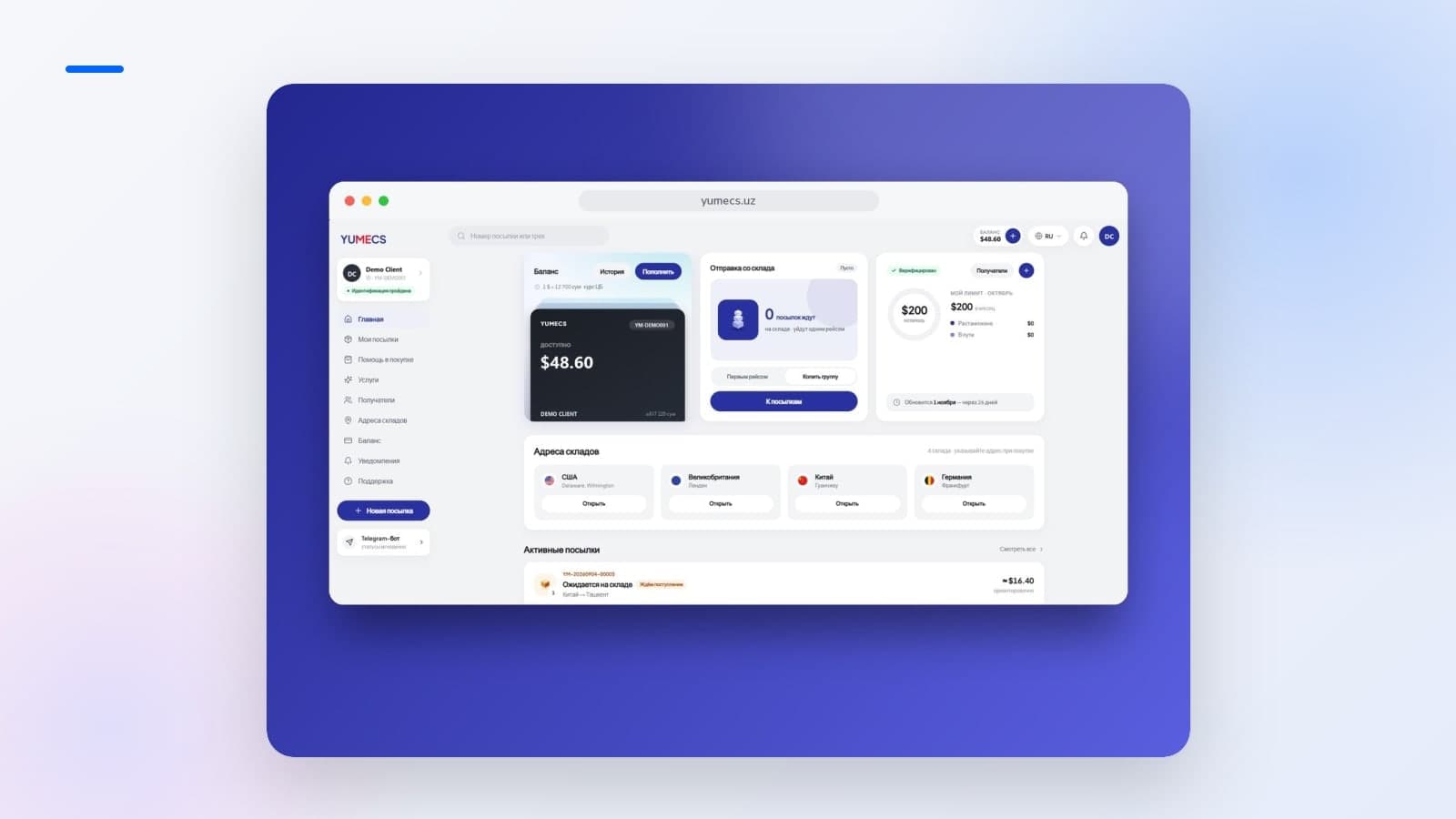
In operations where logistics stretches across international hubs, warehouse transparency directly drives customer satisfaction. For cross-border logistics provider YUMECS, the NDC team designed a bespoke business automation system and customer portal.
The company's clients ship packages through receiving hubs in the United States, the United Kingdom, China, and Germany. To free account managers from answering repetitive tracking queries, we engineered a single portal displaying customer balances, facility addresses, package tracking numbers, and duty-free import limits, complete with automated Telegram status updates whenever parcels change warehouse checkpoints.
Frequently Asked Questions
Should an online store in Uzbekistan choose 1C or MoySklad?
If you need to launch quickly and sync with your website and Uzum Market within a few weeks without hiring in-house developers, MoySklad is usually ideal. On-premise 1C configurations suit larger enterprises managing manufacturing lines, complex financial accounting, and dedicated in-house technical support teams.
Why do online stores need MXIK (IKPU) codes and Asl Belgisi?
These are mandatory requirements under Uzbekistan tax and commerce laws. Every line item on a fiscal receipt must list the Tasnif MXIK (IKPU) code, along with Data Matrix barcodes for regulated product lines. Without sending this data from your inventory system, you cannot issue legally compliant fiscal receipts.
How do I prevent selling the same item on my website and Uzum simultaneously?
This is resolved by automated API connectors. Whenever an order is confirmed on any channel, the software reserves the item in the central catalog and immediately pushes the adjusted inventory count across every connected sales channel.
If you want to sync your inventory across channels or need turnkey CRM development and business automation with warehouse integrations, reach out to us via our contacts page. We will assess your retail sales model and recommend the ideal technology stack.