Marketplace Development in Tashkent: Website or App for MVP Launch
Launching a marketplace in Uzbekistan: when a website and Android app are enough for an MVP, development costs, and how OvqatGo operates.
To launch a two-sided marketplace in Uzbekistan without runaway costs, an adaptive website combined with an Android app is more than enough to start. Custom MVP development for startups in the Tashkent market takes 3–4 months and starts from 102 million UZS (so'm) ($8,000) according to Co-Innovator, while holding off on early iOS development saves budget and speeds up demand validation.
In brief
- In Uzbekistan, Android accounts for 82.06% of the mobile operating system market, while iOS holds 17.93% (Statcounter).
- A Google Play developer account requires a one-time fee of $25 (around 320,000 UZS (so'm)), whereas the Apple Developer Program costs $99 annually (around 1,270,000 UZS (so'm)) (capgo.app).
- E-commerce volume across the country surged from 1 trillion UZS (so'm) in 2020 to 22.6–22.7 trillion UZS (so'm) in 2025 (Spot.uz).
- At the MVP stage, routine product catalog updates are far more cost-effective when handled directly by vendors through a merchant dashboard or a Telegram bot.
Website or mobile app: where to start
The single biggest mistake founders make when launching a platform is attempting to roll out web, iOS, and Android all at once. Full-cycle development across three platforms triples programming, QA, and ongoing maintenance costs. To get a marketplace off the ground, your first priority is validating the core hypothesis: are vendors willing to list items, and will buyers pay for them?
Uzbekistan's user demographics give a clear roadmap for platform rollout. In October 2026, Android represented 82.06% of the mobile market, while iOS accounted for 17.93% according to Statcounter. This means a responsive web platform paired with an Android app covers the vast majority of online consumers in the country.
| Launch Option | Timeline | Budget Range | Best Suited For |
|---|---|---|---|
| Website + mobile web | 2–3 months | from 102M UZS (so'm) | B2B platforms, complex product catalogs, initial demand validation |
| Web platform + Android app | 3–4 months | from 120–150M UZS (so'm) | Local delivery networks, frequent repeat purchases |
| Web + iOS and Android apps | 4–6 months | from 189M UZS (so'm) | Scaling existing platforms with proven unit economics |
Drawing from our experience building marketplaces, a staged approach makes financial sense: launch an adaptive web interface first, build an app for the dominant mobile OS second, and release on the App Store only after your unit economics are sound.
Catalog and logistics mistakes to avoid
Attempting to automate every single process before closing your first real orders leads straight to a cash crunch. We regularly see three classic launch pitfalls:
- Manual catalog management by project founders. If marketplace admins are manually uploading product details on behalf of sellers, your growth will stall by the twentieth merchant.
- Building an in-house fleet from day one. Purchasing delivery vehicles, hiring full-time couriers, and leasing warehouses ties up valuable liquidity. Until order volume stabilizes, rely on third-party courier services or have vendors fulfill their own shipments.
- Overcomplicated interfaces. A cumbersome checkout with a dozen form fields drives customers away. A lean MVP only needs phone number authentication via SMS and integration with standard local payment gateways like Payme and Click.
NDC case study: how the OvqatGo lunch marketplace works
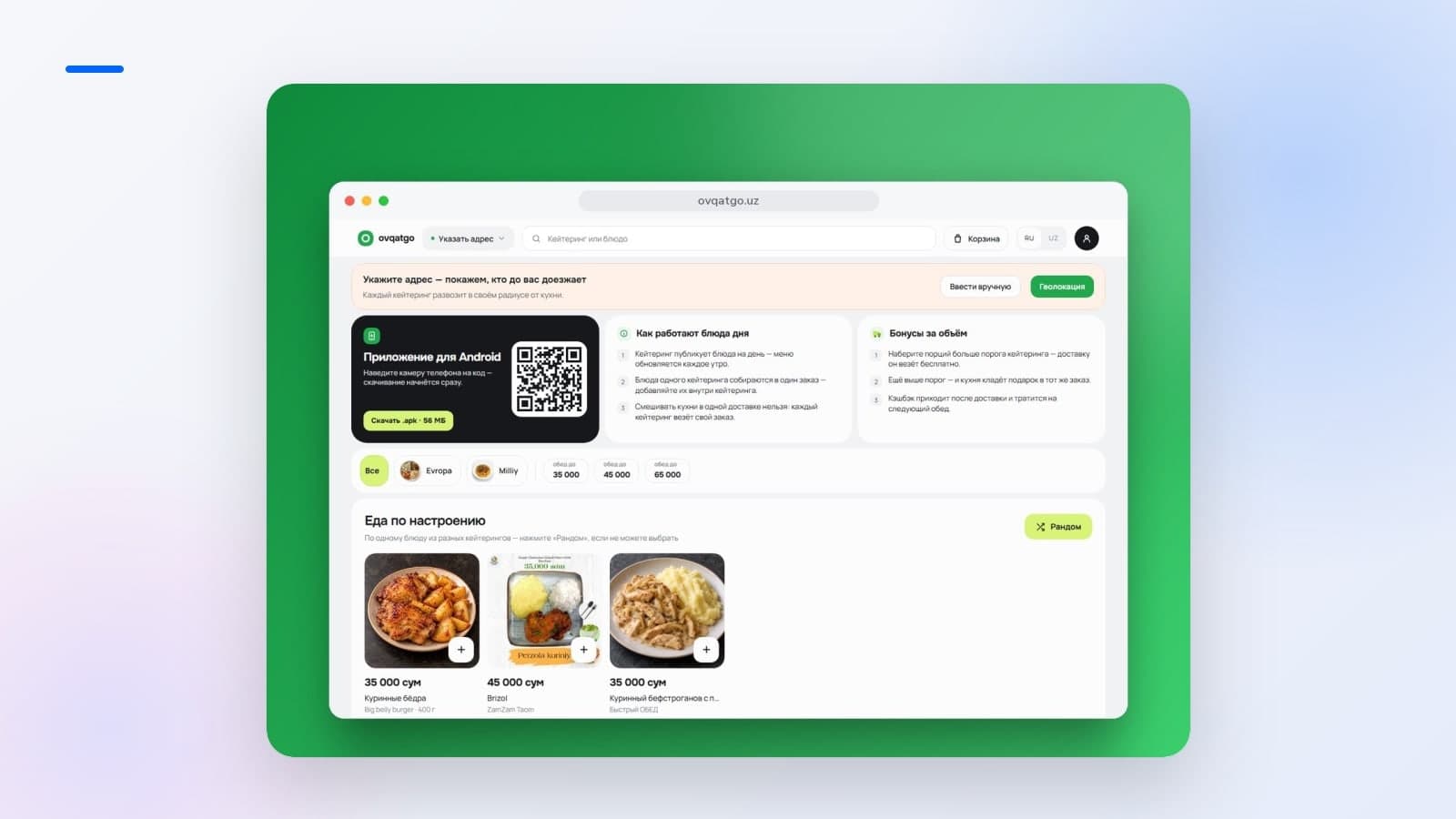
OvqatGo is an NDC proprietary product built as a hot lunch delivery marketplace in Tashkent. The platform operates bilingually in RU and UZ as a web service at ovqatgo.uz alongside a dedicated Android app.
A real case: OvqatGo
Boutique catering kitchens across Tashkent prepare quality homemade lunches, but their menus change daily. Listing their dishes on major food delivery apps was inefficient: approving changing daily items back and forth took hours. Meanwhile, office teams struggled to see which local kitchens could reliably deliver to their district on time.
We engineered a marketplace providing each kitchen with a self-service vendor portal. Chefs post daily lunch specials every morning and set delivery boundaries directly on a map. When a customer opens the platform and enters their address, the system displays only the caterers delivering to that specific zone. Payments were set up via Payme, Click, and cash, with an Android app rolled out for regular smartphone ordering.
As a result, catering kitchens independently maintain their daily menus without marketplace admins getting involved, and customers place orders quickly via ovqatgo.uz and the mobile app.
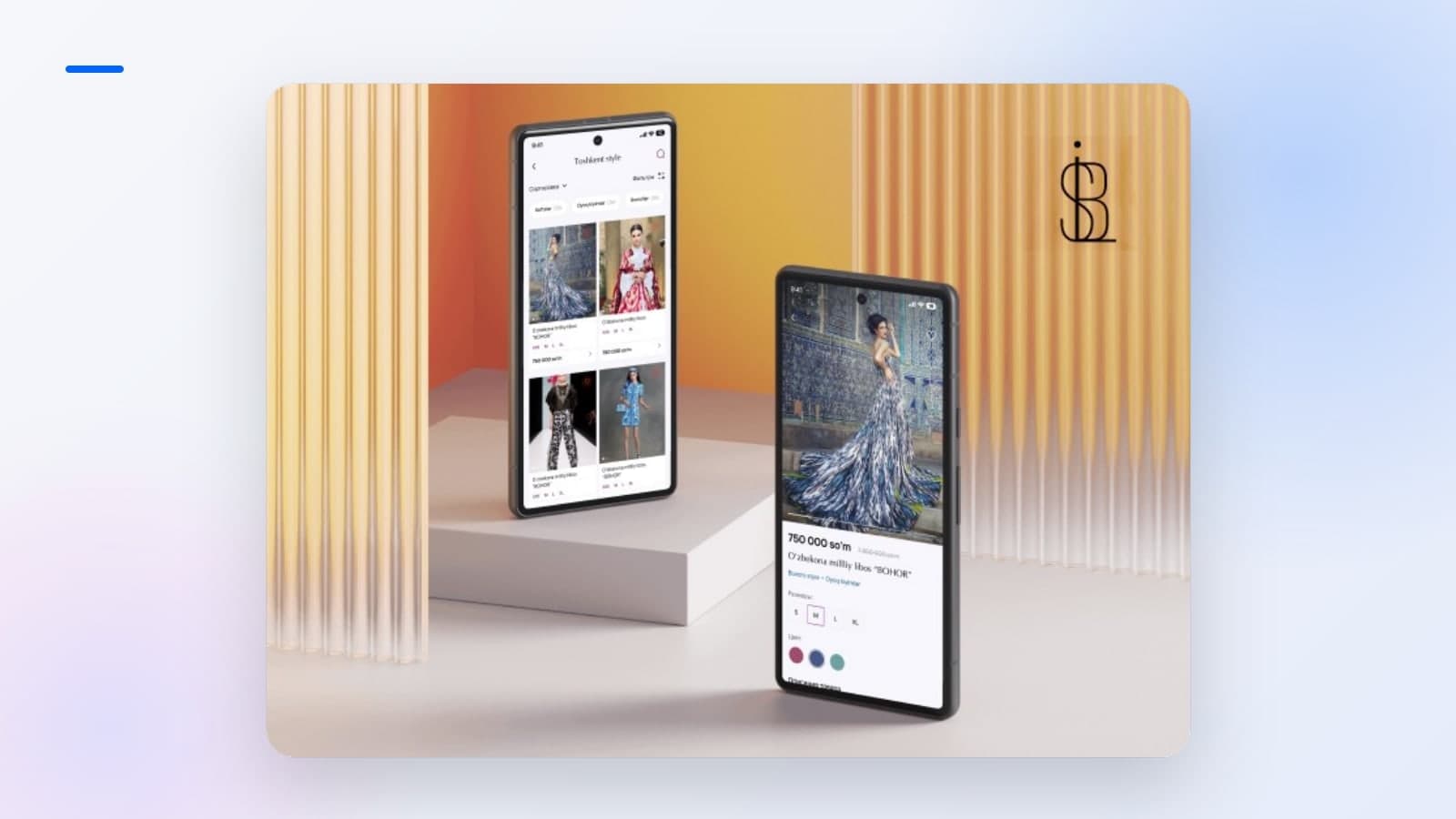
Once a business model is validated and visual commerce becomes central, deploying across both mobile platforms makes commercial sense. For instance, on the Liboss project, we built a mobile apparel marketplace launched simultaneously on iOS and Android, equipped with size filtering, a visual catalog, and an isolated vendor portal for stock control.
If you are just starting
When bootstrapping a project from scratch, your primary objective is confirming real market demand with lean resources.
- Test demand with zero complex code. Launch a Telegram channel or a lightweight digital catalog. Find out whether customers are actually willing to place orders for your target niche.
- Keep feature scope strictly minimal. An MVP only requires a merchant account, a searchable catalog with basic filtering, a shopping cart, SMS login, and payment processing via Click or Payme.
- Launch web and Android first. This path keeps initial development from 102 million UZS (so'm) ($8,000 according to Co-Innovator) and gets your product to market in 3–4 months.
A real case: Second Bloom
The Second Bloom project started out as a lean C2C Telegram channel without a website or mobile app, testing demand for pre-owned floral arrangements. After proving the concept through manual transactions and scaling platform turnover to $150K in 4 months (roughly 45 orders daily), the startup raised $50K in angel funding from Click co-founder Rustam Fayziev—investing in a custom mobile app only after validating unit economics.
If your business is already running
Established businesses with an active customer base or physical retail locations need to digitize inventory without inflating warehousing overhead.
- Sync existing inventory databases. Integrate product inventory and pricing directly from your management software (1C, MoySklad, or spreadsheets) via API to eliminate duplicate data entry.
- Leverage partner infrastructure. Onboard external suppliers and shift order assembly to partner locations, preventing working capital from getting tied up in inventory.
- Invest in the user interface. For established companies, high-converting UX/UI design for websites and apps is crucial to lowering mobile cart abandonment.
A real case: Express24 Bozor
After closing its proprietary warehouse-backed Express Dookon initiative, Express24 sought an asset-light way to scale grocery delivery without leasing distribution hubs or purchasing stock. The company introduced "Express24 Bozor", digitizing the stalls of Tashkent's traditional bazaars through its existing web and app ecosystem: on-site partners pack the orders, couriers deliver, and the platform collects a 5% commission without holding any inventory.
Frequently asked questions
How much does it cost to build a marketplace in Tashkent?
Custom marketplace MVP development in Tashkent starts from $8,000 (around 102 million UZS (so'm)) with a delivery timeline of 3–4 months according to Co-Innovator. Total estimates depend on platform choices, vendor payout logic, and third-party logistics integrations.
What is more cost-effective for an MVP: a website or an app?
During the MVP phase, launching a responsive website or pairing web with an Android application delivers the highest ROI. Android accounts for over 82% of smartphone users in Uzbekistan (Statcounter), and a Google Play developer account costs a one-time $25 fee, compared to $99 billed annually by the Apple Developer Program (capgo.app).
When should an iOS app be developed?
Mobile app development for iOS is practical once your marketplace handles steady order volume, your unit economics are proven, and you have built an audience with higher average order values who prefer checking out on iPhones.
If you are planning to launch a multi-vendor platform and want an accurate scope for your initial version, get in touch with our team via our contacts page. We will analyze your platform architecture, select the optimal tech stack, and pinpoint which features can be safely postponed until your business gains traction.