Online booking for travel agencies: modules, gateways, and payment holds
A practical guide for travel agencies and tour operators in Uzbekistan on shifting from lead forms to real-time seat allotments and two-step payment holds.
A fully featured online booking system for a travel firm differs from a standard inquiry form by locking in actual hotel or flight allotments and placing a pre-authorization hold on card funds until confirmation. Integrating a turnkey search and booking module costs an agency between 6 and 12 million UZS (so'm) and takes 1–2 weeks, while developing a dedicated tour operator engine with custom inventory costs from 45 to 120 million UZS (so'm) and takes 2.5 to 5 months.
In brief
- A basic widget simply forwards contact details to an agent, creating risks of overbooking and price spikes under dynamic pricing models.
- To prevent cancellation penalties, you need two-step acquiring (holding funds for 2–24 hours via Payme, Click, or a direct bank gateway).
- A retail agency gets the best return from an aggregator iframe module, whereas an operator managing seat blocks needs a custom Booking Engine connected via API to its inventory system.
- Aggregators in Uzbekistan bring together over 500 local and international routes with instant date confirmation in these databases.
A “call me back” inquiry or real booking
Most travel company websites in Uzbekistan still rely on standard web forms: the traveler picks a destination, enters a phone number, and waits for a callback. According to booking system developers САМО-Софт, basic website widgets merely send a lead to a team member's email or messenger without checking or locking available slots in real time. During peak season, this causes serious friction: by the time an agent calls back, charter seats are gone, and hotel rates have jumped.
A true online booking system removes manual bottlenecks. The platform connects directly to the tour operator gateway or in-house database, checks available inventory, collects travelers' passport details, and places a temporary hold on the customer's card.
How two-step payments (pre-authorization holds) work
In the travel industry, you cannot immediately charge a card the way an e-commerce store does. There is always a lag between clicking “Pay” and issuing the voucher: the tour operator must verify the hotel reservation or issue the flight ticket. If the hotel declines the booking after funds are already captured, the agency is forced to issue a formal refund, losing non-refundable payment processing fees in the process.
As noted by OnlineTours.uz, safe online package sales require two-step card acquiring (holding funds on the client's card via Payme, Click, or direct bank acquiring). Funds are frozen in the buyer's account for 2 to 24 hours. Once the reservation is confirmed, the system triggers the capture command. If rooms are unavailable, the hold releases instantly without merchant fees, penalty charges, or written refund applications.
Comparing solutions for travel businesses
| Parameter | Turnkey iframe module | Custom Booking Engine |
|---|---|---|
| Best for | Boutique and multi-branch retail agencies | Tour operators with charters and room blocks |
| Data source | Third-party aggregator gateways | Proprietary databases (SAMO-Tour, Master-Tour, 1C) |
| Implementation cost | 6–12 million UZS (so'm) (Tourvisor) | 45–120 million UZS (so'm) (Altsoft) |
| Monthly expenses | 300,000 to 1,500,000 UZS (so'm) | Hosting and API maintenance only |
| Launch timeline | 1–2 weeks | 2.5–5 months |
If you are just starting
If you are launching a retail travel agency, building a proprietary search engine from scratch makes little financial sense. At the outset, you lack direct contracts with dozens of airlines and hotels, meaning you will be reselling packaged inventory from partner operators.
- Select a tour aggregator. Connect a turnkey search module that streams live offers from major operators. Configuring and whitelabeling this solution costs between 6 and 12 million UZS (so'm), alongside a monthly subscription of 300,000 to 1,500,000 UZS (so'm), according to Tourvisor pricing.
- Set up two-step acquiring. Sign an agreement with your payment gateway to enable pre-authorization holds.
- Connect your site to your sales pipeline. Automate customer data flows directly into your managers' working environment. A tailored solution is CRM development and implementation, keeping passport scans, departure dates, and payment statuses in one secure hub.
A real case: a catalog website for Cavsar Tour
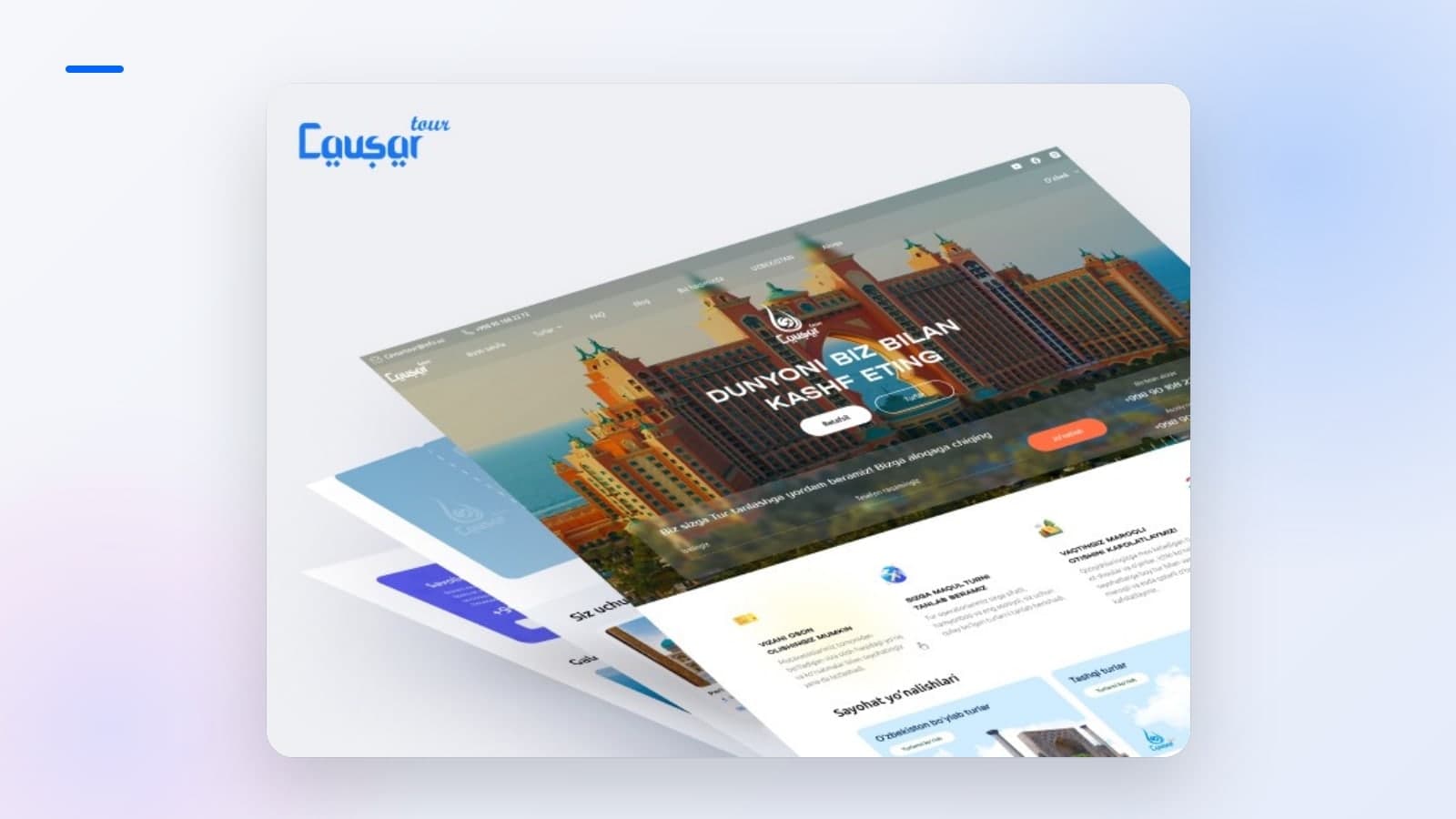
When international travel agency Cavsar Tour needed to organize its extensive destination catalog, the NDC team designed a user-friendly showcase. We structured trips by country and travel style, developed a unified tour detail template with full itineraries, pricing, and terms, and embedded automated lead notifications. The agency's team manages and updates every package independently through the admin panel without hiring developers.
If your business is already running
If you operate as a tour operator packaging your own tours, purchasing charter seat allocations, and holding direct room allotments, an external widget will no longer cut it. You need a dedicated Booking Engine integrated with your internal accounting system.
- Sync your online storefront with your back office. Drawing on our project experience, remaining seat counts and dynamic rates must sync from your database (1C, SAMO-Tour, or Master-Tour) via real-time APIs.
- Launch a B2B portal for sub-agents. Partners must be able to view their commission tiers, book packages for their travelers, and generate wire transfer invoices automatically.
- Automate document issuance. As soon as payment clears, the engine should automatically generate vouchers, e-tickets, and service contracts. NDC implemented a similar paperless workflow without couriers or in-person visits for the online contract signing platform Hesap.
A real case: the Asialuxe Travel ecosystem
Major Uzbekistan national tour operator Asialuxe Travel previously coordinated charter allocations and hotel room quotas manually across physical offices and its agency network, leading to delayed confirmations and cash reconciliation issues. According to developer Altsoft, the company launched a comprehensive digital ecosystem: the Asialuxe Flight Engine, a dedicated Hotel Engine, a B2B agent portal, and an operator ERP system. Consequently, the operator transitioned its wholesale agency network and direct retail tourists to round-the-clock booking with instant quota reservations and automated voucher delivery.
A real case: the Bookatour.me aggregator
Another strong example of consolidated inventory is Bookatour.me. Local guides and independent organizers across Uzbekistan previously sold excursions through Telegram and Instagram, handling card-to-card transfers without a unified schedule. The platform founders introduced an aggregator with an instant booking module, live tour departure calendars, language group filtering, and online payment processing. The platform unified a database of over 500 local itineraries with automated confirmations for both international visitors and domestic travelers.
Common mistakes when launching online booking
- Capturing payments without confirmed allotments. Using standard one-step capture invariably triggers cash flow crunches and customer disputes from holiday overbooking.
- Forcing account creation on the first screen. Demanding passwords before a client can browse hotels kills conversion rates. Only collect contact details once the traveler enters passport details.
- Overlooking messaging sync. Travelers in Uzbekistan expect instant booking confirmations in chat apps. Ensure you duplicate vouchers and order status updates directly to the buyer's Telegram bot. We explored similar storefront and customer service synchronization patterns in our guide on online appointment booking for clinics.
Frequently asked questions
How does a tour booking engine differ from a standard widget?
A widget only captures contact details and emails an inquiry to an agent. A booking engine validates seat availability via API, reserves the hotel room and flight seat, places a temporary pre-authorization hold on the client's card, and issues the official e-ticket and voucher immediately upon confirmation.
How much does a booking module cost for an operator in Uzbekistan?
Developing a custom Booking Engine with quota management, seat allocations, and integrations with accounting software (1C, SAMO-Tour) costs between 45 and 120 million UZS (so'm) based on data from Altsoft. Delivery typically takes 2.5 to 5 months.
Can you set up online tour booking through Telegram?
Yes. You can package your inventory catalog and booking calendar into a Telegram Mini App. Travelers select dates, enter passport data, and authorize payment holds via Payme or Click without leaving the messaging app.
If you want to upgrade your company website or automate tour sales from start to finish, explore our corporate website development services or get in touch with the NDC team through our contacts page to review your technical requirements.