CRM for garment manufacturing: Size matrices and sample approvals
How sewing workshops and textile factories in Uzbekistan can manage B2B orders by size and color matrix without chaotic chat threads.
For garment manufacturers in Uzbekistan, system selection depends directly on scale: a small sewing workshop can manage with a cloud CRM customized with matrix specifications, whereas a contract apparel factory requires a bespoke ERP featuring cutting and pre-production modules. Basic sales pipeline setup starts from 3,900,000 UZS (so'm), while implementing an industry-grade platform like Odoo takes 30 to 90 days with budgets beginning at 60,000,000 UZS (so'm).
In brief
- Standard retail systems do not support size-height-color matrices or pre-production sample approval stages.
- Base sales pipeline subscriptions start from 79,000 UZS (so'm) per user per month, with implementation starting at 3,900,000 UZS (so'm).
- End-to-end manufacturing with batch tracking on Odoo Enterprise runs from 60,000,000 UZS (so'm) with system integrators.
- Odoo 19 introduces official Uzbek localization (376 modules), removing language barriers for shop-floor supervisors.
What makes apparel order management unique
Most customer management systems are designed for single-item retail: selling one smartphone, one sofa, or one standardized service. In apparel manufacturing, a single B2B order for 5,000 hoodies is not a one-line invoice; it is a multifaceted matrix combining fabric colors, height fits, and a full size curve from S to XXL.
Furthermore, contract manufacturing splits into two distinct workflows:
- Pre-production: pattern design and grading, fabric sourcing, production of approval samples (counter-samples), fittings, and client sign-off on technical specifications.
- Mass production: raw material procurement, cutting, sewing, ironing and finishing (pressing), quality control inspections, and final batch packaging.
As noted in an industry study by BUline, the primary flaw in out-of-the-box software is the complete absence of matrix specification support and the inability to split a deal card into a lab sample stage versus a mass run. When sales reps try to manage these workflows through generic deal cards or Telegram groups, production teams mix up thread colors, cut incorrect sizes, and clients flood phone lines demanding delivery updates.
Available solutions: From a simple pipeline to an industry ERP
When selecting software, it is vital to pinpoint where revenue is lost: during sales communication with clients, or directly inside the sewing workshop.
| Option | Cost and licensing | Deployment timeline | Best fit |
|---|---|---|---|
| Cloud CRM (amoCRM) with matrix customizations | Licenses from 79,000 to 259,000 UZS (so'm) per user/month, setup from 3,900,000 UZS (so'm) based on MCRM.uz data | 2–4 weeks | Sewing workshops focused on active B2B sales and short negotiation cycles |
| Specialized Odoo Enterprise platform | Implementation from 60,000,000 UZS (so'm) based on Kabulov Technologies data | 30–90 days | Contract factories requiring end-to-end tracking from raw fabric to shipment |
| Custom web portal or B2B client dashboard | Based on our project experience, custom development is quoted per technical specification | 6–12 weeks | Apparel brands and factories with non-standard approval flows and wholesale dealer networks |
If your goal is to build an accountable sales department, explore our approach to CRM development and implementation tailored with industry modifications. For comprehensive plant planning, we also prepared an overview guide: read more about ERP for textile factories in Uzbekistan.
If you are just starting
If you run a compact workshop with 10–25 sewing machines, rolling out a heavy industrial ERP is premature. Your main objective is organizing inbound leads and ensuring approved tech packs are never misplaced.
- Standardize a single specification template: every order must feature a structured grid detailing model, fabric color, sizing, and quantity.
- Set up a basic CRM (for example, on a tier starting at 79,000 UZS (so'm) per month) to consolidate your website, phone calls, and business Telegram accounts into a single feed.
- Build a pre-production pipeline: "Inquiry" → "Cost Estimate" → "Pattern Approval" → "Sample Sewing" → "Down Payment" → "Sent to Production".
- Hold off on automating fabric and notions inventory inside the CRM at stage one; manage base stock levels in simple spreadsheets so staff are not overwhelmed by complex data entry. We covered materials management in detail in our article on fabric and inventory software for sewing workshops.
A real case: Mobile tracking for apparel workshops
Small custom sewing shops struggled with work-order confusion and disputes with seamstresses regarding piece-rate pay, while clients called continuously asking when their production batch would be ready. This project was documented by software developer Hayot Soft.
The workshops implemented a mobile-first order tracking app in Uzbek, introducing QR-code labels for cut fabric bundles (bichuv) and logging operations straight from floor supervisors' smartphones.
As a result, every production piece is tracked from cutting to packing, piecework payroll calculates automatically without paper logs, and account managers monitor production completion percentages in real time.
If your business is already running
For an established factory with 50+ employees, the bottleneck shifts to desynchronization between sales, patternmakers, and inventory managers. An account manager confirms an order in Tashkent, only for the production engineer in Andijan to discover that required buttons are out of stock and the cutting floor is booked two weeks out.
In this environment, a basic sales funnel is insufficient. Moving to an enterprise-grade platform involves the following steps:
- Product catalog audit: migrating databases of fabrics, threads, trims, and models while establishing multidimensional variant attributes.
- Bridging CRM and manufacturing: generating automated bills of materials (BOM) the moment an order advances to "Sample Approved".
- Integration with local software: syncing data with 1C for accounting and launching Telegram bots to alert clients as production stages wrap up.
- Shop-floor training: since Odoo 19 includes 376 modules localized into Uzbek (reported by Deep Vision), floor supervisors can manage tasks in their native language.
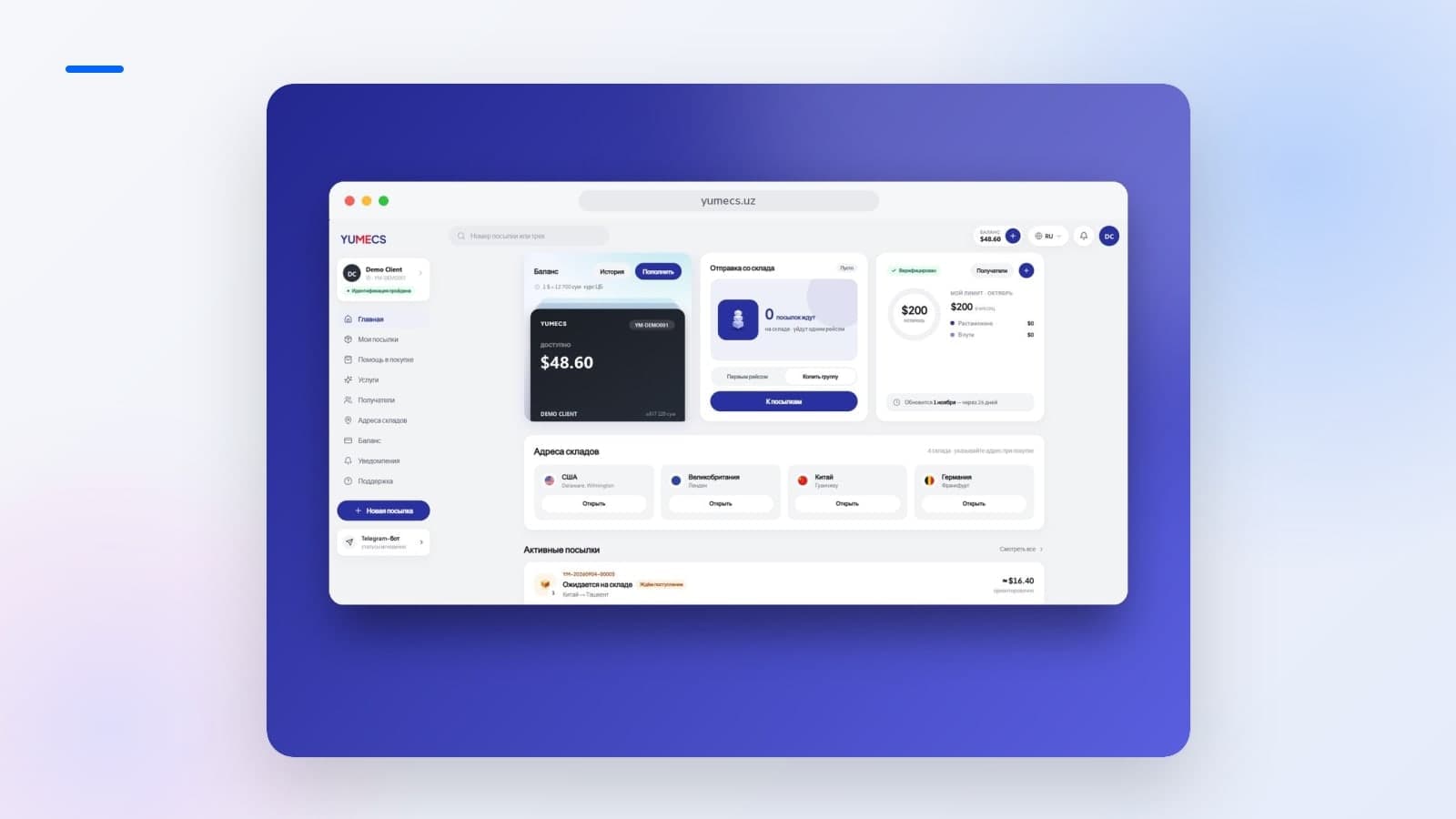
Custom customer portals provide significant value when automating external interactions. For instance, in our logistics system project for YUMECS, we engineered business automation allowing customers to check balances, review movement milestones, and receive Telegram bot notifications without calling support. The same workflow applies to contract manufacturing, enabling wholesale buyers to check production readiness directly in a client portal.
A real case: Unified operational loops for textile enterprises
Textile and apparel manufacturers in Uzbekistan were tracking client orders and wholesale buyers across disconnected Excel spreadsheets and Telegram chats. Sales managers lacked live visibility into shop-floor operations (cutting, sewing, pressing, packing), and inventory balances for fabrics and trims were detached from size and color matrices. This implementation experience was recorded by the team at PDP Synergy.
The companies adopted Odoo ERP with CRM and make-to-order manufacturing modules, digitizing an end-to-end workflow from inbound B2B lead to final shipment, structuring product catalogs with multidimensional attributes (size/color), and introducing step-by-step shop floor tracking.
As a result, specification errors during handoffs between sales and production were eliminated, order progress became visible in real time, and export contracts alongside foreign currency invoices are now generated automatically from the deal card.
Frequently asked questions
How does a garment workshop CRM differ from standard retail CRM?
A standard CRM tracks contact details and total deal values. An apparel-focused system breaks orders down into a multi-attribute size-and-color matrix, links patterns and technical packs to the deal card, and controls sample sign-off workflows before mass production begins.
What is the cost of implementing a CRM for a textile factory in Tashkent?
Standard cloud-based sales setups for wholesale teams begin at 3,900,000 UZS (so'm), excluding user licenses (which start at 79,000 UZS (so'm) per user/month). Comprehensive ERP deployments covering production floors and warehouse inventory start from 60,000,000 UZS (so'm) and typically take one to three months.
Can factory floor supervisors use the system if they do not speak Russian?
Yes. Modern platforms support Uzbek interfaces; for instance, Odoo offers official localization for over three hundred modules. For sewing lines, teams frequently deploy simplified tablet interfaces or Telegram bots featuring clear Uzbek action prompts.
How does a CRM simplify pre-production sample sign-offs?
Deals include dedicated pre-production stages. Sales reps attach photos of test garments, notes from patternmakers, and courier tracking numbers. System permissions block orders from moving to bulk fabric cutting until the client provides digital or written confirmation on the approval sample.
If you want to organize your order intake, connect your sales team with the workshop floor, or launch a dedicated wholesale client portal, reach out via NDC contacts. We will examine your production processes and deliver a streamlined solution that fits your team's workflow.
Sources
- Текстильные и швейные предприятия Узбекистана (внедрение PDP Synergy) · pdp.uz
- Локальные швейные цеха (решение Hayot Soft) · hayot-soft.uz
- Kabulov Technologies: Внедрение Odoo Enterprise в Узбекистане — тарифы и сроки
- Deep Vision: Odoo на узбекском языке — локализация и поддержка регионов
- MCRM.uz: Официальные тарифы amoCRM в Узбекистане
- BUline: Отраслевые модули Odoo для текстиля и швейных производств