Online Food Delivery Store: Catering, Meal Plans, and Semi-Finished Goods
How to launch an online store for catering, meal prep plans, and semi-finished food in Uzbekistan: pre-order slots, catch-weight billing, B2B invoicing, and POS integration.
An online store for catering, meal plans, and frozen semi-finished goods works quite differently from a standard pizzeria website: it requires 24–48 hour pre-order slots, floating catch-weight calculations, and automated corporate invoicing. Custom development for this type of store in Tashkent costs 25,000,000 – 55,000,000 UZS (so'm) with a timeline of 4–7 weeks, whereas basic express delivery can be launched on ready-made cloud platforms starting from 1,300,000 UZS (so'm) per month.
In brief
- Standard food delivery platforms are designed for 40-minute turnarounds and cannot handle catch-weight items with adjustments after weighing.
- Catering services critically depend on minimum pre-order lead times (e.g., 24 hours in advance) and automatic generation of contracts and invoices for corporate entities.
- Online acquiring fees via Click and Payme range from 1.5% to 2.0%, with receipts requiring fiscalization and precise IKPU codes.
- A custom storefront featuring date reservations and 1C integration takes 4–7 weeks to build and pays off by eliminating manual manager chats in messaging apps.
How complex food e-commerce differs from standard delivery
Most delivery engines are optimized for fast food: the customer picks a pizza, taps checkout, and 40 minutes later, the courier rings the doorbell. For producers of semi-finished foods, meal prep services, and catering companies, this workflow fails for three main reasons.
Pre-orders and production cycles. A bruschetta platter for 40 guests or a banquet pilaf cannot be whipped up in 20 minutes. The website must enforce mandatory time slots: orders must be placed at least 12, 24, or 48 hours before dispatch. When kitchen capacity is reached, the system must automatically shut off those specific time windows.
Catch-weight goods with open receipts. Frozen manti, steaks, or stuffed poultry rolls cannot be packaged to the exact gram. A customer places an order for an estimated weight of 1 kg, but at the warehouse, the packaged product might weigh 1,080 g. The system needs to either pre-authorize a buffer amount on the bank card via payment holds or generate a balance payment link after precision packing and weighing.
Corporate clients and closing documents. Catering and office lunch subscriptions are frequently paid by legal entities via bank transfers. Managers often end up manually drafting invoices, verifying tax details, and sending formal acceptance acts via Didox. Automation allows corporate buyers to enter their TIN at checkout, auto-populate company details, and instantly download a ready-to-pay invoice.
Turnkey delivery platforms vs. custom storefronts
Cloud-based restaurant logistics services in Uzbekistan handle typical order flows effectively. Industry data indicates that turnkey platforms, including Delever, connect digital storefronts with POS systems like iiko, R-Keeper, and Jowi, powering more than 1,200 branches and processing over 40,000 online orders daily (digitalpool.gov.uz). However, their core logic does not always suit complex culinary production.
| Feature | Turnkey delivery platform | Custom online store |
|---|---|---|
| Cost | From 1,300,000 UZS (so'm) / month (delever.io) | 25,000,000 – 55,000,000 UZS (so'm) one-time (digitalpool.gov.uz) |
| Launch timeline | 7–14 days | 4–7 weeks |
| Menu type | Standard fast-food items, single dishes | Event platters, multi-day meal plans, weighed frozen foods |
| Pre-order time slots | Rigid, limited time settings | Flexible lead-time logic (8–48 hours ahead) |
| B2B buyers | Basic retail consumer checkout only | Auto-generation of contracts and invoices via TIN |
We covered the core trade-offs between turnkey platforms and tailored builds in our guide on selecting food delivery infrastructure: Creating a food delivery website: platform or custom development.
Payments, taxes, and fiscalization in Uzbekistan
When launching an online food store in Tashkent, regulatory fiscalization requirements must be designed into checkout workflows from day one. E-commerce merchant acquiring fees for food retail through Click and Payme payment gateways sit at 1.5%–2.0% (lex.uz).
Regulatory frameworks mandate that each receipt item pushed through the fiscal data operator (OFD) must carry a verified five-digit IKPU code, the active VAT rate, and the correct unit of measurement (lex.uz). For catering sets, units are counted as pieces or portions, while a butchery or semi-finished facility bills in kilograms with decimal values. If the e-commerce engine cannot send this metadata directly to the merchant gateway, your accounting team will have to punch in every receipt manually on physical POS terminals.
If you are just starting
If your culinary facility or meal prep business is just entering the market, avoid investing in complex software architecture right away.
- Define a standardized, fixed-weight menu. Skip variable-weight items in the first phase. Sell frozen foods in fixed-weight boxes (e.g., exactly 1 kg or 2 kg packages) and catering as pre-assembled box sets.
- Set a clear order cut-off window. Post a firm rule on the site: next-day delivery for all orders placed before 18:00. This eliminates the headache of minute-by-minute dispatch routing.
- Launch with a clean, streamlined website. A lightweight digital catalog or a standard CMS setup works fine for validating demand. In our experience, online store development with basic integrated payments lets you test the market without overspending.
A real case: Korobka Catering
Traditional off-site event catering relied on lengthy back-and-forth menu negotiations with sales reps, manual spreadsheets, and on-site service staff, making small office orders for 30–50 people financially unviable.
The company rolled out an e-commerce storefront around a "catering in a box" concept, featuring fixed food sets, transparent pricing per portion, an enforced 8–48 hour pre-order requirement, and an instant checkout flow for both retail consumers and businesses.
As a result, the brand has catered over 750 events and onboarded 42 recurring corporate accounts, shortening order placement from 3–4 hours of messaging down to 3 clicks online without hiring more sales staff (korobkacatering.uz).
If your business is already running
Once a culinary production facility or catering brand builds up a loyal customer base, managing orders via Telegram chats quickly becomes a growth bottleneck. Team members mix up delivery addresses, forget to notify chefs about food allergies, and spend hours drafting paper delivery notes.
- Sync inventory with production lines. Integrate your website with 1C or your restaurant management system so that raw ingredient stocks, semi-finished inventory, and daily pre-order thresholds update automatically.
- Set up recurring subscription billing for meal plans. If you sell daily nutrition plans, let customers pick calorie targets, exclude allergens (such as dairy or nuts), and pause deliveries during vacations directly inside their user dashboard.
- Automate corporate invoicing. Include a TIN input field in the cart so business clients can instantly download an official invoice within 10 seconds without manual bookkeeping intervention.
A real case: HealthyFood
Processing daily nutrition meal plans through Telegram chats created address mix-ups, required labor-intensive tracking of dietary exclusions (allergies, intolerances), and caused drop-offs when renewing monthly plans.
The company launched a dedicated web portal with 8 distinct calorie programs (ranging from 800 to 2,500 kcal), a built-in diet calculator, an ingredient exclusion tool, and automated calendar-based billing for 10- to 30-day plans.
This enabled them to scale up to 300+ daily dispatches, surpassing 657,000 total meal deliveries across Tashkent with automated driver route planning for their private courier fleet (healthyfood.uz).
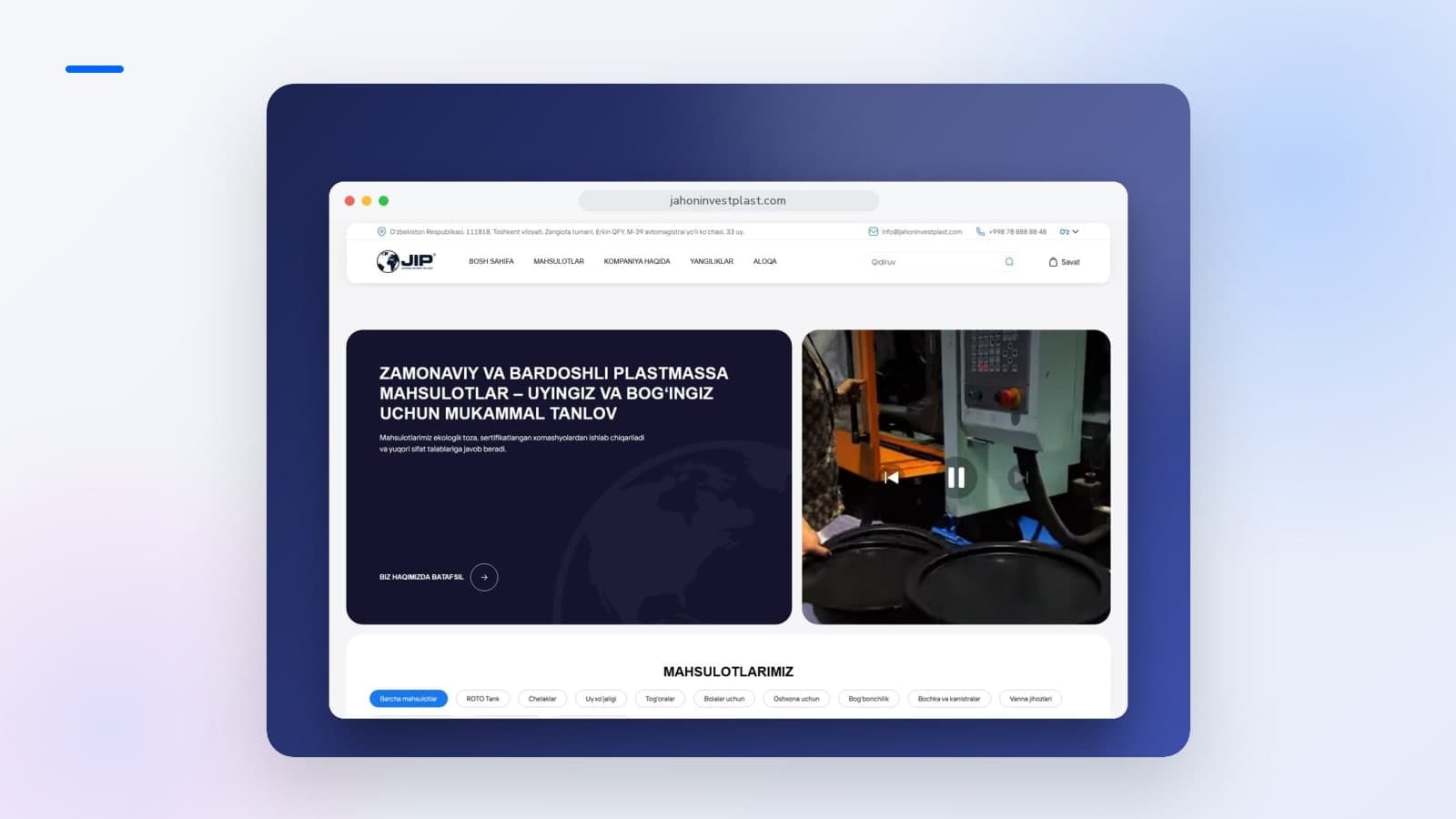
We apply similar catalog engineering across our retail and industrial projects. For example, when building an e-commerce catalog with a cart for Jahon Invest Plast, we organized hundreds of items into clear categories, embedded exact dimensions and packaging specs directly onto product cards, and provided the interface in Uzbek, Russian, and English so wholesale and retail clients could select what they needed without manual sales assistance.
Frequently Asked Questions
How much does it cost to build a catering online store in Tashkent?
According to national IT registries, custom food e-commerce development featuring date reservations, minimum pre-order lead-time logic, and payment acquiring integration costs 25,000,000 – 55,000,000 UZS (so'm) over a 4–7 week build cycle (digitalpool.gov.uz). Turnkey cloud express delivery platforms start at 1,300,000 UZS (so'm) per month (delever.io).
How do you sell catch-weight food items online if the exact weight is unknown before packaging?
The product card displays the price per 1 kg alongside an estimated portion unit. At checkout, the payment gateway places a pre-authorization hold on the customer's card with a slight safety buffer (e.g., +10%). Once the order is assembled and weighed, the packer scans the item barcode, the exact total is finalized, and any unspent balance is released immediately. Alternatively, you can send a dynamic Click or Payme payment link for the remaining difference right after weighing.
Do meal plan delivery services really need a dedicated mobile app?
A fast, responsive mobile-optimized website is usually more than enough for launch. Developing native apps makes sense for recurring subscription programs where customers adjust delivery hours daily or swap individual meals. For catering setups and one-off culinary orders, a streamlined web store converts paid traffic much faster.
If you are looking to launch a tailored online store for your commercial kitchen, catering business, or meal production facility, get in touch through our contacts page. We will assess your kitchen workflow, outline the right software integrations, and design an e-commerce setup fitted to your operational model.