Website Maintenance Costs in Tashkent: A Monthly Expense Checklist
How much does it cost to maintain a website or online store in Uzbekistan after launch: ongoing operational costs, hidden fees, and a practical ROI formula.
The total cost of website maintenance in Tashkent consists of core infrastructure (hosting, domain, fiscalization) and technical support: for a standard corporate website, it ranges from 120,000 to 1,000,000 UZS (so'm) per month, while an e-commerce store with an active catalog and online payments costs between 1,300,000 and 3,800,000 UZS (so'm) monthly. The exact budget depends on your traffic volume, SMS verification needs, and developer response time agreements.
In brief
- Local hosting within the TAS-IX zone costs between 36,000 and 450,000 UZS (so'm) per month, while a .UZ domain costs 35,000 to 80,000 UZS (so'm) per year.
- Acquiring services from Payme, Click, and Uzum carry no monthly subscription fees, charging instead a 1.5% to 2.5% commission per transaction.
- Transactional SMS messages for login verification and order updates are billed separately at 85 to 95 UZS (so'm) each.
- Virtual cash registers and electronic document management (EDO) add between 90,000 and 290,000 UZS (so'm) to your monthly expenses.
- Monthly retainer support from web agencies in Tashkent ranges from 900,000 to 3,000,000 UZS (so'm) depending on your development requirements.
What Makes Up the Total Cost of Website Ownership
When business owners budget for a web project, they often only account for one-time development. Once live, however, every project faces recurring operational costs. Without them, your storefront will break down, fall out of regulatory compliance, or lose buyers. We group these costs into three distinct areas: technical foundation, retail operations, and ongoing engineering support.
E-commerce in Uzbekistan is scaling rapidly: according to Spot.uz, total market volume reached 22.6–22.7 trillion UZS (so'm) by the end of 2025, with online retail capturing 4.6% of all retail commerce. Alongside sales turnover, the demand for resilient online infrastructure has grown as well.
| Expense item | Frequency | Price range (2025–2026) | Who needs it |
|---|---|---|---|
| .UZ domain name | Annual | 35,000 – 80,000 UZS (so'm) | Every website |
| TAS-IX hosting / VPS | Monthly | 36,000 – 450,000 UZS (so'm) | Every website |
| Agency technical support | Monthly | 900,000 – 3,000,000 UZS (so'm) | Businesses with steady lead volume |
| Virtual cash register and EDO | Monthly | 90,000 – 290,000 UZS (so'm) | Online stores |
| SMS gateway (OTP and alerts) | Per message | 85 – 95 UZS (so'm) / text | Stores and secure client portals |
| Online acquiring | Per transaction | 1.5% – 2.5% per sale | Websites processing card payments |
A Checklist of Mandatory Recurring Expenses
To avoid unexpected overhead just weeks after launch, audit each infrastructure layer before starting work.
- Server and hosting with local data residency. Uzbekistan law mandates that personal data of its citizens must be processed on servers located within the country. Shared hosting and VPS environments within the TAS-IX exchange run from 36,000 – 40,000 UZS (so'm) monthly for simple websites up to 120,000 – 450,000 UZS (so'm) for high-traffic catalogs (according to Uzcloud.uz). What to ask your provider: Are daily backups to an isolated offsite server included, and how much SSD storage is allocated for media files?
- Domain name. Registering and renewing an address in the national .UZ zone costs 35,000 – 80,000 UZS (so'm) annually through accredited registrars (data via Megagroup.uz). What to ask: Is the domain registered under your company's legal entity, and do you have direct credentials to the registrar panel?
- Transactional SMS notifications. Phone-number logins, one-time passwords (OTP), and delivery status updates carry per-message gateway fees: from 85 to 95 UZS (so'm) for domestic SMS in Uzbekistan, with marketing messages reaching up to 175 UZS (so'm) (according to Bitrix24.uz). What to ask: Can the website route free automated notifications through a Telegram bot first before triggering a paid SMS?
- Fiscalization and EDO. Legitimate online sales require a certified virtual cash register and electronic document management integration. Monthly servicing for fiscalization starts around 90,000 UZS (so'm), while Didox electronic document flow costs up to 200,000 UZS (so'm) per month (data via Doirastan.uz). What to ask: Does the system automatically generate a QR-code receipt upon payment and transmit tax reports in real time?
- Payment gateway acquiring. Integrating Payme, Click, or Uzum typically comes with zero monthly maintenance fees. Instead, payment providers collect a commission of 1.5% to 2.5% on each completed checkout (data via Innobek.uz). What to ask: Is there an automated refund workflow if a customer cancels an order prior to delivery?
- Technical support agreements (SLA). Basic uptime monitoring and automated backup validation with Tashkent web agencies start at 900,000 UZS (so'm) monthly. Comprehensive plans covering security audits, plugin updates, and dedicated engineering hours cost between 2,000,000 and 3,000,000 UZS (so'm) per month (according to Samsa.agency and Optimize.uz). What to ask: How many developer hours are included each month, and what is the guaranteed turnaround time for critical emergencies?
Hidden Costs Businesses Easily Overlook
Beyond routine invoices for hosting and fiscal software, e-commerce brands often lose significant money to manual operational overhead. If product inventory is not synced automatically, sales managers waste productive hours cross-referencing warehouse numbers in Excel instead of closing deals. A second operational drain is answering the same repetitive questions about shipping and delivery status.
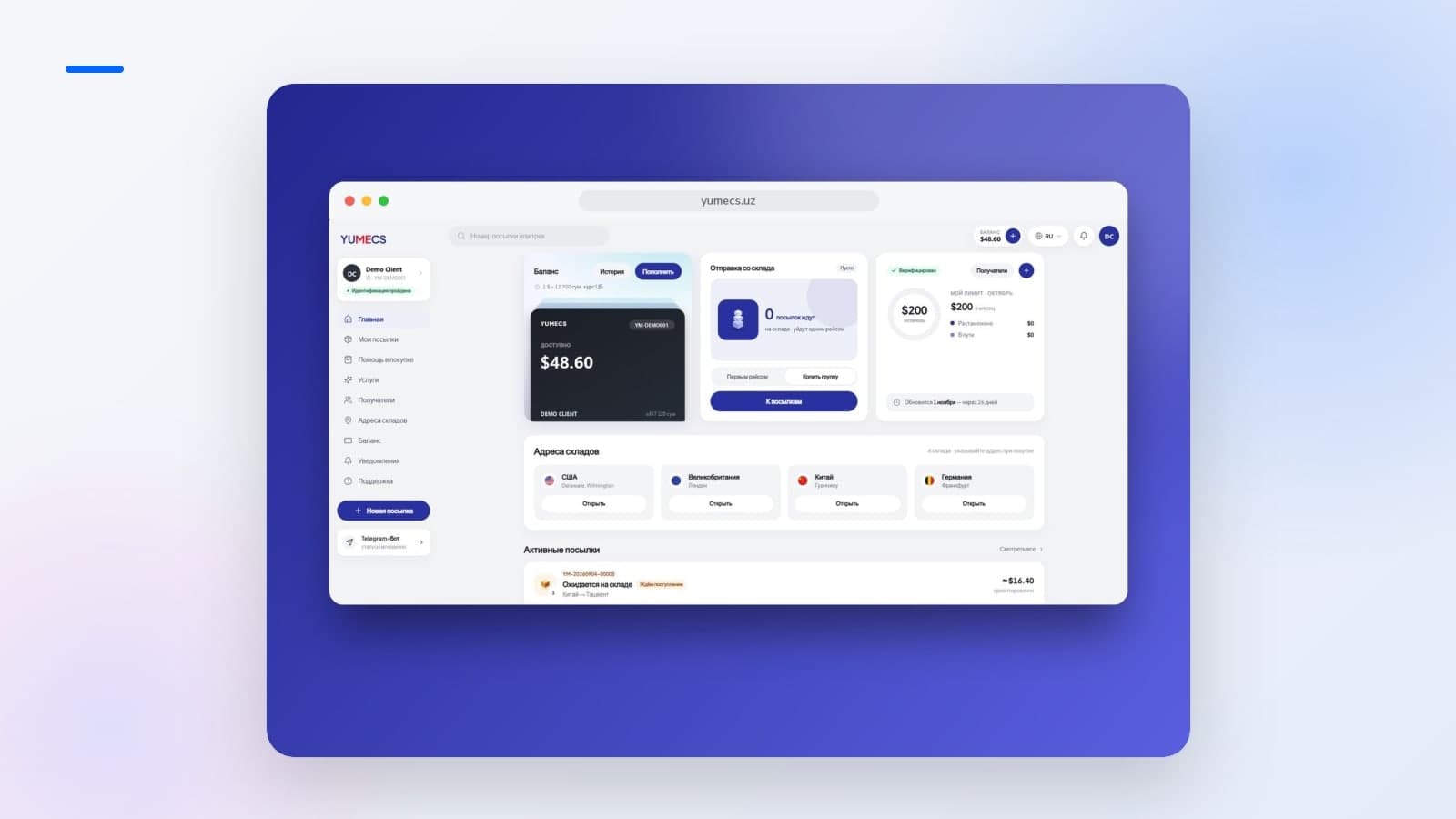
To protect operational bandwidth, forward-thinking brands automate standard workflows. For example, for the international courier service YUMECS, we engineered a unified client portal and parcel management system: shipping costs calculate automatically against central bank currency rates, while order updates and customs duty thresholds trigger instant notifications via a Telegram bot. This removed hundreds of repetitive phone calls from customer service reps every single day.
If you are just starting
When launching a new business line, avoid complex technical architectures or high-retainer agency plans. Your immediate goal is validating product demand with the lowest fixed burn rate possible.
- Register your .UZ domain directly under your company name (up to 80,000 UZS (so'm) per year) and secure an entry-level TAS-IX hosting tier for 36,000 – 40,000 UZS (so'm) per month.
- Launch a clean digital showcase or corporate website with a streamlined order form: in our experience, practical corporate website development featuring a standard catalog takes between 3 and 6 weeks.
- Hold off on paid SMS gateways for minor notification steps; route inquiries and updates through Telegram instead. At early volumes, this costs nothing.
- Accept direct payments via dynamic QR codes or standard acquiring gateways with zero monthly retainers, paying only the 1.5–2.5% fee on closed transactions.
A real case: Lean scaling with strict cost control
In 2023, local retailer Matrix Z entered the consumer electronics and home appliance market with just four team members and a lean IT and storage budget. As covered by Spot.uz, the company adopted an FBS model (fulfillment by seller, keeping inventory in their own facility to cut third-party overhead) and cut recurring operational expenses. In under two years, their team expanded to 8 people, monthly turnover surged to 5–6 billion UZS (so'm), and their single-week campaign during the "11.11" shopping festival generated 3.2 billion UZS (so'm) in orders.
If your business is already running
When managing hundreds of orders every week, manual bottlenecks cost far more than premium servers and software. At this stage, your technical investment must focus on seamless database synchronization and eliminating downtime.
- Migrate your platform to an isolated virtual private server (VPS) inside TAS-IX for 120,000 – 450,000 UZS (so'm) monthly, ensuring flash sales and seasonal ad traffic never trigger a server crash.
- Build direct, automated catalog and inventory sync with 1C, MoySklad, or your core database: professional CRM development and automation prevents customer disputes by eliminating out-of-stock purchases.
- Put a formal Service Level Agreement (SLA) in place with an engineering team to guarantee rapid response times for production outages (900,000 to 3,000,000 UZS (so'm) per month).
- Automate real-time fiscal receipt generation via a cash gateway and Didox so your accounting team is not generating tax receipts by hand for individual sales.
A real case: Scaling a national e-commerce platform
Online retailer Asaxiy.uz evolved from a niche online bookstore into one of Uzbekistan's prominent e-commerce ecosystems. Founder Firuz Allayev structured his IT budget by separating user-facing store development ($1,000 – $20,000) from operational automation (linking 1C, warehouse, CRM, server infrastructure, and call centers), allocating an initial budget of $40,000 – $50,000 inclusive of recurring technical upkeep, as reported by Spot.uz. Automating stock controls proved its return on investment by allowing nationwide delivery scaling without requiring an army of manual customer support staff.
How to Calculate Your Website's Return on Investment
Measuring your website's ROI requires looking beyond top-line revenue—you must also calculate the cost saved on order processing. Here is a clear formula to run the numbers:
Net monthly economic impact = (Gross profit from online orders + Staff hours saved) – (Monthly hosting, software, and maintenance expenses).
If an online storefront brings in 5,000,000 UZS (so'm) in net product margin, while your VPS, Didox, SMS gateway, and support retainers total 2,200,000 UZS (so'm), your digital channel delivers 2,800,000 UZS (so'm) monthly toward paying down initial development costs. Conversely, if you process only 10 sales a month while paying an agency 3,000,000 UZS (so'm) without meaningful work being delivered, your infrastructure is operating at a net loss.
Frequently Asked Questions
How much does it cost to maintain a website each month in Uzbekistan?
For a standard business website, baseline expenses run from 36,000 to 120,000 UZS (so'm) per month for TAS-IX hosting, along with an annual domain renewal. For an e-commerce store with automated fiscalization, SMS verifications, and professional technical support, regular overhead averages between 1,300,000 and 3,800,000 UZS (so'm) monthly.
Is a monthly agency support contract mandatory?
No. Simple informational sites without frequent updates do not require ongoing retainers; maintaining reliable hosting and hiring developers hourly on demand is often enough. A dedicated monthly SLA (from 900,000 UZS (so'm) monthly) is essential for online stores where even brief outages mean lost revenue and failed transactions.
What are the most common hidden expenses when operating an online store?
Most business plans miss transactional SMS costs for order updates (85–95 UZS (so'm) per message), monthly software subscriptions for fiscal cash registers and EDO systems (90,000 to 290,000 UZS (so'm)), and card acquiring fees (1.5% to 2.5% per successful checkout).
If you need an accurate maintenance cost projection for your project or want to optimize your web stack to eliminate unnecessary fees, reach out through our contacts page. We will evaluate your business goals and give you an objective breakdown of what infrastructure you need today and what can wait.
Sources
- Matrix Z · spot.uz
- Asaxiy.uz · spot.uz
- Тарифы интернет-магазина и сопутствующих сервисов в Узбекистане — Doirastan.uz
- Прайс-лист на разработку и поддержку сайтов в Ташкенте — Optimize.uz
- Техническая поддержка и обслуживание сайтов в Узбекистане — Samsa.agency
- Инфраструктура e-commerce и фулфилмент в Узбекистане — Spot.uz
- Цены на создание и обслуживание сайтов в Ташкенте — Megagroup.uz
- uzcloud.uz
- bitrix24.uz
- innobek.uz