Building a Food Delivery Website: Turnkey Platform vs. Custom Development
We break down how food delivery websites differ from standard online stores, how much launching costs in UZS (so'm), and how to connect your site directly to your POS.
Building a food delivery website in Uzbekistan costs from 1,300,000 UZS (so'm) per month when renting a turnkey restaurant platform, or between 8,000,000 and 11,500,000 UZS (so'm) for custom web development with POS integration. Launching on a pre-built solution takes 7–14 business days, while bespoke development with custom delivery zones and online payments takes 2 to 5 weeks. Choosing the right path depends on whether you need to quickly test a menu or establish an independent sales channel free from monthly third-party commissions.
In Brief
- Food delivery aggregators take a 20–30% commission on every order, making a proprietary website an investment that pays for itself by protecting your profit margins.
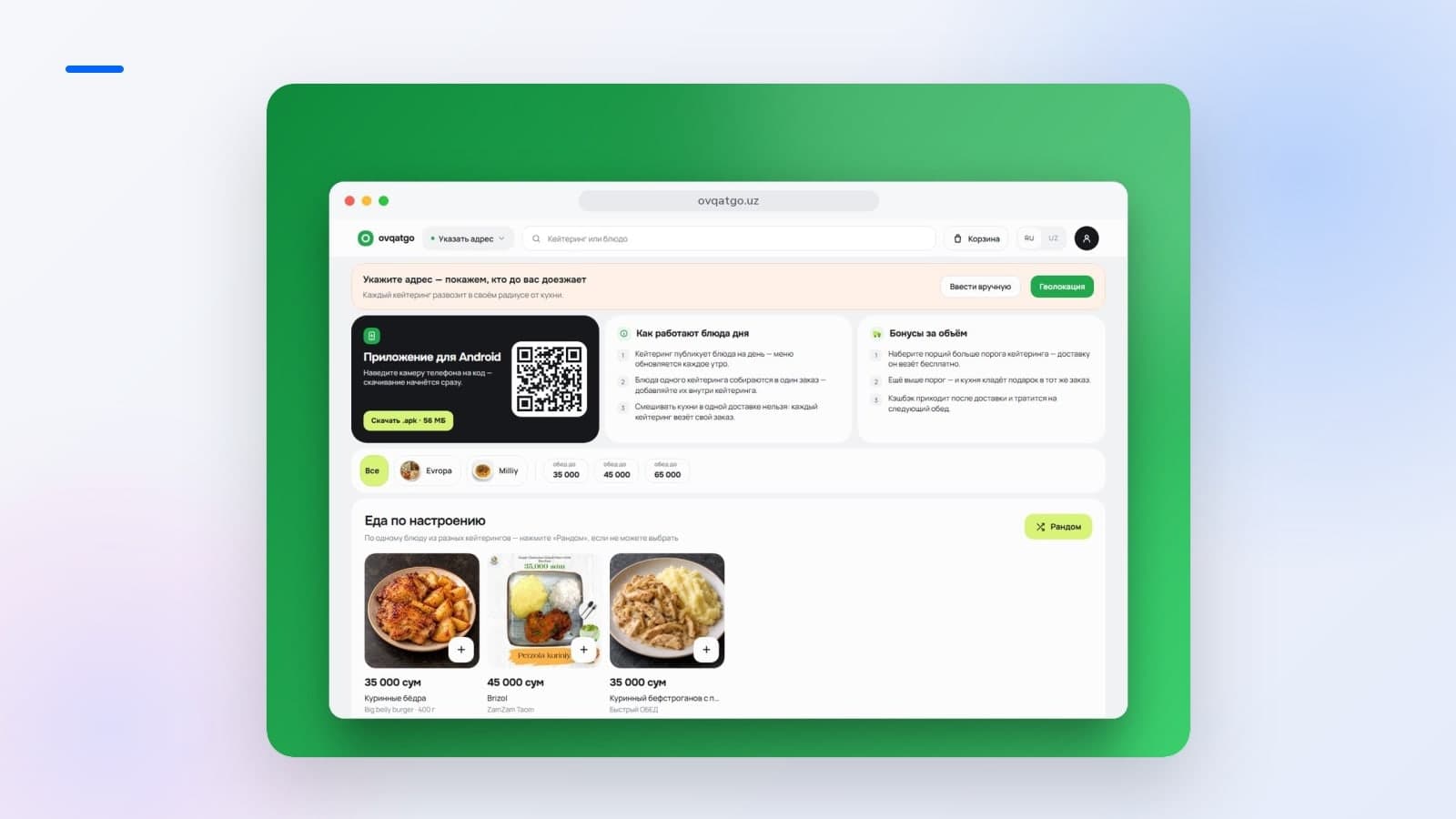
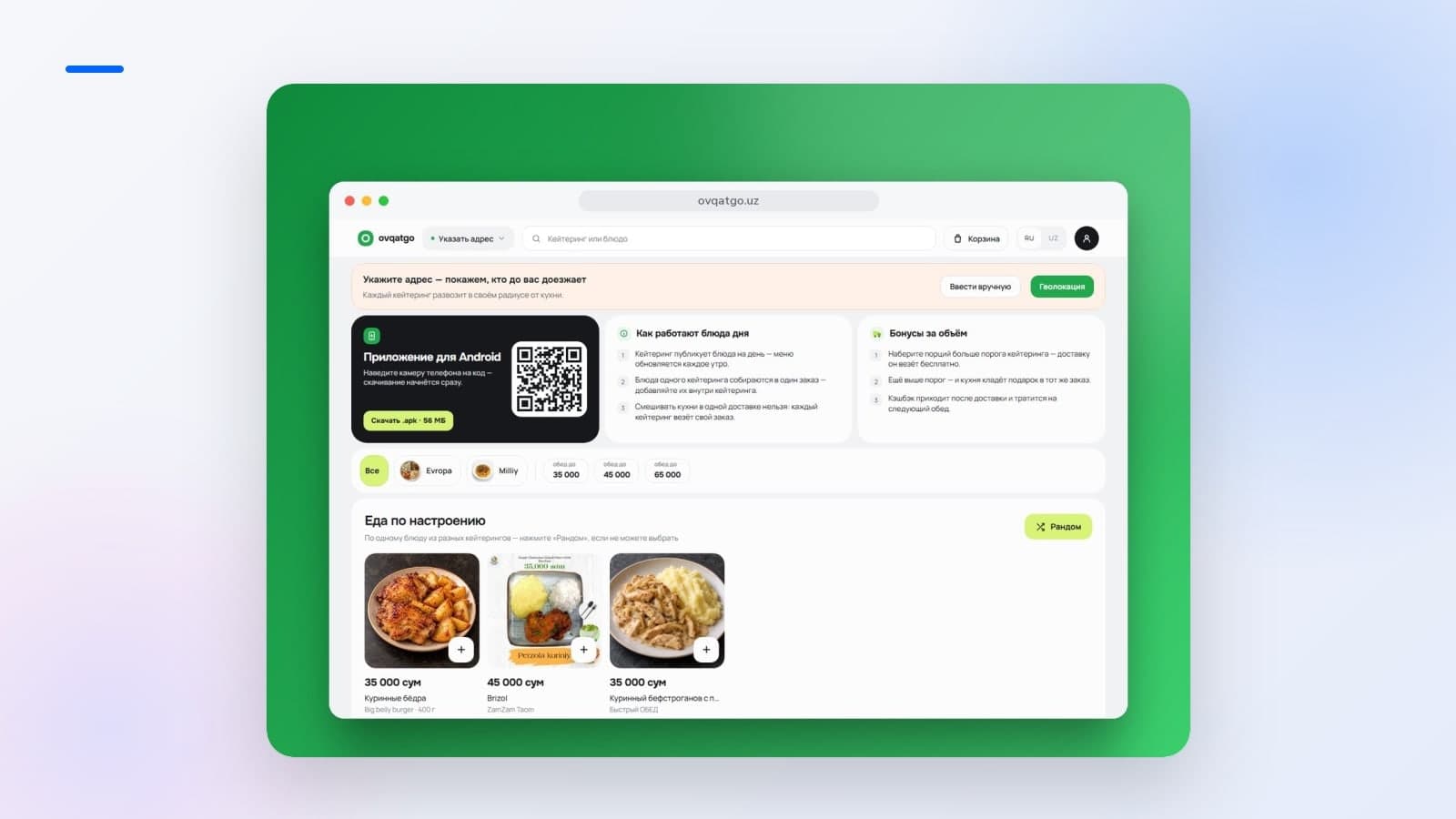
- Food service websites require delivery map geofencing, dynamic stop-lists, and portion modifiers—features not found in standard CMS templates.
- Renting an industry SaaS solution starts at 1,300,000 UZS (so'm) per month, whereas custom website development with POS integration starts at a one-time cost of 11,500,000 UZS (so'm).
- Direct synchronization with iiko, Jowi, or Poster pushes orders to the kitchen display screen or receipt printer instantly with zero manual entry.
How Food Delivery Differs from a Standard Online Store
Trying to run a food delivery service on a typical retail e-commerce template often leads to operational breakdowns on the very first evening. In conventional retail, orders are picked and packed over hours or days; in a commercial kitchen, every minute counts. If your website does not accommodate restaurant workflows, staff waste valuable time re-entering orders into the POS system, while couriers get dispatched to unprofitable delivery zones.
- Polygon-Based Delivery Geozones. Instead of flat-rate citywide delivery, restaurants require precise polygons on Yandex Maps: a free delivery zone around the kitchen, tiered pricing by district, or automated dynamic distance calculations.
- Modifiers and Combos. Guests frequently customize their orders—choosing portion sizes, meat doneness, pizza toppings, or asking to remove onions from a salad. The checkout cart must relay these parameters seamlessly to the kitchen receipt.
- Real-Time Stop-List Synchronization. When the kitchen runs out of tenderloin, the dish must instantly disappear from the website. Without this automated sync, managers are forced to call customers back to cancel or alter orders.
- Direct Kitchen Routing. Every order should print immediately on the chef's service printer or pop up on the Kitchen Display System (KDS) without requiring manual dispatcher approval.
If you only need a straightforward product catalog without intricate kitchen workflows, traditional e-commerce website development is a more economical option. However, hot meals and catering require an entirely different architecture.
Launch Options: Comparing Costs and Timelines
According to data from Tashkent agencies, a basic online menu showcase starts at 2,000,000 UZS (so'm) with a turnaround time of 5 business days, as reported by MXMEDIA. A full-fledged online ordering store featuring an interactive catalog, delivery zones, Click/Payme integration, and Telegram notifications starts from 8,000,000 UZS (so'm), with POS system integration adding another 3,500,000 UZS (so'm) to the budget. Specialized SaaS platforms serve as a ready-made alternative.
| Feature | Turnkey SaaS Platform | Custom Website with POS Integration |
|---|---|---|
| Launch Cost | From 1,300,000 UZS (so'm) per month (Start plan up to 1,000 orders), per data from Delever | From 11,500,000 UZS (so'm) one-time (website from 8M + integration from 3.5M, per data from MXMEDIA) |
| Launch Timeline | 7–14 business days | 3–5 weeks based on our project experience |
| Subscription Dependency | Yes; subscription fees increase as order volume scales | No; you only pay for standard hosting and domain registration |
| Design Flexibility | Constrained by pre-built platform blocks | Tailored UI/UX built around your brand identity |
| Best For | Small cafes, new food startups, single-item concepts | Restaurant chains, dark kitchens, and catering providers |
Integrating with Restaurant POS Systems
According to Delever, the restaurant sector in Uzbekistan is dominated by POS systems like Jowi (~30% market share, from $24/month), iiko (~40% across the CIS, from $30/month), and Poster ($14 to $25/month). Integrating your website with these platforms routes incoming orders directly to the kitchen display or service printer in real time, completely bypassing manual handling by an operator.
Once an order is confirmed and paid via Click or Payme, it lands in the restaurant's POS system as an open check. Kitchen staff see the dish and modifiers, the expediter receives a packing slip, and courier services get the exact delivery pin on the map. We explored multi-channel order orchestration in detail in our guide to CRMs for food delivery and catering.
If you are just starting
If you are launching a new concept, a dark kitchen, or an office lunch delivery service, committing a large budget to complex custom development right away is rarely practical: your menu and logistics will inevitably shift.
- Choose a POS with an open API. Implement Poster, Jowi, or iiko. Automating delivery is virtually impossible without sound core tracking for ingredients and inventory.
- Adopt a ready-to-go delivery SaaS module. Renting an industry platform for 1,300,000 UZS (so'm) per month gets your ordering website and web widget live within 7–14 days.
- Define 1–2 initial delivery zones. Keep your radius to a compact 3–5 km to ensure your kitchen staff and couriers can handle rush-hour demand smoothly.
- Test market demand. Begin processing direct orders, assemble your customer contact database, and benchmark your actual fulfillment times.
A real case: Express 24 / Be.Kitchen ("Fast Lunches")
A culinary venture in Tashkent built around a streamlined daily menu initially tested a mobile van-selling model where drivers repeatedly returned to a central kitchen, leaving customers waiting up to 40 minutes for their food. The team phased out this inefficient workflow and shifted to a tech-enabled dark kitchen model featuring its own direct ordering website, mobile app, and zone-based courier dispatch. As a result, lunch wait times dropped to 15 minutes, while online direct orders surged to 500–600 per week within six months, bringing the operation into profitability, as reported by spot.uz.
If your business is already running
For an established restaurant or chain, delivery aggregator fees (Uzum Tezkor, Yandex Eats, Express24) taking 20–30% out of every ticket cut deeply into bottom-line profits, as noted by research from ndc.uz. In this scenario, developing a custom integrated website quickly pays for itself by shifting loyal patrons into direct ordering channels.
- Sync your menu directly from your POS. Set up automated catalog sync for item names, prices, descriptions, and photos straight from iiko or Jowi so you never have to manage menus in two places.
- Map out delivery zones across Tashkent. Implement tiered pricing rules: for example, free delivery on orders over 150,000 UZS (so'm) within a 5 km radius, and calibrated rates for outer districts.
- Integrate local payment gateways. Connect checkout processing through Click, Payme, or Uzum Bank with automated fiscal receipt generation.
- Drive traffic to your direct channel. Include promotional inserts offering discounts on first direct website orders inside every bag dispatched through third-party couriers.
A real case: Uzbek Cuisine Restaurant Chain in Tashkent
A chain of 4 traditional Uzbek restaurants in Tashkent operated primarily via third-party delivery apps, sacrificing up to 30% of each ticket in commissions without having a direct digital ordering channel connected to their cash registers. The management deployed a custom branded delivery website featuring district-based pricing across all 11 Tashkent districts, Click/Payme payments, and two-way integration with iiko. Within 3 months, 47% of total delivery orders moved to the restaurant's direct channel, unlocking commission savings and generating +180 million UZS (so'm) in net annual revenue, according to case data by Zoomda.
Specific Considerations for Catering Websites
Building a website for catering operations differs considerably from designing a standard fast-food ordering site. Catering clients rarely order a single meal for immediate delivery; instead, orders are planned days ahead for groups numbering dozens of guests. These projects call for specialized UX/UI design for websites and apps that makes estimating banquet menus and per-guest pricing intuitive.
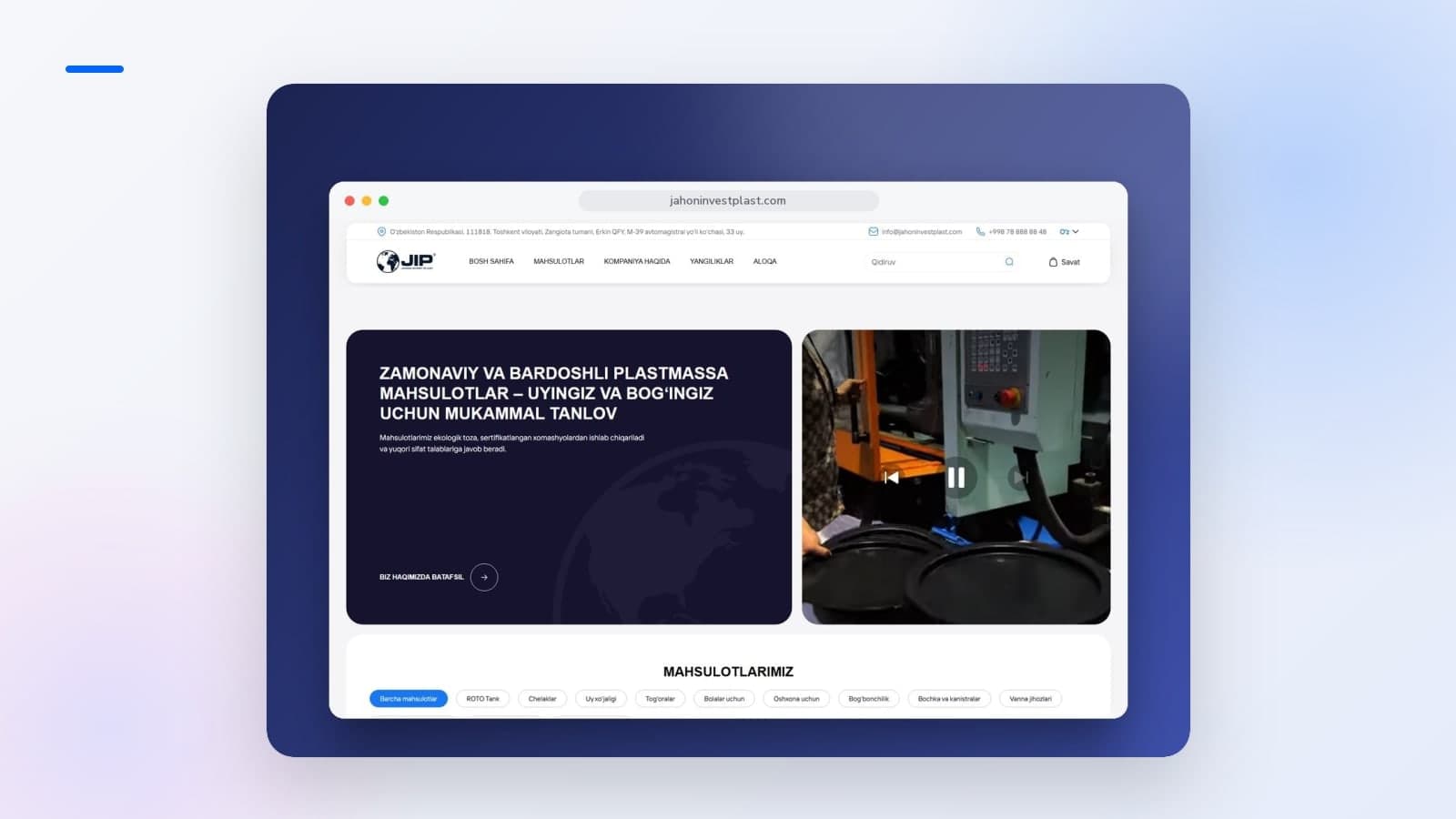
We frequently tackle complex multi-attribute catalogs in our work. For example, during our engagement with Jahon Invest Plast, a plastics manufacturer, we built a multilingual catalog with shopping cart capabilities in Uzbek, Russian, and English, allowing buyers to navigate hundreds of items with exact technical dimensions and packaging specs. The same principles of portioning, event segmentation, and multi-language support apply directly to enterprise catering platforms.
Frequently Asked Questions
How much does it cost to build a food delivery website in Tashkent?
A simple menu showcase starts from 2,000,000 UZS (so'm) according to data from MXMEDIA. A full-featured e-commerce site with cart functionality, Click/Payme processing, and delivery geozones costs from 8,000,000 UZS (so'm), with iiko, Jowi, or Poster POS integration adding another 3,500,000 UZS (so'm). Renting a turnkey platform starts at 1,300,000 UZS (so'm) per month according to Delever.
Can we run delivery without integrating our restaurant POS?
When you are just testing the market, you can route new orders to a Telegram group for your managers. However, once you cross 30 orders a day, manual data entry leads to frequent human errors, forgotten modifiers, and kitchen delays.
How does a catering website differ from regular food delivery?
Catering websites require per-person pricing calculators, calendar availability booking, add-on staffing or tableware rentals, and advance deposit payments. Unlike quick-service food orders, catering features substantially higher average order values and longer customer consideration journeys.
Why build an independent site when we already use Yandex Eats and Uzum Tezkor?
Aggregators are great for customer acquisition, but they take a 20% to 30% cut on every single transaction, as highlighted by ndc.uz. A proprietary website allows you to retain repeat guests, protect your margins on recurring orders, and build an owned customer database.
If you are planning to launch direct delivery or automate order processing for your establishment in Tashkent, reach out to us via our contacts. We will review your menu structure, analyze your POS setup, and help you select the most effective web development approach.