Startup Landing Pages: Microdemos, Waitlists, and Budgets
How tech startups in Uzbekistan can launch a landing page to validate market demand and collect waitlists without wasting budget on code: formats, tech stack, and costs.
A landing page for an IT startup or MVP solves one specific task: confirming real user demand before building the core product, while building an early access waitlist with conversion metrics for investors. A basic landing page to validate a hypothesis starts at 4 000 000 UZS (so'm) and takes 3–7 days to launch, while a custom build with an interactive interface microdemo and end-to-end telemetry costs up to 25 000 000 UZS (so'm) over 2–3 weeks.
In brief
- A startup landing page tests people's willingness to use the product before writing thousands of lines of backend code.
- An interactive UI microdemo replaces lengthy text explanations and clearly showcases the service's core mechanics.
- Connecting the signup form to a Telegram bot allows founders to validate interest and reach out to initial leads within minutes.
- For accelerator selections and competitions like the President Tech Awards, transparent event analytics (clicks, signups, CAC) are mission-critical.
Why a Startup Needs a Landing Page Before the Product Is Ready
The single biggest mistake early-stage tech projects make is spending six months and their entire budget building a complex backend, mobile app, and user dashboard without testing if the market actually needs it. Full-scale development takes time, whereas a focused landing page lets you run ad campaigns, get your first visitors, and measure audience interest within days.
The second reason is institutional program requirements. For instance, the prize fund of the national startup contest President Tech Awards increased to $5M in 2026, with the number of participating teams jumping from 444 to 862, according to it-park.uz. In such a competitive landscape, juries and venture capital funds demand proof of traction: a live link, a clear value proposition, and verified engagement metrics.
MVP Landing Page Formats: Comparing Your Options
Depending on project stage and founder goals, different technical approaches apply. In our client projects, we distinguish between fast no-code site builders for quick experiments and custom development on a modern tech stack to prepare for funding rounds.
| Format | What is included | Timeline | Cost in UZS (so'm) | Best suited for |
|---|---|---|---|---|
| Basic no-code landing page | Hero section with offer, lead form, basic analytics | 3–7 days | 4 000 000 – 7 000 000 | Pre-seed teams, express testing of 1–2 hypotheses |
| Custom pitch landing page | React / Next.js, UI microdemo, multilingual setup (RU/UZ/EN), end-to-end event tracking | 2–3 weeks | 12 000 000 – 25 000 000 | Seed stage, accelerator applicants, B2B SaaS |
According to data from the agency realcoders.uz, a basic no-code landing page for collecting a waitlist costs between 4 000 000 – 7 000 000 UZS (so'm) and takes 3–7 days, whereas a custom React/Next.js build featuring an interactive UI microdemo, three languages, and end-to-end telemetry ranges from 12 000 000 to 25 000 000 UZS (so'm) over 2–3 weeks.
Key Modules of a High-Performing Tech Landing Page
A generic agency-style one-pager rarely brings results because it relies purely on static copy. A high-converting tech startup page needs four functional building blocks:
- Hero section with a crisp value proposition. One clear sentence explaining the exact problem your service solves and who it is built for. The primary call-to-action opens the waitlist or starts the product demo.
- Interactive microdemo (UI Playground). A lightweight interactive component where visitors can adjust sliders, input sample data, or click prototype buttons to experience how the algorithm works without downloading an app. If you need your interface designed from scratch, exploring professional UX/UI design for websites and apps beforehand helps significantly.
- Waitlist mechanics. An early access signup form with clear incentives: closed beta access, a discount on the annual plan, or special early-adopter status.
- Event telemetry. Conversion tracking configured for pricing tier clicks, demo interactions, and form submissions in Yandex Metrica and Google Analytics.
If you are just starting
If you only have an idea or an unstyled prototype, your main objective is to avoid burning cash on heavy architecture. You need to calculate customer acquisition cost (CAC) and conversion rate into early signups.
- Define your core unique value proposition in one sentence without engineering jargon.
- Build a lean page: value proposition, 3 primary benefits, an interface mockup via screenshot or quick animation, and a form collecting email and Telegram handles.
- Set up instant alerts. According to accelerator data from uzcombinator.uz, validating a startup hypothesis in Tashkent using a simple stack of landing page, lead form, and Telegram bot takes starting from 7 days.
- Drive targeted traffic with a test budget of 2 000 000 – 3 000 000 UZS (so'm) to see the first hundred visits and gauge click-through rates.
A real case: waitlists for UzCombinator cohorts
According to data from the accelerator uzcombinator.uz, pre-seed founders lacking a finished mobile app or backend needed to demonstrate Product-Market Fit to investors. The teams launched single-page promotional landing pages with waitlist mechanics, interactive product prototypes, and automated Telegram alerts sent to founders for every registration. As a result, the teams verified their cost per lead in just 1–2 weeks, proved audience demand, and collectively raised over $3.1M on Demo Day.
If your business is already running
If your project is already serving initial customers or preparing for B2B expansion and institutional venture rounds, a basic one-screen builder site is no longer enough. At this stage, you need high-end landing page design and creation or end-to-end corporate website development focused on architectural stability.
- Deploy a custom frontend on React or Next.js to guarantee lightning-fast load times even on slow mobile connections.
- Implement complete multilingual capability. For Central Asian markets, localization across Uzbek, Russian, and English with dedicated indexing is essential.
- Integrate incoming data streams into your corporate CRM, PostgreSQL database, or internal analytics dashboards via custom webhooks.
- Showcase verified traction metrics: active user count, transaction volume, current partner logos, and data security certifications.
A real case: Layf's multilingual B2B landing page
As reported by uzdaily.uz, Uzbek e-commerce AI startup Layf was preparing to raise an institutional round and expand across Central Asia and the Caucasus. The team created a targeted multilingual landing page showcasing its B2B integrations for banks and online marketplaces, backed by transparent traction figures and a partner onboarding flow. Consequently, the startup won at the Digital Startup Awards, secured $100 000 (including a SAFE round from IT Park Ventures and a local venture fund), and established partnerships across Uzbekistan, Kazakhstan, and Tajikistan.
A real case: showcasing a new product with Business Connect
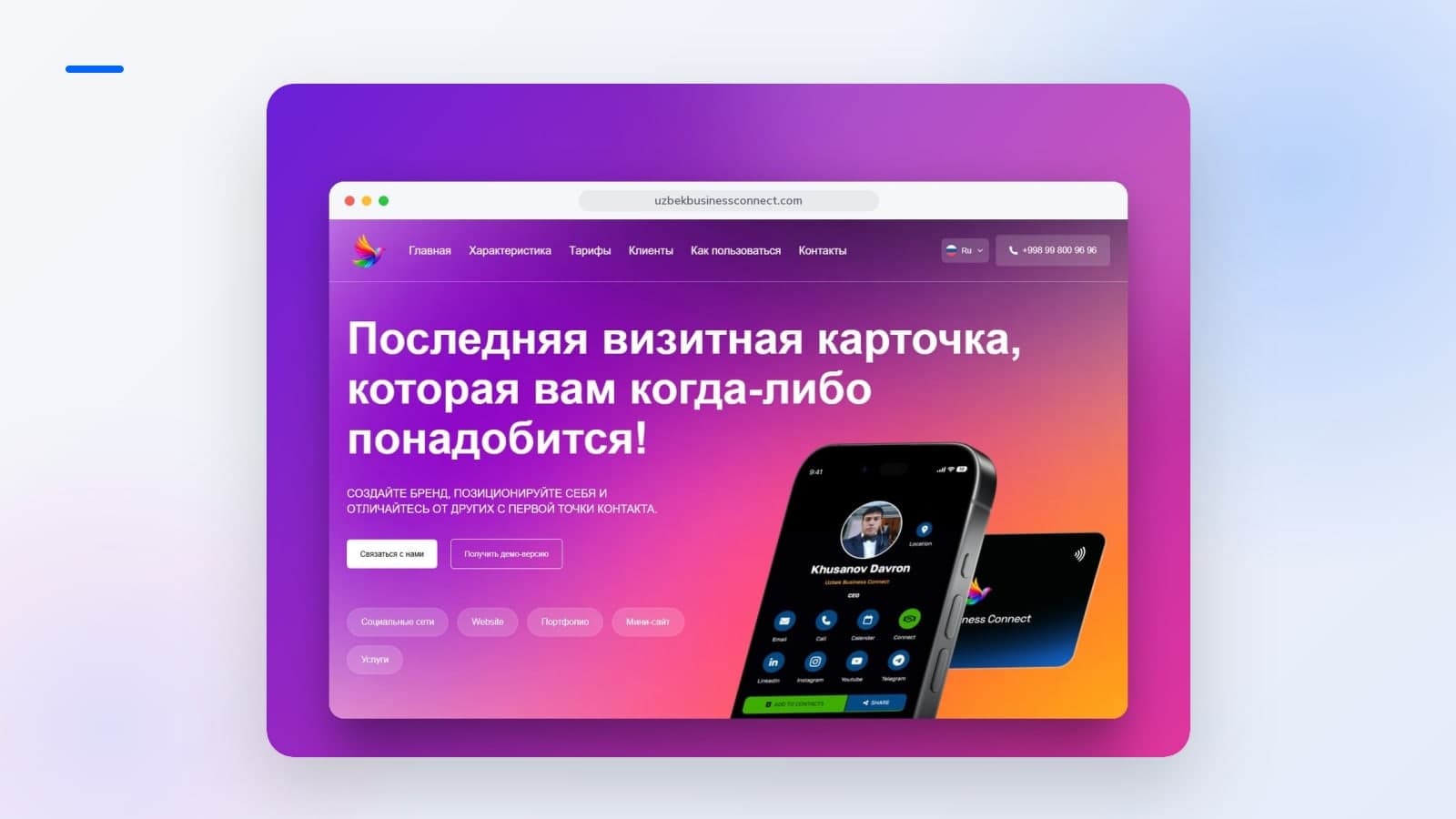
We solved a similar challenge when building the landing page for digital business card service Business Connect. Smart business cards were unfamiliar to many local prospects, so the site had to quickly illustrate how the product worked and guide visitors straight to plan selection. We designed a clear one-page layout featuring interactive phone mockups, transparent pricing breakdowns, a plan-specific lead form, and full bilingual support in Uzbek and Russian.
What to Avoid When Launching Your Promo Page
- Bloated code and heavy unoptimized video. If your page takes more than three seconds to load on a smartphone, over half of your paid ad traffic will bounce before the hero section even renders.
- Overly long forms. Request only what is strictly necessary to start a conversation during hypothesis validation: name, Telegram handle, or phone number. Asking for ten fields slashes conversion rates immediately.
- Missing click telemetry. Without goal tracking configured on buttons and forms, you cannot prove to investors what percentage of visitors expressed genuine interest. We also explored best practices for lead capture architecture in our guide to landing pages for legal practices in Tashkent.
Frequently Asked Questions
How much does it cost to build a tech startup landing page in Tashkent?
A basic landing page on a no-code platform to test a hypothesis and gather a waitlist ranges from 4 000 000 to 7 000 000 UZS (so'm). A custom landing page featuring an interactive UI microdemo, RU/UZ/EN localization, and end-to-end web analytics costs between 12 000 000 and 25 000 000 UZS (so'm).
How long does it take to build an MVP landing page?
Setting up a basic solution integrated with Telegram takes 3 to 7 days. A custom, full-service build with responsive design and interactive elements typically requires 2 to 3 weeks based on our project experience.
Do I need multiple languages on a pre-seed landing page?
If you are testing a consumer product solely in Tashkent, one or two languages (Uzbek and Russian) are sufficient to start. If you are pitching international funds or applying for global grants, an English version becomes mandatory.
Should I choose a no-code builder or custom development?
For an initial 7–10 day hypothesis test, a reputable site builder works great. Once the startup prepares for institutional fundraising or needs to demonstrate custom algorithmic interfaces, investing in clean React/Next.js code is the safer long-term choice.
If you are planning an MVP launch or preparing for a startup competition, get in touch with us via NDC contacts. We will help you structure your waitlist, select the ideal landing page format, and calculate an exact project estimate without unnecessary coding expenses.