Logistics Website Shipping Rate Calculator: CBM and Fleet Matching
How to implement an accurate shipping rate calculator and online vehicle booking system using volumetric CBM, local fleet sizing, and direct CRM integrations.
To prevent logistics companies in Uzbekistan from losing inquiries and wasting dispatcher hours, websites are implementing interactive calculation modules based on volumetric weight (CBM) and commercial vehicle types. Based on our projects in Tashkent, developing such a solution costs between 12,000,000 and 25,000,000 UZS (so'm) and takes 3 to 5 weeks (ndc.uz), eliminating rate disputes and automating booking transfers to CRM, 1C, and Telegram.
In brief
- Volumetric weight in Uzbekistan is calculated using the formula: length × width × height (cm) ÷ 6000 for domestic shipments and ÷ 5000 for international routes, with rates applied to whichever value is higher (emu.uz).
- The module must incorporate a granular breakdown of Uzbekistan's commercial fleet: Labo/Damas, Porter/Gazelle, Isuzu, and 20-ton freight trucks (gruzovichkof.uz).
- Integration with Telegram and 1C eliminates manual data entry and cuts booking confirmation turnaround.
- A custom turnkey module costs 12–25 million UZS (so'm) with a launch timeline of 3–5 weeks (ndc.uz).
Why logistics needs a calculator with volumetric weight and fleet selection
Most generic website scripts and plugins calculate distance strictly in a straight line. For real-world logistics in Uzbekistan, that approach falls short: lightweight foam panels take up the entire cargo bay of an Isuzu, while a heavy metal spare part easily fits into a Labo trunk yet exceeds its payload limit. When a website gives customers an unrealistic estimate, dispatchers have to call back, quote a higher rate, and deal with lost orders.
A well-built module tackles three tasks: it automatically converts cubic meters (CBM) into volumetric weight, matches cargo dimensions to Uzbekistan's standard commercial fleet sizes, and instantly generates a finalized booking request for a specific date.
The CBM formula and fleet classification in Uzbekistan
According to freight standards in Uzbekistan, the standard volumetric weight formula is: length × width × height (in cm) ÷ 6000 for domestic transport and ÷ 5000 for international consignments (emu.uz). The final charge is always billed against whichever is greater: the actual physical weight on the scale or the calculated volumetric weight.
To select the right vehicle, the calculator algorithm must support at least four common cargo categories used in Uzbekistan's market (gruzovichkof.uz):
- Compact urban vans (Labo, Damas): payload up to 0.5 t, usable volume up to 2 m³. Ideal for small commercial batches, e-commerce packages, and carton boxes.
- Light commercial trucks (Changan, Porter, Gazelle): payload 1.2–1.5 t, volume 7–9 m³. Designed for local deliveries of furniture, building supplies, and equipment.
- Medium-duty trucks (Isuzu): payload up to 5 t, volume 18–20 m³. Fit for intercity routes, regional distribution, and palletized shipments.
- Heavy-duty vehicles (euro-trailers): payload 20–22 t, volume 82–92 m³. Best suited for long-distance wholesale Tashkent-to-region shipments or international transit.
Beyond base mileage and weight, algorithms include practical local options: refrigerated container modes (+35% to standard rates), cargo escort or courier pickup starting from 30,000 UZS (so'm), and declared value cargo insurance at 1% of the valuation (bts.uz).
Comparing deployment options for your website
Before kicking off development, evaluate your business scale and current operational software. The table below outlines general cost and timeline benchmarks:
| Solution | Timeline | Cost (UZS) | Best suited for |
|---|---|---|---|
| No-code widget form | 3–7 days | 2,000,000 – 5,000,000 | Independent drivers with 1–2 vehicles and flat urban rates |
| Custom rate & booking module | 3–5 weeks | 12,000,000 – 25,000,000 | Freight and cargo carriers with mixed fleets and LTL shipping (ndc.uz) |
| Client portal with billing & API | 2–3 months | from 35,000,000 | National logistics networks, customs brokers, and 3PL fulfillment |
If you are just starting
If you run a small transport company or dispatch office, avoid complicating the user interface with unnecessary integrations.
- Build a clear rate grid in a spreadsheet. Set fixed minimum dispatch rates and per-kilometer pricing for urban and intercity routes across two core vehicle classes (such as Labo and Gazelle).
- Add a calculation form to your site. Let shippers select points A and B, enter dimensions, and see a transparent price. If you need a stable platform, explore our corporate website development service.
- Send lead notifications to a Telegram team chat. Your dispatchers will see shipper contact details, route info, and calculation data with zero delay.
- Timeline and budget: a reliable basic calculator with a web request form can be launched in 1–2 weeks with a budget between 5,000,000 and 8,000,000 UZS (so'm) based on our past projects.
If your business is already running
For established transport companies with regional branches and larger fleets, a calculator transforms from a simple form into a system that unloads dispatchers and creates orders automatically.
- Sync the module with your operations software. Implement CRM development and integration or a direct link to 1C, so that incoming web orders generate a vehicle transport order, reserve a loading slot, and issue a trip ticket for the driver. For more details on accounting systems, see our guide on ERP systems for transport companies.
- Automate capacity thresholds and CBM. Integrate the standard 6000 divisor and automatic fleet suggestions based on weight and volume to avoid underquoting.
- Add digital payments and live shipment tracking. Let customers pay upfront and follow truck status updates through a Telegram bot. For an in-depth look at designing logistics software, check out our piece on freight forwarding applications.
- Timeline and budget: building an end-to-end booking module integrated with 1C and CRM takes 3–5 weeks and ranges from 12,000,000 to 25,000,000 UZS (so'm) (ndc.uz).
A real case: LTL groupage calculator for BTS Express
Logistics carrier BTS Express Cargo Servis experienced excessive call center overhead handling manual quotes for consolidated and oversized freight across Uzbekistan. The company rolled out an interactive online calculator on its website featuring dimensional inputs (length/width/height/weight), delivery options for warehouse-to-warehouse or door-to-door, and a courier dispatch tool tied to vehicle types ranging from parcel vans up to 5-ton trucks (bts.uz).
As a result, shippers receive an instant estimated quote and a tracking code right at checkout, while dispatchers receive pre-filled digital orders with complete dimensions without needing manual phone measurements (bts.uz).
A real case: resolving freight density disputes at EMU
At EMU (Express Mail Universal), shippers sending light yet bulky packages frequently contested final branch invoices that relied solely on physical scale weight. To eliminate misunderstandings, the carrier incorporated a transparent CBM formula (divisor 6000 for domestic routes), automatic charge calculation using whichever weight is higher (actual vs. volumetric), 1% cargo insurance calculations, and pickup requests into its web module (emu.uz).
This implementation reduced counter disputes across regional parcel pickup points and secured a consistent stream of direct web bookings (emu.uz).
A real case: YUMECS international delivery portal
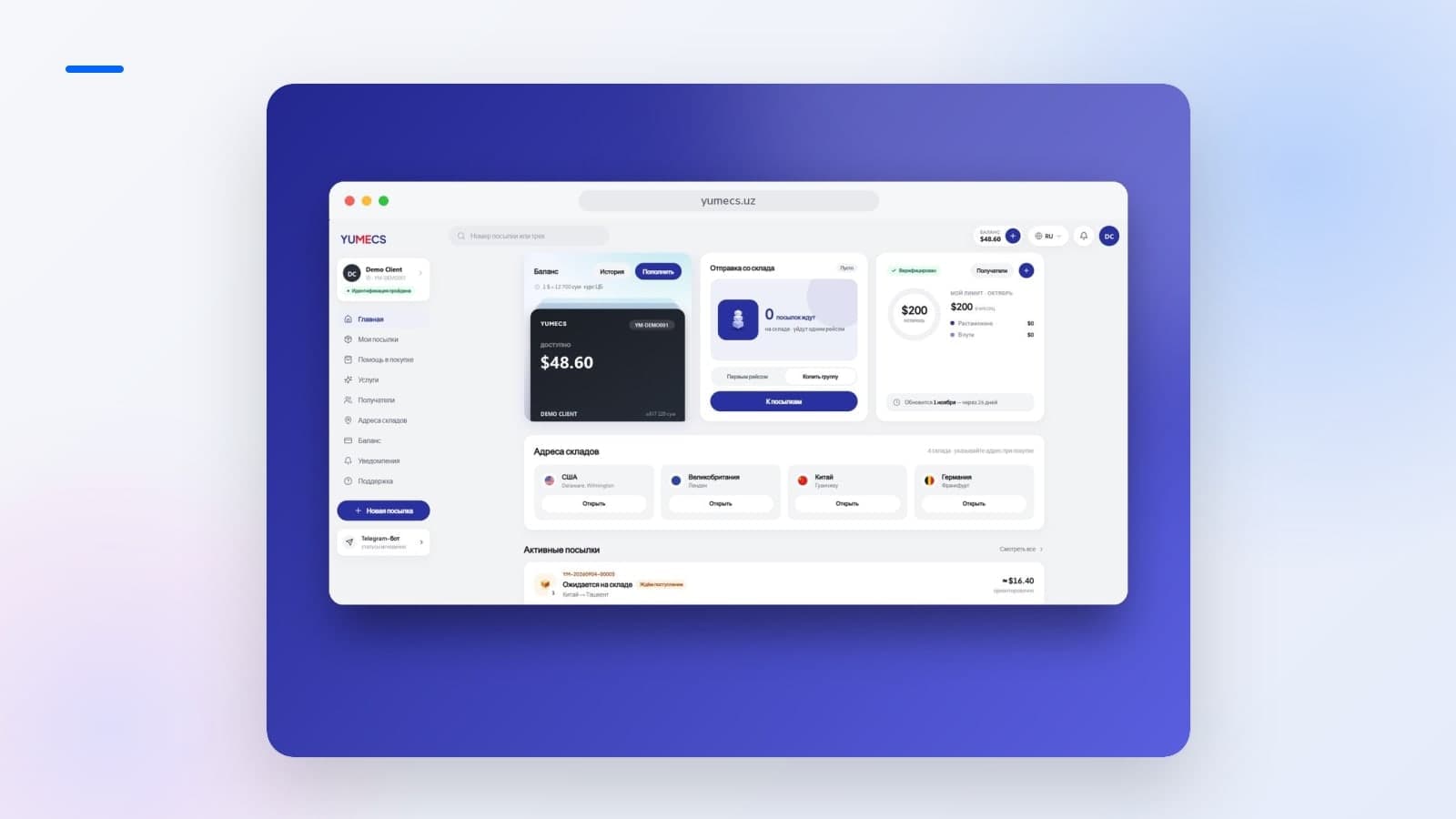
For cross-border delivery service YUMECS, the NDC team engineered a business automation platform and customer portal (YUMECS project). Customers order products from international retailers and forward them through company-managed transit warehouses. Handling queries about balances, warehouse addresses, and package statuses manually was placing a heavy burden on support staff.
We developed a dedicated self-service customer portal that manages USD balances calculated using Central Bank exchange rates, displays personal warehouse addresses in the US, UK, China, and Germany, lists packages, and tracks monthly duty-free customs allowances. Status changes are automatically dispatched to users via a Telegram bot, answering routine questions without phone calls to operators (YUMECS project).
Frequently asked questions
How does a freight shipping calculator work for websites in Uzbekistan?
Users input pickup and drop-off points, weight, and package dimensions (length, width, height). The system multiplies the measurements and divides by 6000 to calculate volumetric weight in line with domestic logistics standards (emu.uz). It then compares this figure to the actual scale weight, picks whichever is higher, and calculates the final quote based on distance and the appropriate vehicle class.
How much does it cost to build a cargo rate calculation module?
Based on experience across Tashkent agencies, developing a custom interactive calculator with automated vehicle matching (from Labo to multi-ton trucks), map routing, and CRM or Telegram integration costs between 12,000,000 and 25,000,000 UZS (so'm) (ndc.uz). The typical turnaround time is 3 to 5 weeks.
Can we set up Gazelle or freight truck bookings in Tashkent directly via Telegram?
Yes. The web calculator can be synchronized with a Telegram Web App (mini-app) or a dedicated bot. Customers calculate their quote on the website, while booking confirmations and tracking links are delivered via Telegram, simultaneously routing the order into your CRM dispatch queue.
How can we prevent shippers from understating cargo dimensions during booking?
Website calculators should clearly label rates as preliminary quotes. Order confirmation terms must state that shipments are subject to mandatory control measurement by couriers or warehouse staff using the CBM formula, protecting the carrier from operational losses.
If you want to automate order intake, launch an accurate calculator adapted to your fleet, and reduce dispatcher workloads, contact us through our form on the contacts page. We will audit your pricing logic and propose an efficient technical setup without unnecessary overhead.