Automating food service and delivery: choosing an ERP and connecting with 1C
How to unify orders, kitchen, couriers, and catering into a single ERP with 1C, eliminating perishable food waste and lost tableware at off-site events.
Automating food service and delivery requires uniting the checkout, kitchen, courier logistics, and catering into a single ERP workflow with transaction exports into 1C. Launching a turnkey cloud platform takes from 1 business day with license fees ranging from 484,000 to 1,050,000 UZS (so'm) per month per terminal, while custom inventory tracking for catering and tailored modules takes 4–8 weeks based on our project experience.
In brief
- Cloud restaurant systems handle POS, kitchen display, and couriers, with licenses from official integrators costing between 484,000 and 1,050,000 UZS (so'm) per month per terminal.
- Over 500 food service businesses in Uzbekistan run on the iiko platform with local 24/7 support in Uzbek and Russian featuring response times under 15 minutes.
- For catering, the primary source of hidden losses is not ingredient write-offs, but misplaced tableware, lost textiles, and chafing dish wear, which all require separate reusable asset tracking.
- Training in management accounting and syncing restaurant software with 1C in Tashkent costs around 2,500,000 UZS (so'm) for 8 academic hours.
Hidden accounting pitfalls: raw materials, delivery, and catering
Restaurants with in-house delivery and off-site event services face three distinct accounting workflows under one roof. Running them across disconnected spreadsheets and Telegram chats creates systemic data blind spots:
- Writing off perishable ingredients. Without FIFO batch tracking (writing off stock with earlier delivery dates first), meat, fresh greens, and dairy are written off at average cost, masking actual expiration-date waste.
- Tracking off-site equipment and tableware. Banquets and receptions routinely lose 5–10% of their glassware and cutlery. Standard restaurant tools only write off ingredients against recipe cards, leaving chafing dishes, insulated food carriers, and serving platters outside inventory control.
- Syncing with bookkeeping. Till receipts, payments processed via Humo, Uzcard, and aggregator channels must flow into the 1C accounting system without operators manually keying in invoices.
While a standard retail point needs only basic cashier software, hybrid formats and dark kitchens often require additional custom interfaces, which we deliver through our CRM development and implementation service.
Solution options: off-the-shelf platform vs. custom ERP integration
When choosing an architecture, balance the scale of your operations against the setup budget. The table below outlines estimated costs for the Uzbekistan market.
| Solution | Implementation cost | Monthly operating costs | Deployment timeline | Best suited for |
|---|---|---|---|---|
| Turnkey restaurant ERP (cloud) | From 2,500,000 UZS (so'm) (configuration and training) | 484,000 – 1,050,000 UZS (so'm) per terminal | 1 to 5 days | Cafes, pizzerias, dark kitchens with standardized menus |
| ERP + custom catering module | Based on our project experience: 18,000,000 – 35,000,000 UZS (so'm) | Server hosting + ERP licenses | 4–8 weeks | Catering businesses that rent out event equipment |
| Full custom ERP built from scratch | Based on our project experience: from 50,000,000 UZS (so'm) | Infrastructure maintenance only | 3–5 months | Large restaurant chains with commissary kitchens and wholesale distribution |
To learn more about when ready-made tools fall short for order intake, read our guide on CRM for food delivery: ready-made platforms versus custom software.
How to organize inventory tracking for catering equipment
Glassware, chinaware, linens, and food-warming units require a lifecycle completely different from consumable ingredients. The workflow is organized in four clear steps:
- Tagging and cataloging. High-value assets (deck ovens, mobile grills, insulated carriers) receive unique inventory asset tags, while returnable tableware (plates, glasses, cutlery) is bundled into standardized sets.
- Creating returnable equipment waybills. When dispatching from the warehouse, inventory is reserved specifically for the event alongside prepared dishes and prep goods.
- On-site handover documentation. The catering lead signs an on-site handover certificate with the client or confirms item counts before the banquet starts.
- Return reconciliation and breakage write-offs. Once back at the central depot, storekeepers scan all returned items; shortages or damaged pieces are immediately marked as breakage or invoiced to the client.
If you are just starting
If you are launching a boutique dark kitchen or a local delivery brand, avoid building custom software from day one.
- Adopt a proven cloud inventory solution. According to integrator A-ONE CORP, cloud licenses for Start and Pro plans in Tashkent run from 484,000 to 1,050,000 UZS (so'm) per month per terminal, with checkout and inventory setups achievable in as little as 1 business day.
- Set up basic recipe cards and track raw materials across a single location first.
- Deploy a courier mobile app on delivery drivers' smartphones to monitor delivery drop-off times.
- Rely on standard exports to Excel or a weekly direct batch export into 1C.
For your initial online storefront, a ready-made platform works best, as detailed in our guide on food delivery website development: platforms versus custom builds.
If your business is already running
When your venue operates a dining room, an in-house delivery hub, and banquet catering, manual data entry leads to discrepancies between kitchen prep balances and bookkeeping ledgers.
- Audit your item catalog. Standardize the naming conventions for all raw ingredients between your front-of-house POS and your 1C database into one unified directory.
- Configure a live synchronization gateway with 1C. Daily dish sales, supplier delivery invoices, and write-offs should export automatically every evening.
- Train your food cost accountant and floor manager. According to integrator Kafesoft, hands-on training courses covering cost control, warehouse accounting, and restaurant-to-1C data exports in Tashkent cost 2,500,000 UZS (so'm) for 8 academic hours.
- Introduce customer self-service portals and container tracking. For catering orders, deploy a dedicated interface for quote bookings and tracking equipment returns.
A real case: Sushixan restaurant and delivery chain
Uzbek restaurant and delivery chain Sushixan struggled with fragmented order processing across their dine-in locations and delivery hubs, along with unreliable kitchen inventory balances and inefficient procurement. The team at integrator Kafesoft implemented an integrated ERP ecosystem powered by iiko, linking warehouse inventory directly with sales forecasting models and automated recipe cards. As a result, the chain consolidated dine-in and delivery orders into a unified database, cut administrative routine for management by up to 80%, and trimmed perishable product losses through exact consumption calculations.
A real case: Silk Road Kokand Hotel
The banquet and restaurant operations at the Silk Road Hotel in Kokand needed reliable automation for large-scale events, zero POS downtime, and a steady connection with their hotel management system. Specialists from Kafesoft configured the iiko software suite, receipt printers, and banquet workflows, integrating the entire setup with the Exely hotel platform. This eliminated service delays during major events, automated table bookings, and enabled accurate banquet cost estimates without manual paperwork.
A real case: YUMECS logistics portal by NDC
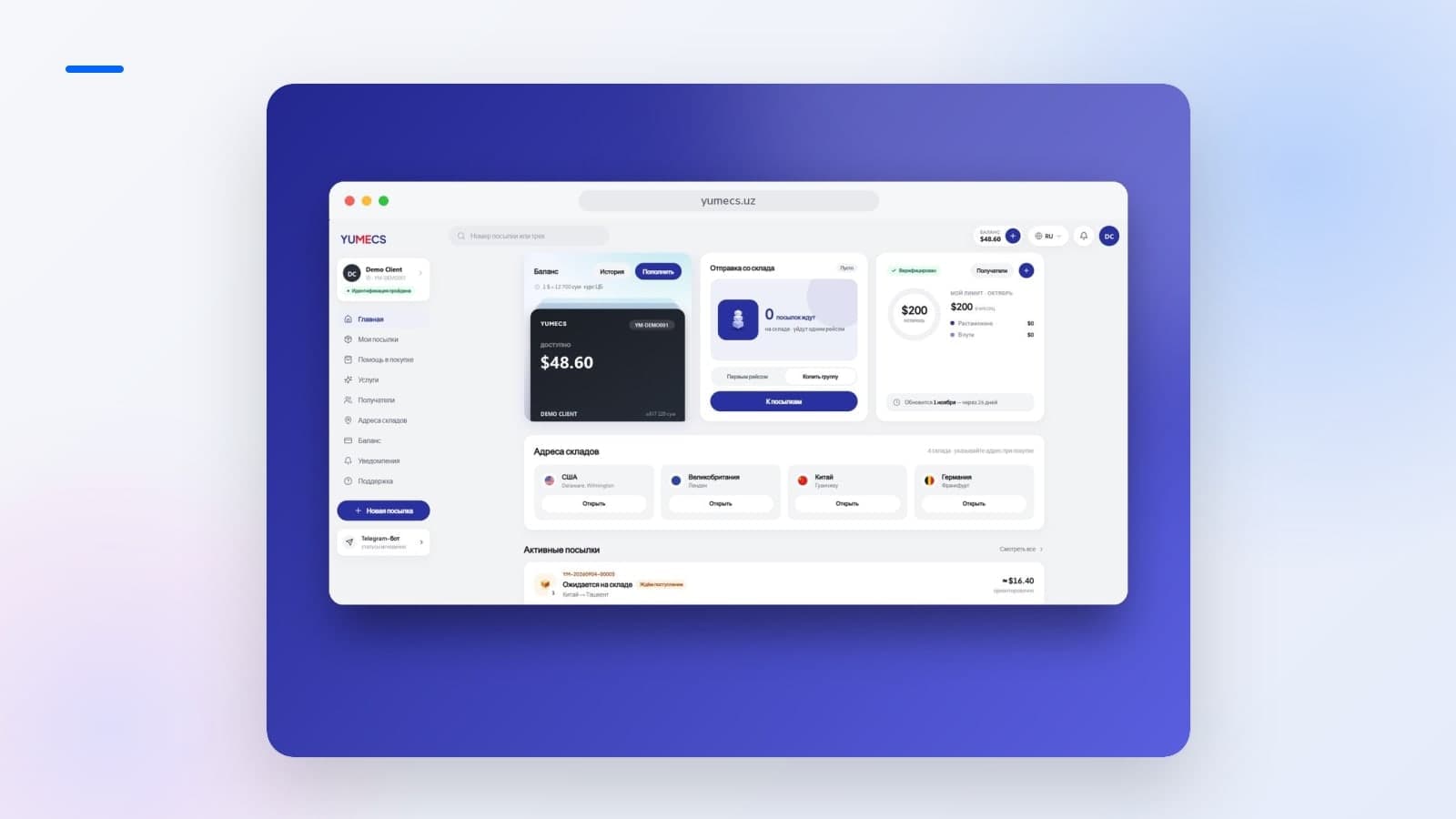
Multi-step operational logistics frequently requires bespoke customer portals. For international courier service YUMECS, the NDC team engineered a complete business automation platform: an account dashboard reflecting live exchange rates from the Central Bank, warehouse hubs across four countries, parcel tracking, automated customs duty threshold calculation, and an instant Telegram notification bot. This exact model of transparent status monitoring and documented custody transfers applies directly to catering operators managing equipment across off-site event teams.
Frequently asked questions
Should we choose an off-the-shelf catering ERP or a custom 1C integration?
The industry standard is a hybrid setup: a dedicated restaurant front-office handles POS operations, incoming orders, and kitchen ingredient write-offs in real time, while a data exchange module exports monetary and stock totals directly into 1C for official accounting and tax filings.
How many food venues in Uzbekistan rely on local restaurant ERPs?
According to Kafesoft, more than 500 restaurants, cafes, and delivery providers across the Republic of Uzbekistan use iiko automation platforms, supported by 24/7 technical assistance in Uzbek and Russian with response times under 15 minutes.
How do you track food delivery couriers within an ERP?
An ERP connects to a courier mobile application. Incoming orders are assigned to available couriers, the app maps the route, logs the exact handover time to the customer, and records payments collected via cash or mobile payment terminals.
If your food delivery service or catering firm needs to merge order processing, inventory controls, and bespoke client workflows, reach out via our contact page. We will analyze your operations and recommend an efficient software architecture without runaway expenses.