Uzum Market timeslot booking bot: ready solutions and development
How to automate booking FBO delivery windows at the Uzum Market warehouse, secure store credentials, and prevent warehouse penalty fees.
To secure an FBO delivery timeslot at the Uzum Market warehouse without spending hours manually refreshing the seller portal, sellers use ready-made Telegram bots with pay-per-booking models or commission custom server scripts. Based on our project experience at NDC, setting up an off-the-shelf bot takes 10–20 minutes, while building a secure internal microservice costs between 4,000,000 and 12,000,000 UZS (so'm) and takes 1–2 weeks.
In brief
- During peak sales events, open warehouse delivery windows disappear within seconds, prompting intermediaries to charge between 100,000 and 200,000 UZS (so'm) per slot according to UPL.uz.
- The maximum Uzum fine for a missed timeslot or failure to cancel at least 48 hours in advance is 300,000 UZS (so'm) under official Uzum regulations.
- Never share direct logins and passwords with third parties: configure automation via API sessions, authorization tokens, or secure private bots.
- Ready-made pay-per-result bots suit early-stage stores, while high-volume suppliers benefit from direct integration with internal inventory software.
The FBO timeslot challenge: why manual booking fails
Delivering goods to the marketplace fulfillment center under the FBO scheme requires a scheduled digital booking. During quiet months, the schedule remains open, but ahead of major promotional campaigns, slots fill up instantly. Cancellations by other sellers open windows randomly and unpredictably.
No operator can manually refresh a browser page every five seconds around the clock. As a result, packed inventory sits idle in supplier warehouses, working capital is frozen, and product listings lose search rankings as stock runs out. We covered the relationship between stock levels and sales ranking in our guide on Uzum Market analytics.
Warehouse penalties and operational rules
Automated Uzum timeslot booking must strictly follow marketplace rules. According to Uzum guidelines, sellers must navigate several firm constraints:
- Non-compliance fine: If a delivery vehicle fails to arrive within the scheduled window or a cancellation is submitted past the deadline, the penalty reaches up to 300,000 UZS (so'm) per consignment.
- Cancellation deadlines: Free rescheduling or cancellation is allowed no later than 48 hours before the reserved delivery time. Unfulfilled deliveries are automatically canceled by the warehouse after 72 hours.
- Consignment limits: A single delivery invoice cannot exceed 100 SKU items. Standard-size goods (small/medium) and oversized freight must be booked on separate consignment notes with independent timeslots.
If an automated tool reserves an incomplete invoice or misclassifies cargo dimensions, the seller faces direct financial penalties and rejected warehouse intake at the gate.
Comparing approaches: ready SaaS bots versus custom software
| Parameter | Ready Telegram bots (SaaS) | Custom script / microservice |
|---|---|---|
| Launch speed | 10–30 minutes | 1–2 weeks |
| Implementation cost | Free setup (pay-per-booking fee) | From 4,000,000 to 12,000,000 UZS (so'm) |
| Cost per slot | From 50,000 to 150,000 UZS (so'm) | 0 UZS (so'm) (server hosting only) |
| Data security | Risk of sharing active sessions with external tools | Full control with credentials kept on your server |
| Integration with 1C / WMS | None | Direct integration via API |
| Best suited for | Sellers making 1–3 deliveries per month | Distributors and brands with continuous shipments |
If you are just starting
If you run an emerging store delivering goods 2–4 times a month, building custom software from scratch is unnecessary. The practical option is using trusted pay-per-result solutions.
- Assemble and confirm the consignment invoice: Pack your items, separate standard goods from oversized cargo, and stay within the 100 SKU limit per document. Set your bot to search only for stock that is ready to ship immediately.
- Select a public service: Look for platforms like UzSellersHelper, where slot monitoring is free and charges apply only after a timeslot is successfully secured.
- Define an acceptable date range: Give your bot an arrival window with at least a 48-hour buffer so you can cancel without incurring the 300,000 UZS (so'm) penalty if unexpected delays arise.
A real case: UzSellersHelper
Local Uzum Market sellers were spending hours manually refreshing intake calendars, missing slots released by canceled shipments. The platform developers launched a background monitoring service and browser extension running 24/7, filtering invoices by date and notifying users of successful bookings via Telegram. As a result, sellers automated slot capture within fractions of a second without keeping open browser tabs, paying strictly for confirmed reservations (sellershelper.uz).
If your business is already running
For established distributors, importers, and manufacturers handling dozens of weekly shipments, external bots present risks: compromised session tokens and recurring booking fees. Sustained operations require a dedicated, private infrastructure deployed as part of broader CRM development and implementation or logistics automation.
- Isolated access control: The script runs on your dedicated server in Tashkent. Authentication tokens remain encrypted and are never exposed to external databases.
- ERP and WMS synchronization: The bot communicates directly with your internal 1C system or warehouse software. Once the warehouse packs 100 SKU items, the consignment invoice generates automatically, and the script begins querying the logistics hub calendar.
- Multi-account scheduling: The system balances bookings across separate legal entities, verifies parcel dimensions, and prevents transport dispatch overlaps.
A real case: automated server-side monitoring
Enterprise sellers managing multiple brands on Uzum Market experienced revenue losses and missed delivery targets because they could not secure intake slots for seasonal inventory. A specialized developer deployed a dedicated Telegram bot supporting multi-account management, warehouse filtering, and box-count verification prior to booking. The sellers moved monitoring to 24/7 automation, eliminated warehouse idle time, and avoided intake fines caused by mismatched cargo volumes (sanjardev.uz).
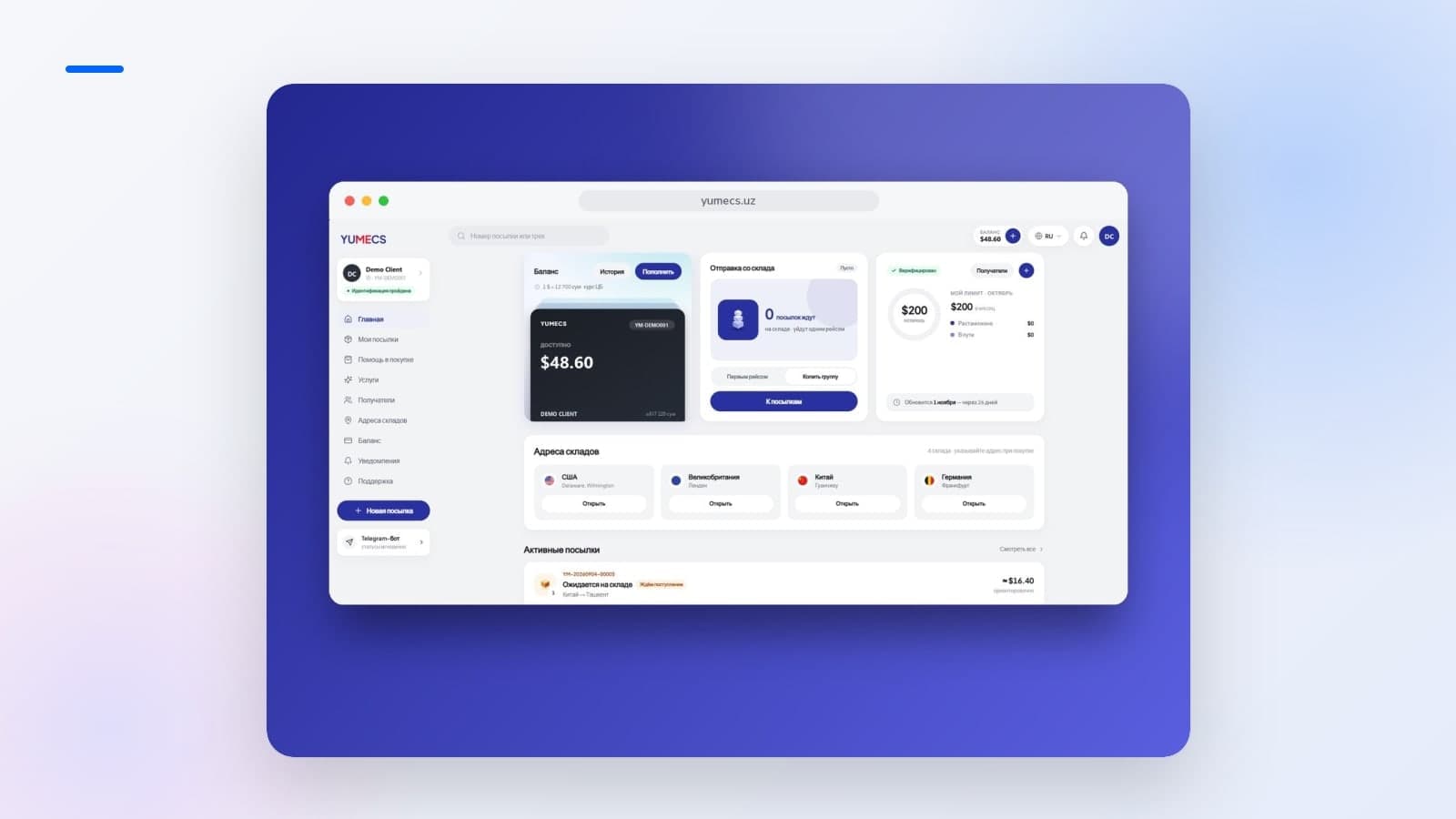
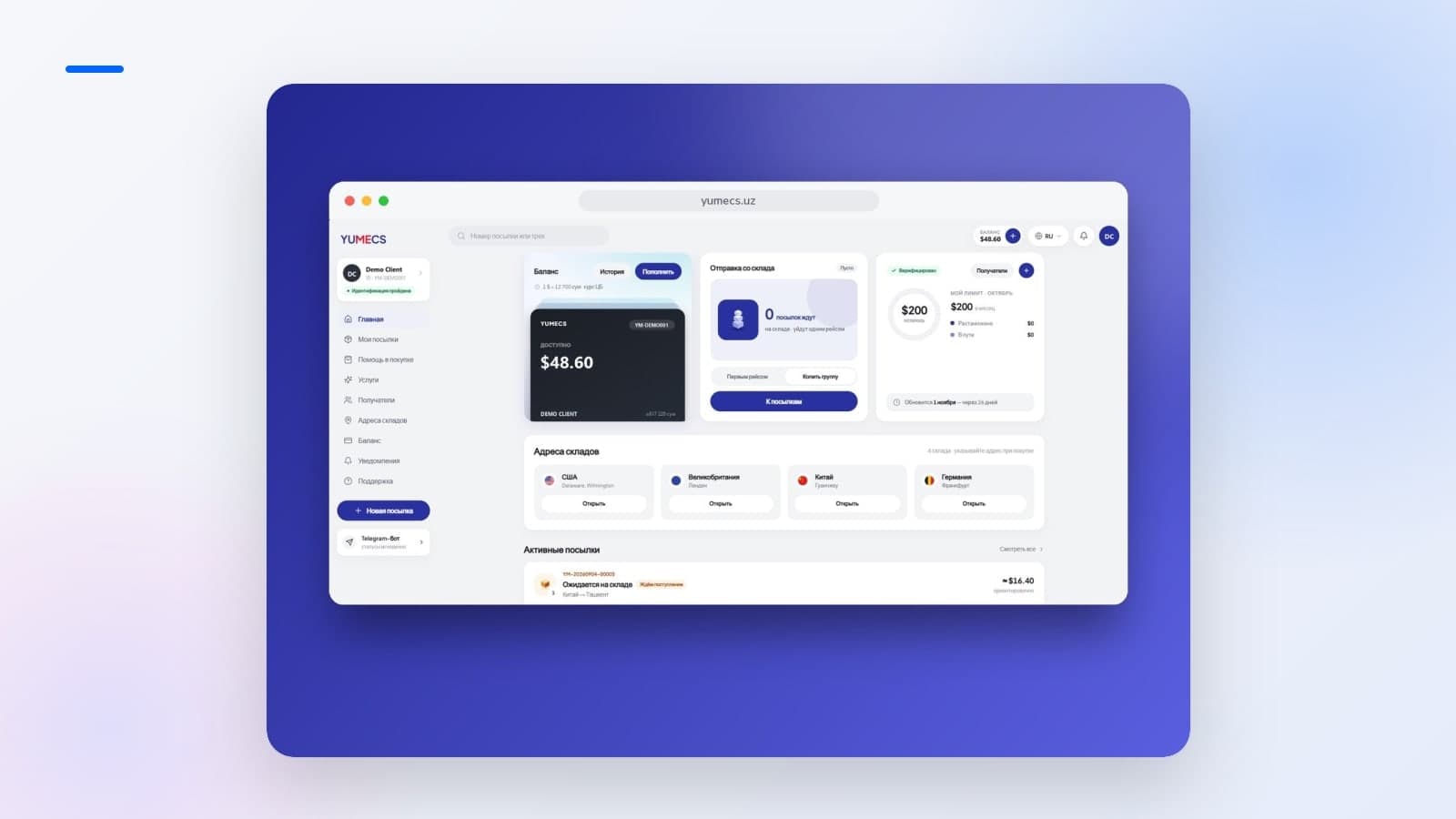
We applied similar logistics synchronization principles for the international package forwarder YUMECS, balancing inventory data across fulfillment hubs in the US, Europe, and China, maintaining weight quotas, and feeding live updates to customers via a Telegram bot without manual operator intervention.
Frequently asked questions
What is automated timeslot booking for Uzum?
It is an automated script or Telegram bot that continuously queries the marketplace intake schedule. As soon as another seller cancels a consignment or the fulfillment center expands intake quotas, the script reserves the opening for your pre-approved consignment within a fraction of a second.
Is it legal to use a bot to capture Uzum Market timeslots?
The marketplace regulates platform query loads and shipping paperwork accuracy. There is no explicit rule against workflow helper software, but automated scripts must incorporate rate-limiting intervals to avoid account restrictions. The central requirement remains delivering cargo that matches the approved consignment details precisely.
How much does a ready-made timeslot booking tool cost?
Most commercial bots charge on a success basis, typically ranging from 50,000 to 150,000 UZS (so'm) per confirmed reservation. During peak promotions like 11.11, secondary brokers charged between 100,000 and 200,000 UZS (so'm) according to UPL.uz. A custom server script generally pays for itself within 1–2 months for companies shipping weekly.
How can I avoid the 300,000 UZS (so'm) warehouse fine?
Only schedule booking automation for dates when your inventory is already packed and labeled. If your delivery vehicle cannot make the window, cancel the reservation through the seller portal at least 48 hours before the scheduled time to avoid non-compliance penalties.
If you want to automate fulfillment operations, streamline order processing, or develop a secure custom bot for your business, contact us through our contacts page. We will review your workflow and build an efficient, cost-effective solution.