ERP System for Transport Companies in Uzbekistan: 1C vs TMS
Exploring ERP and TMS architectures for fleet operators in Uzbekistan: 1C integration, Wialon fuel sensors, multi-currency trips, and cost estimates in UZS (so'm).
To automate a transport company in Uzbekistan, the best approach is pairing a national 1C database for accounting and taxes with a dispatching TMS or the specialized "1C:FMS", integrated with Wialon GPS telematics. End-to-end implementation for 10–25 workstations takes 2 to 5 months and costs between 45 000 000 and 140 000 000 UZS (so'm) according to data from Transport Telematics Uzbekistan, while a base industry license for "1C:Fleet Management Standard" starts at 18 162 000 UZS (so'm) in Tashkent according to Leading.uz.
In brief
- Dispatchers spend up to 40% of their time manually re-entering trip sheets; connecting GPS tracking (Wialon) cuts this routine 2–3 times (gogps.uz).
- Cross-border routes require multi-currency accounting in UZS, USD, and CNY with auto-updating Central Bank of Uzbekistan exchange rates (CloudPlus).
- A base license for "1C:FMS Standard" in Tashkent starts from 18 162 000 UZS (so'm), while turnkey rollout costs range between 45 000 000 and 140 000 000 UZS (so'm).
- An off-the-shelf 1C solution fits standard fleets, while a custom web interface or Telegram bot is vital when drivers and clients need simple access without touching a heavy ERP system.
Core bottlenecks in freight operations
Most fleet operators in Uzbekistan run into the exact same issues. Customer orders arrive in Telegram chats, dispatchers log them into Excel, drivers receive drop-off points via personal messaging, and fuel receipts and CMR waybills reach accounting in a messy stack at the end of the month. As a result, the real cost of a haul only becomes clear 2–3 weeks after it is completed.
A second common gap is fuel and mileage tracking. When odometer data is typed manually from paper trip sheets, mileage inflation and mismatches with fuel station receipts are inevitable. According to integrator gogps.uz, accountants and dispatchers spend up to 40% of their working hours manually reconciling mileage and fuel receipts, whereas feeding telematics directly into accounting software handles fuel deductions using fuel level sensors (FLS) and cuts trip-processing labor 2–3 times.
A third challenge is international shipping. When handling routes between Uzbekistan, China, and EAEU countries, freight operators must continuously track multi-currency balances across UZS, USD, and CNY using auto-updated CBU exchange rates, while syncing with national electronic invoicing systems (Didox, Soliq) and customs cargo declaration platforms, as highlighted by CloudPlus experts.
Architecture options: 1C:FMS, ready-made TMS, or custom software
There is no magic all-in-one software that simultaneously manages Uzbekistan payroll scales and live GPS freight tracking for foreign clients. In practice, businesses choose between three approaches.
| Architecture | Timeline | Budget in UZS (so'm) | Best for |
|---|---|---|---|
| Standard "1C:FMS" (Fleet Management System) | 1–3 months | From 18 162 000 UZS (so'm) (license) + setup | Companies with 5 to 30 company-owned vehicles focused on vehicle maintenance, trip tickets, and fuel deductions based on standard consumption rates. |
| Custom Web TMS + National 1C Integration | 3–5 months | From 45 000 000 to 140 000 000 UZS (so'm) for turnkey deployment | Freight forwarders and LTL carriers requiring client portals, mobile interfaces for drivers, and multi-currency billing. |
| Wialon Telematics & Telegram Bots linked with 1C | 1–2 months | Based on our experience: from 35 000 000 to 70 000 000 UZS (so'm) | A rapid start: automated trip status and mileage updates without burdening drivers with complicated apps. |
We build full-scale custom dispatch workflows as part of our CRM development and implementation service whenever standard 1C layouts prove too bulky for fast-paced logistics and freight sales operations.
If you are just starting
If you run fewer than 10 trucks or work mainly as a freight forwarder using hired carriers, rolling out a heavyweight ERP system is premature. A complex platform requires a dedicated system administrator and rigid operational discipline, which will only slow down early sales.
- Clean up your shipment tracking cards. Standardize order templates: pickup and drop-off points, agreed freight rate in contract currency, fuel allowance, and driver per diem.
- Set up basic telematics. Install GPS trackers with fuel level sensors. A cloud setup like Wialon or Omnicomm is plenty to give dispatchers real-time visibility over routes and refueling stops.
- Deploy a dispatcher Telegram bot. Drivers will never fill out spreadsheets from mobile phones. A bot lets them tap twice to send a GPS check-in at pickup, record customs clearance, and upload photos of signed CMR waybills on the go.
A real case: LTL groupage shipments in Tashkent
A groupage logistics carrier based in Tashkent started out coordinating 18 owned and subcontracted trucks through Telegram groups and fragmented Excel sheets. Accounting was reconciling invoices in national 1C with a 2–3 week lag, leading to untracked fuel waste and currency fluctuations on freight rates.
The company connected Wialon telematics directly into their 1C trip-sheet module, launched a Telegram dispatch bot for drivers (for loading updates and CMR photos), and enabled multi-currency billing across UZS, USD, and CNY. According to gogps.uz, time spent generating closing documents dropped from 14 days to 24 hours, fraudulent driver mileage was eliminated, and fuel overconsumption dropped by 12% in the first 3 months.
If your business is already running
For an established fleet, the primary goal of automation is uniting disconnected records: operational haul data, truck and trailer servicing, parts inventory, and financial accounting. The transition must happen in structured phases to prevent operational downtime.
- Separate operational from statutory accounting. Never force logistics teams to record minute-by-minute trip milestones directly inside a legacy accounting system. Accountants need finalized primary documentation, while dispatchers need a high-speed web interface or specialized TMS.
- Set up end-to-end multi-currency accounting. Revenue and expenses on international trips should be logged in the contract currency (USD, CNY, EUR), with automatic revaluation of cash balances against the CBU rate on the transaction date.
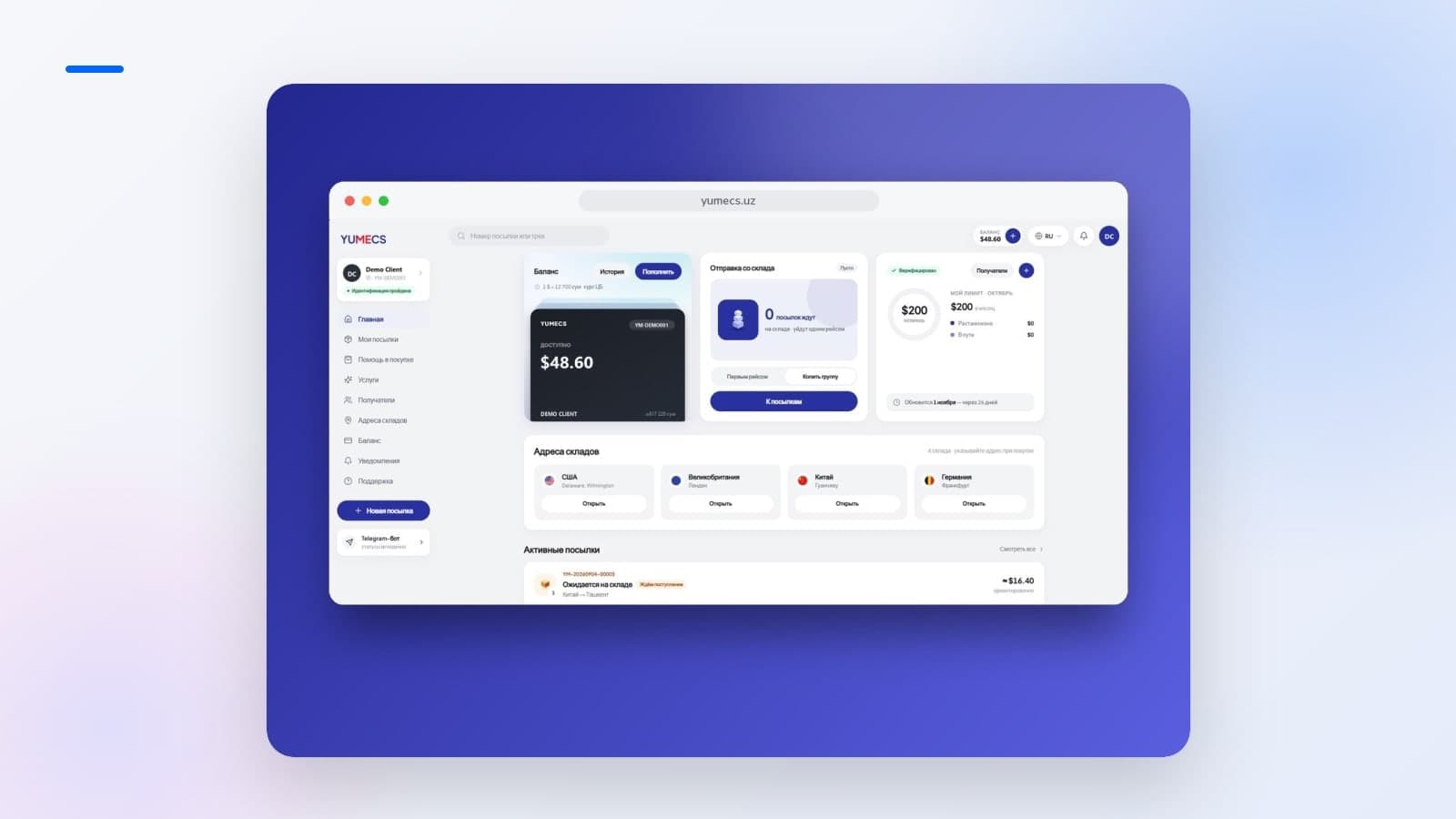
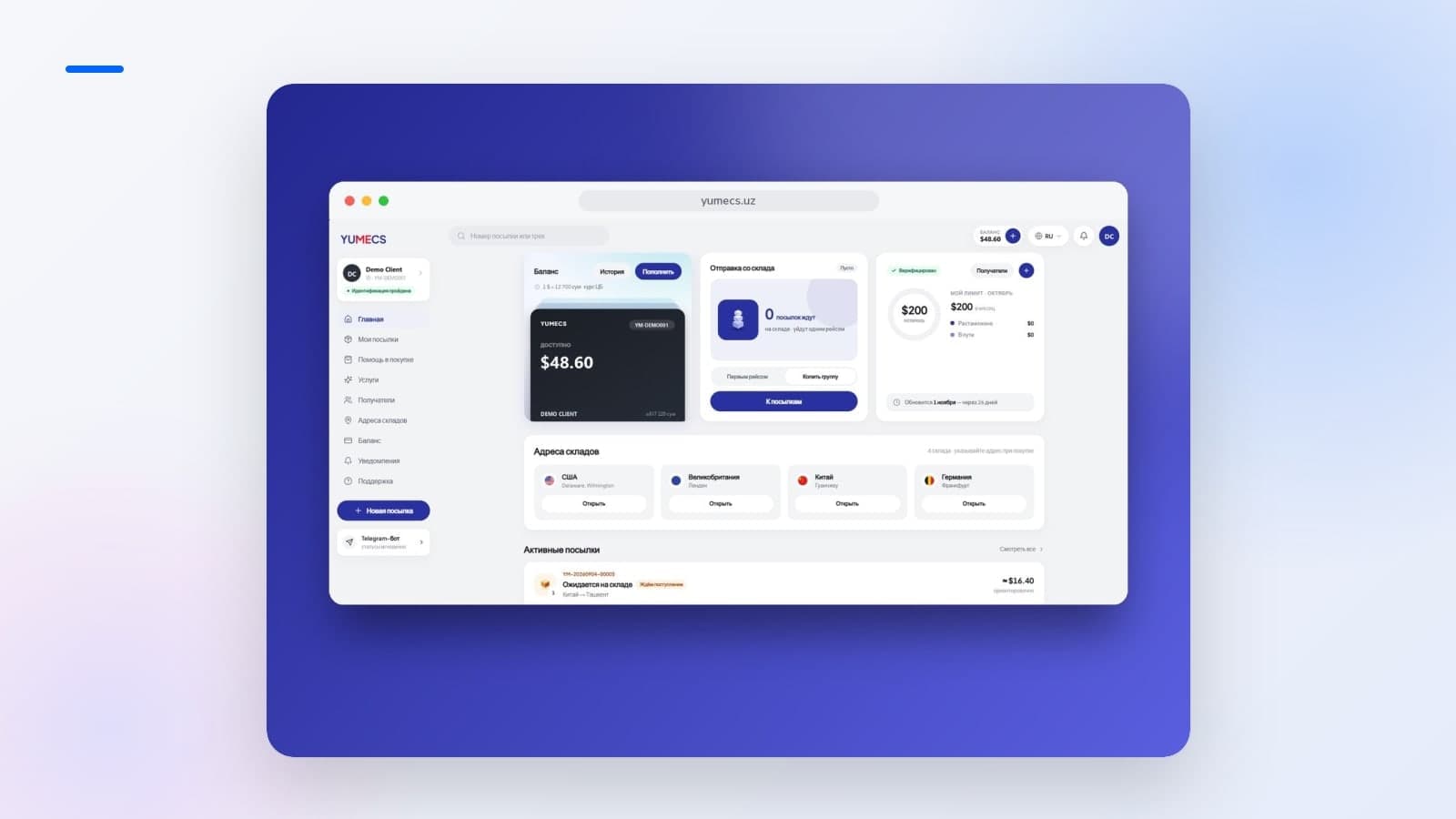
- Automate customer self-service. Giving clients visibility over shipment statuses and balances via an online portal cuts customer support calls dramatically. In the YUMECS project, we delivered an operational automation system for an international delivery service: customers track packages, check balances in USD using the CBU exchange rate, monitor monthly customs limits, and receive live status notifications via a Telegram bot.
- Introduce a maintenance and repair calendar. Link tire wear, oil changes, and spare parts wear directly to actual telematics mileage, preventing costly roadside breakdowns on long-haul cross-border trips.
A real case: fleet standardization for a major carrier
Large multi-service logistics operator PEK, expanding its regional branch network including operations in Uzbekistan, struggled with fragmented data across isolated systems (Fenice, Itilium), Excel files, and paper logbooks. This led to vehicle release delays and cost discrepancies.
The company migrated to a unified "1C:Fleet Management" environment, standardizing rolling stock tracking, scheduled maintenance, and fuel monitoring. As reported by logistics trade publication retail.ru, the project reduced unit operational costs by 30%, lowered vehicle downtime by 15%, decreased production discrepancies by 20%, and accelerated order processing speeds by 25%.
Common freight automation mistakes
- Deploying software that drivers cannot use. If the mobile client demands reliable 4G or complicated authentication, drivers crossing remote regions like Karakalpakstan or the Kazakh steppe will simply stop sending updates. The interface must be lightweight and queue data for automatic sync when connectivity returns.
- Deducting fuel exclusively using paper consumption rates. Baseline fuel consumption during winter on mountain passes in Uzbekistan varies wildly from flat highways. Fuel write-offs must be verified against fuel level sensors and fuel card receipts.
- Ignoring electronic invoicing integration. In Uzbekistan, formal closing acts and tax invoices are processed through state electronic document exchange platforms. If your fleet platform cannot feed data into accounting 1C for Didox export, manual data entry remains unresolved.
Frequently asked questions
Which is better: 1C:FMS or a custom transport management system (TMS)?
If your fleet runs straightforward domestic routes in Uzbekistan and your main requirement is logging trip tickets, tire wear, vehicle maintenance, and fuel deductions for tax accounting, standard "1C:Fleet Management" is sufficient. If you manage groupage, multimodal freight, forwarding, or work extensively with third-party carriers, a custom web TMS connected to 1C via API gives both clients and subcontractors a far better operational experience.
How much does it cost to implement an ERP for a logistics company in Tashkent?
A base license for "1C:FMS Standard" starts at 18 162 000 UZS (so'm) (Leading.uz). Turnkey implementation—including process customization, Wialon telematics integration, and dispatcher workstation setup—generally ranges between 45 000 000 and 140 000 000 UZS (so'm) over a 2 to 5 month timeline (Transport Telematics Uzbekistan).
How do you connect Wialon GPS trackers to a 1C database?
Integration runs via the open Wialon API. The system fetches real-time coordinates, shift mileage, and fuel level sensor readings automatically on a set schedule or on-demand, populating electronic trip sheets in 1C. This removes manual odometer logging by dispatchers entirely.
Why does a transport company need a Telegram bot if they already have an ERP?
A Telegram bot acts as an accessible mobile interface for drivers on the road. Instead of navigating complicated software, drivers tap dedicated buttons like "Arrived at Loading", "Customs Cleared", and upload photos of stamped CMR bills or parking receipts. The ERP immediately updates the job status and attaches documents directly to the order card.
Looking to streamline dispatching, set up multi-currency trip accounting, or integrate fleet GPS trackers with your core software? Contact our team on our contacts page. We will assess your company's workflows and design an architecture that delivers a return on investment without interrupting daily shipments.
Sources
- ПЭК (международный мультисервисный логистический оператор с филиальной сетью в Узбекистане) · retail.ru
- Транспортно-логистическая компания сборных грузов (Ташкент) · gogps.uz
- 1С Управление автотранспортом в Ташкенте и Узбекистане — Leading.uz
- Внедрение и сопровождение 1С для логистики и автопарков — Transport Telematics Uzbekistan
- Облачные решения и 1С:ERP для логистических компаний в Узбекистане — CloudPlus