How Much Does It Cost to Build an Online Store in Tashkent: Estimates and Expenses
A realistic breakdown of e-commerce costs in Uzbekistan: development budgets, Payme and 1C integrations, monthly hosting fees, and ROI calculations.
Building a fully functional online store in Tashkent costs between 8,000,000 and 45,000,000 UZS (so'm), with launch timelines ranging from 30 business days to 2–3 months. The final price tag depends on whether you opt for a standard catalog with basic payment checkout or an advanced custom platform featuring multi-warehouse 1C sync, multiple languages, and personalized customer portals. Beyond initial development, businesses must also budget for ongoing overhead, such as payment gateway fees, hosting, and transactional SMS notifications.
Quick Take
- A turnkey starter store in the Tashkent market starts at 8–10M UZS (so'm) and takes at least 30 business days.
- A full-scale e-commerce platform with 1C inventory sync and mobile checkout costs 25–45M UZS (so'm).
- A standalone 1C integration for automated real-time stock sync starts at 13M UZS (so'm).
- Recurring monthly costs include payment gateway fees (0.8–2% per transaction), hosting (90,000–250,000 UZS (so'm)), and SMS delivery (85–95 UZS (so'm) each).
Breaking Down the Development Estimate
When business owners ask what an e-commerce website costs in Tashkent, they often compare two completely different products: a simple product showcase with an inquiry form versus an automated commercial sales engine. Professional agencies price projects modularly, with each component addressing specific operational requirements.
Basic e-commerce development across Tashkent web studios covers a product catalog with category filters, a shopping cart, Click or Payme payment integration, and an administrative control panel. As of November 2026, standard turnkey setups start at 8,000,000 – 10,000,000 UZS (so'm) with a delivery timeline of around 30 business days, based on estimates from itspace.uz.
If your business needs a tailored solution with optimized mobile checkout flows, automated shipping calculators, warehouse synchronization, and baseline on-page SEO, the price shifts considerably. Full-scale e-commerce projects delivered by local digital agencies range from 25,000,000 to 36,000,000 – 45,000,000 UZS (so'm), as confirmed by public rates from Alfalab.
| Project Tier | Included Features | Price in UZS (so'm) | Launch Timeline |
|---|---|---|---|
| Starter Store | Standard design, catalog, shopping cart, Payme/Click, admin dashboard | 8,000,000 – 15,000,000 | from 30 business days |
| Store with 1C Integration | Custom UX, automated stock & price sync, customer accounts | 25,000,000 – 36,000,000 | 45–60 business days |
| Custom E-Commerce Platform | Advanced automation, delivery setups, wholesale/B2B pricing, multilingual support | from 36,000,000 to 45,000,000+ | 60–90 business days |
Integration Costs: 1C, Payment Systems, and Languages
Your online store cannot exist in a vacuum, detached from your accounting and inventory systems. If you carry hundreds of SKUs, updating prices and out-of-stock statuses by hand is virtually impossible; your sales team will inevitably take orders for items that have already sold out.
A dedicated two-way data sync between your online store and 1C (covering products, tiered pricing, product attributes, warehouse balances, and order statuses via CommerceML or REST API) starts at 13,000,000 UZS (so'm) in Uzbekistan, according to software firm Perfect Solutions. This is a specialized backend engineering task that aligns your store's logic with your internal corporate inventory databases.
Multilingual capabilities are another typical line item. For shoppers in Tashkent and the provinces, having an interface in both Uzbek and Russian is essential. Adding a second language version to the site architecture increases the estimate by 500,000 to 800,000 UZS (so'm), excluding actual translation services for product descriptions, according to agency MXMEDIA.
Based on our experience at NDC, if you are working with a tight budget, it is smart to start with two core languages (Uzbek and Russian) and add English down the road when you secure international partners or export contracts.
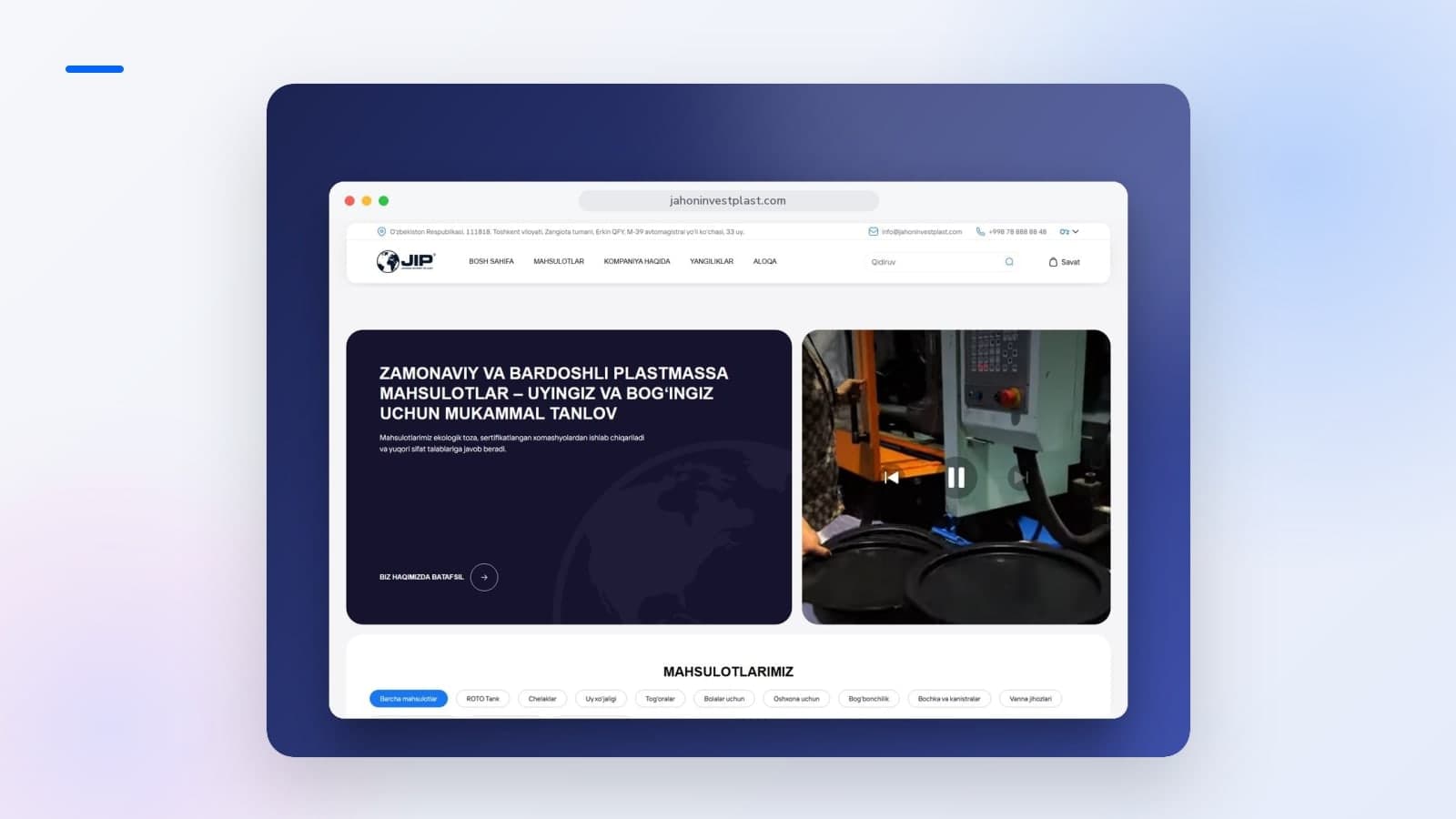
A real case: B2B and B2C catalog for Jahon Invest Plast
Plastics manufacturer Jahon Invest Plast manages hundreds of SKUs. Both wholesale buyers and retail shoppers needed a seamless way to browse product lines, review dimensions and packaging specs, and submit order inquiries in their preferred language.
We engineered an intuitive digital catalog featuring clear categories, detailed product cards, and an inquiry cart. The catalog and site content are effortlessly managed via an administrative panel in three languages: Uzbek, Russian, and English. The project runs live at jahoninvestplast.com, enabling their internal team to update their product catalog independently.
Hidden and Recurring Monthly Expenses
Building your website is not just a one-off capital investment. Once your store goes live, ongoing operational overhead is required to keep servers running, accept digital payments, and communicate with shoppers.
- Online Payment Processing: Payment gateways like Payme, Click, and Uzum Bank charge 0.8% to 2% per transaction when processing local Uzcard and Humo cards. Qualifying for merchant integration requires an active legal entity (LLC or registered sole proprietorship) with a dedicated corporate bank account and an accredited ePOS virtual cash register, as noted by Insan Agency.
- Domain and Hosting Infrastructure: Annual .UZ domain registration through accredited local registrars costs between 27,000 and 35,000 UZS (so'm). Hosting your catalog on reliable SSD hosting or a virtual private server (VPS) in Tashkent data centers with direct unmetered TAS-IX traffic costs anywhere from 90,000 to 250,000 UZS (so'm) monthly, per rates from AIRNET.
- Transactional SMS: Sending automated OTP login verification codes and order status updates through local SMS gateways like Eskiz costs approximately 85–95 UZS (so'm) per message, according to data from MXMEDIA.
If you are just starting
If you are launching a retail brand from scratch with fewer than 50–100 products, do not burn cash on an enterprise platform worth 35 million UZS (so'm) with complex enterprise resource planning integrations. In the beginning, your sole focus should be proving market demand and closing sales with minimal financial exposure.
- Secure a .UZ domain for 27,000 – 35,000 UZS (so'm) and get a starter TAS-IX hosting plan for 90,000 UZS (so'm) a month.
- Commission a standard, clean e-commerce store with an intuitive cart and frictionless mobile responsiveness in the 8,000,000 – 15,000,000 UZS (so'm) bracket. For most young companies, investing in clean, functional UX/UI design for websites and apps built around time-tested user flows is all you need.
- Connect digital debit card payments through Payme or Click, and configure automated order alerts directly into your sales team's Telegram group.
- Skip automated 1C sync for now. You can manage inventory balances manually or through a structured Excel spreadsheet once a day. This streamlined setup can be completed and launched in 30 business days.
A real case: laCafe.uz online ordering launch
Local dining establishments and delivery kitchens were searching for an independent mobile ordering solution without paying exorbitant commissions to third-party delivery aggregators. Mimsoft built a dedicated e-commerce ordering engine with rapid mobile checkout, card payments, and instant notifications. As a result, participating venues lifted their average online order value by 20% thanks to streamlined user journeys and smart cart upsells, according to agency data on mimsoft.uz.
If your business is already running
For an established retail enterprise with brick-and-mortar locations, wholesale stock, and accounting running in 1C, a basic 10-million-so'm website will trigger headaches rather than growth. If your staff is manually re-entering dozens of orders and invoices while your storefront displays stale pricing, you risk both revenue and your brand's reputation.
- Start with a thorough audit of your 1C database: clean up product codes, technical specs, variations, and warehouse stock levels before engineers write a single line of frontend code.
- Plan for an end-to-end investment of 25,000,000 – 45,000,000 UZS (so'm), which includes deep CommerceML or REST API automated data exchange starting at 13,000,000 UZS (so'm).
- Migrate your inventory gradually: begin with a pilot catalog category, verify test order placements, confirm that transactions populate in 1C correctly, and only then roll out the remaining stock.
- Expect a delivery timeline of 45 to 60 business days. Your business should migrate seamlessly without pausing daily trade: keep your existing sales workflow active until the integration is fully stress-tested.
A real case: e-commerce platform for SAG carpet mill
As the premier carpet manufacturer in Uzbekistan, SAG.uz operated a nationwide retail footprint with an extensive catalog of dimensions, patterns, and pile textures, yet lacked a unified digital direct-to-consumer channel showing live stock. The team at Mimsoft engineered an e-commerce platform featuring dynamic product options, integrated Payme/Click checkout, and a direct link to their corporate 1C database for live inventory tracking. As a result, the factory successfully unlocked nationwide direct digital sales without ever selling an out-of-stock item.
How to Calculate Your Return on Investment
An online store pays for itself in two main ways: bringing in new sales from search engines and advertising campaigns, and freeing up team hours previously wasted on handling phone calls and endless messenger chats.
To calculate your payback period, compare three metrics: your upfront development cost, your average gross margin per order, and your projected monthly sales volume. For instance, if a store with standard integrations costs you 25,000,000 UZS (so'm), and your net profit on an average sale is 120,000 UZS (so'm) (after deducting the 0.8–2% payment gateway fee), your project breaks even after 208–210 completed sales. At a modest pace of 4–5 orders a day, your initial development investment is completely recouped in just six to eight weeks of steady sales.
Frequently Asked Questions
How much does it cost to start an online store in Uzbekistan from scratch?
Your total startup costs include official business registration fees, a .UZ domain (27,000 – 35,000 UZS (so'm)), local hosting (from 90,000 UZS (so'm) monthly), and web development. Standard store setups from local Tashkent studios start at 8,000,000 – 10,000,000 UZS (so'm). The realistic entry budget for a reliable, working storefront is around 10–12 million UZS (so'm).
How long does it take to build an e-commerce website in Tashkent?
A standard e-commerce site featuring a catalog, cart, and Click/Payme integration typically launches within 30 business days. Custom platforms requiring two-way 1C sync, custom UX layouts, and multilingual versions take between 45 and 60–90 business days.
What works better: an e-commerce website or a Telegram bot?
For a compact restaurant menu or a boutique with 10–20 fashion items, a Telegram bot is often faster and cheaper to pilot. However, a dedicated online store is vital if you want search traffic from Google and Yandex, advanced filtering across hundreds of product attributes, and seamless automated sync with your inventory software.
If you are planning to take your retail operations online and need a reliable, tailored estimate, explore our online store development service or reach out through our contacts page. We will assess your product catalog, help you choose the right architecture, and give you an honest appraisal of which features you need right away and which can wait.
Sources
- SAG (SAG.uz) · mimsoft.uz
- Создание интернет-магазина в Ташкенте — от 36 млн сум | Alfalab
- Разработка интернет-магазина в Ташкенте под ключ | Premium Digital
- Onlayn do'kon ochish: narxi va muddatlari | MXMEDIA
- Интеграция 1С с интернет-магазином и сайтом в Узбекистане | Perfect Solutions
- Подключить Payme и Click к сайту: что нужно знать владельцу | Insan Agency
- Тарифные планы хостинга в Ташкенте (TAS-IX) | AIRNET
- itspace.uz