8 CRM Implementation Mistakes in Uzbekistan and How to Save Your Budget
We break down 8 critical CRM implementation mistakes in Uzbekistan—from sales team pushback to chatting in personal Telegram accounts—with pricing and clear workflows.
A successful CRM launch in Tashkent takes between 3 and 14 business days for basic configuration and costs between 3,900,000 and 6,600,000 UZS (so'm) according to doirastan.uz, while complex end-to-end projects range from 12,000,000 to 35,000,000 UZS (so'm) as estimated by tipa.uz. However, without clear workflows and proper training, 40% to 70% of DIY attempts end in complete abandonment within the first 3–6 months according to statistics from avar.uz. To protect your budget, start by capturing existing communication channels rather than paying for expensive custom development upfront.
In brief
- Up to 30–40% of inbound customer inquiries in Uzbekistan get lost when sales reps keep chatting through personal Telegram accounts.
- A turnkey basic pipeline setup starts at 3,900,000 UZS (so'm), while official amoCRM licenses begin at 79,000 UZS (so'm) per user per month.
- Complex 1C integration is unnecessary at the start: basic product catalog sync starts at 7.8M UZS (so'm) ($600) and often just slows down your sales team.
- Staff resistance isn't solved by fines; it's solved with one strict rule: if a deal isn't logged in the system, it doesn't count toward sales bonuses.
Why CRMs Fail to Take Root: 8 Major Mistakes
Most business owners assume that buying software licenses instantly brings order to their sales pipeline. In practice, companies run into passive resistance from employees and lost leads. Let's look at the typical mistakes we see every day across the local market.
1. Selling through personal Telegram accounts
In Uzbekistan, Telegram is the primary business communication channel. When customers message reps on their personal numbers, the company has zero visibility into conversations. If a rep gets sick or quits, your client list and deal history leave with them. According to analytics from Avar.uz, businesses lose 30–40% of inbound leads without a centralized inbox. The solution is connecting official bots or shared corporate numbers through CRM development and implementation, ensuring every incoming message automatically generates a deal.
2. Buying software without updating workflows and KPIs
If your sales workflow isn't documented on paper, automation only speeds up the chaos. Reps don't know when to move a lead to "Deciding" or when to mark it as lost. As agency avar.uz highlights, 40% to 70% of self-guided launches fail precisely because of missing guidelines and a disconnect between CRM data entry and employee compensation.
3. Rushing into 1C integration too early
Complex synchronization with accounting software is often one of the biggest budget drains. According to systems integrator Tipa.uz, simply syncing product catalogs and stock balances with 1C starts at 7.8M UZS (so'm) ($600). In the early stages, this cost is completely unnecessary: reps get overwhelmed by dozens of fields, and the sales floor stalls. Focus first on training your team to follow up promptly and guide leads through the pipeline.
4. An overloaded pipeline with dozens of mandatory fields
A manager's desire to capture every tiny detail often produces a 25-field intake form. Filling that out after a quick phone call takes 15 minutes. Reps inevitably go back to keeping notes in paper planners and only update the CRM retroactively right before Friday meetings. Your initial sales pipeline should have no more than 4–6 clear, essential steps.
5. Lack of direct leadership involvement
Implementation is often dumped on the system administrator or a senior sales rep—neither of whom has the authority to change operational habits. If the business owner or sales director never opens the software and still accepts reports in Excel or verbally, employees realize they can safely ignore the CRM.
6. Rolling out the system without team training
Even the simplest interface creates friction for staff accustomed to paper notebooks. Without live, hands-on training built around real-world calls and chats, team members will steer clear of the software out of fear of making mistakes.
7. Overlooking telephony and missed calls
Reps often take hours to return a missed call—by which point the prospect has already bought from a competitor. Without a virtual PBX integration, managers have no visibility into callback times, call recordings, or lost call rates.
8. Trying to build custom software from scratch without a real need
Building a custom CRM for straightforward retail, wholesale, or service businesses is a frequent misstep. Custom engineering requires months of work and continuous maintenance. A standard off-the-shelf solution covers 90% of a typical sales department's needs much faster and at a fraction of the cost.
How Much Does CRM Implementation Cost in Uzbekistan?
Project costs consist of official software licenses alongside integrator fees for pipeline setup, telephony and chat integrations, and staff training.
| Expense item | Cost (in UZS (so'm)) | Timeline | Best for |
|---|---|---|---|
| amoCRM licenses ("Basic") | 79,000 / user per month | 1 day | Micro-businesses, 1–2 sales reps |
| amoCRM licenses ("Advanced") | 179,000 / user per month | 1 day | Teams up to 10 with automated tasks |
| amoCRM licenses ("Professional") | 259,000 / user per month | 1 day | Mature sales teams, complex analytics |
| Basic integrator setup | 3,900,000 – 6,600,000 | 3–14 business days | Small team: 1 pipeline, chat apps, PBX |
| Comprehensive implementation | 12,000,000 – 35,000,000 | 3–6 weeks | Multiple pipelines, end-to-end analytics, 1C |
Official amoCRM pricing for 2026 is confirmed by authorized partner mcrm.uz, while integrator price ranges reflect current public rates from Doirastan and tipa.uz.
If you are just starting
When your company is in its early stages, your main goal is simple: never drop an incoming lead and respond fast, without blowing millions on complex infrastructure.
- Choose a ready-made cloud system. For 2–3 employees, the "Basic" tier at 79,000 UZS (so'm) per user per month is plenty, according to data from mcrm.uz.
- Unify your channels in one dashboard. Connect your company's Telegram bot, corporate WhatsApp, and website. Every landing page form should instantly generate a deal card. If you don't have a reliable web presence yet, we build high-converting landing pages through our corporate website development service.
- Keep your pipeline simple. Five stages are more than enough: "New Lead", "Qualified", "Proposal Sent", "Invoice Issued", and "Payment Received".
- Hold off on complex integrations. Don't waste early budget on real-time inventory sync or automated invoices. A basic turnkey setup starts at 3,900,000 UZS (so'm) based on rates from doirastan.uz, taking under two weeks to launch.
A real case: INVENTORS WORLD (Tashkent)
The company was building out its operations: sales reps handled incoming leads manually, deal tracking lacked transparency, and response times lagged. Management couldn't see where leads were dropping off in the funnel.
The integrator configured pipelines in amoCRM, automated lead routing among reps, set up task deadlines and analytics dashboards, and trained the team on daily system usage.
According to the case study by integrator icorp.uz, lead-to-sale conversion climbed by 18%, initial response time dropped by 35%, and productive output per sales rep increased by 25%.
If your business is already running
For an established business, rolling out or replacing a CRM is like performing engine repairs mid-flight. You can't afford to cut off your sales team for two weeks just to transition systems.
- Audit your channels. Migrate all customer conversations out of reps' personal chat accounts into connected, company-owned channels.
- Synchronize your phone system. Ensure every missed call automatically creates a high-priority task to call back within 15 minutes.
- Enforce the "No CRM, no bonus" rule. Make it company policy: sales commissions are paid exclusively on deals tracked in the system with complete interaction notes.
- Roll out 1C integrations in phases. Start with syncing account names and payment amounts, leaving complex inventory tracking for phase two. An end-to-end rollout takes 3 to 6 weeks with budgets from 12,000,000 to 35,000,000 UZS (so'm) according to tipa.uz.
A real case: Davr Bank
Prior to unifying their CRM, the bank's customer workflows were fragmented: lead databases, telephony, and digital touchpoints operated independently, forcing reps to cross-check information across 5 separate systems manually.
The bank adopted Ready Bank, a specialized solution by Rocket Tech that brought together front-office operations, the call center, and the sales team under a single interface with a unified customer profile.
As reported by business outlet spot.uz, sales conversion rose by 20%, while rep workloads decreased substantially once redundant manual data entry was eliminated.
When a Standard CRM Isn't Enough
Sometimes an off-the-shelf sales pipeline falls short because your operations stretch far beyond standard rep-to-client messaging. When your business needs a dedicated client portal with custom pricing calculators, order tracking, or digital document workflows, we build custom automation platforms tailored to your model.
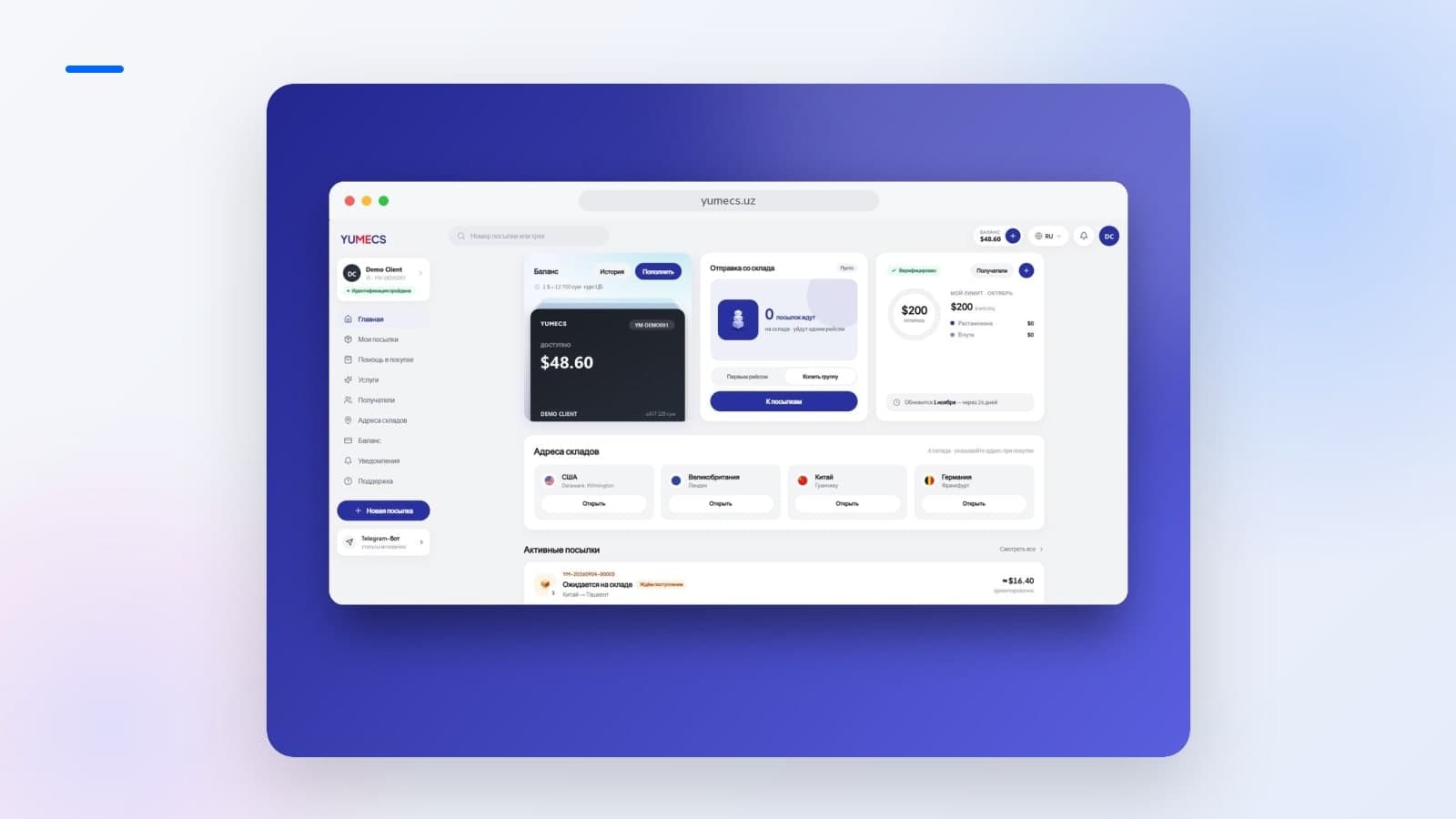
For international logistics provider YUMECS, we developed a customer portal and internal management console. Client balances are calculated in USD using Central Bank exchange rates, foreign warehouse addresses and parcel lists are displayed alongside customs limits, and parcel status changes trigger instant Telegram notifications. This removed hundreds of routine inquiries from the support team's plate.
Another example is Hesap, a platform engineered for digital contract signing without paperwork delays. We built user portals with full document history and automated notifications, enabling counterparties to review and sign agreements in just a few clicks.
Frequently Asked Questions
Why do sales reps resist using a CRM and sabotage the rollout?
The primary reason is that the tool added extra friction instead of making their jobs easier. If deal cards have too many fields while management still demands side reports in Excel, reps will naturally push back. Tie bonuses strictly to CRM records and eliminate duplicate reporting entirely.
How much does amoCRM implementation cost in Tashkent?
Software licenses cost between 79,000 and 259,000 UZS (so'm) per user per month depending on the tier, based on pricing from mcrm.uz. Basic turnkey configuration for a small team starts at 3,900,000 UZS (so'm) according to doirastan.uz.
Why is Telegram integration crucial for CRMs in Uzbekistan?
The vast majority of local buyers prefer chatting on Telegram over phone calls. Without integration, chats stay trapped on reps' personal phones, and leads get dropped. Integrating Telegram links all message history directly to the deal card, distributes inbound inquiries across available staff, and ensures client contacts stay with your company if a rep leaves.
Can we skip 1C integration during the initial launch?
Yes, and in most cases we strongly recommend postponing it to phase two. Nailing down lead capture and fast response times matters most early on. A basic 1C connection costs from 7.8M UZS (so'm) ($600) according to tipa.uz and requires clean product data; rushing it can drag your launch out for months.
If you want to build transparent lead tracking without wasted budgets or team pushback, get in touch with us through our contacts page. We'll review your current processes and recommend the right setup for your sales department.
Sources
- Davr Bank · spot.uz
- INVENTORS WORLD (Ташкент) · icorp.uz
- Ошибки внедрения CRM-систем для бизнеса в Узбекистане — NexGroup
- Стоимость внедрения CRM в Ташкенте и смета расходов — Tipa.uz
- Цены и тарифы amoCRM в Узбекистане под ключ — Doirastan
- Типичные ошибки при внедрении CRM и почему 40% заявок теряются — Avar.uz
- mcrm.uz
- doirastan.uz
- tipa.uz
- avar.uz