Payment Aggregator vs Direct Acquiring in Uzbekistan: What to Choose
Comparing three online payment methods in Uzbekistan: direct integration with Payme and Click, the OCTO aggregator, and Uzum Nasiya installments by fees and costs.
For a compact catalog and quick launches, integrating an all-in-one payment aggregator is usually the best move: it saves development budget and goes live within 3–7 business days. Direct gateways like Payme and Click make sense once you have steady order volume and monthly turnover in the tens of millions of UZS (so'm), while online installment plans are essential for stores with an average order value above 1,000,000 UZS (so'm).
In brief
- The OCTO aggregator charges 0.8% for Uzcard/Humo and up to 3.5% for international cards, integrates via a single API, and clears compliance within 3–5 business days.
- Direct acquiring via Payme and Click carries a 0.8–2.0% merchant fee, but requires a separate agreement and technical gateway for each platform.
- Developing a single direct gateway on a website costs between 2,500,000 and 6,000,000 UZS (so'm) and takes 2–5 business days.
- Uzum Nasiya installments grant customers financing limits of up to 25–35 million UZS (so'm) across 3–12 months with no down payment, driving up to 40% of sales in higher-ticket retail.
Three Ways to Accept Payments on a Website or Telegram Bot
When launching an e-commerce website development project or a sales bot, every business faces a choice: integrate individual payment providers, use a ready-made aggregator window, or offer split payments. Here is how each option works in practice.
Direct acquiring (Payme Business, Click Merchant). You sign an individual merchant contract with each payment provider. On your site, developers set up a custom gateway for each provider's API. Payouts arrive directly in your local bank checking account within 1–3 business days, as highlighted by Gazeta.uz.
Payment aggregator (OCTO by Octobank). This service acts as a single payment layer between your website and acquiring banks. Under a single contract, you unlock a hosted payment form that accepts national currency cards, international Visa and Mastercard, and digital wallets. According to Octobank, business verification takes 3–5 business days.
Online installments (Uzum Nasiya). A standard Buy Now, Pay Later (BNPL) model. The buyer spreads the cost into monthly installments through the provider's app, while the financial service disburses the full purchase amount to the merchant right after the deal is approved.
Comparing Fees, Timelines, and Setup Costs
According to an analysis by Tashkent web studio Comingsoon.uz, technical integration for a single direct payment gateway (Payme JSON-RPC or Click Shop API) typically takes 2–5 business days and costs between 2,500,000 and 6,000,000 UZS (so'm). Integrating both platforms doubles your development spend, whereas an aggregator brings all payment methods under one API in 3–7 days.
| Feature | Direct Payme / Click | OCTO Aggregator | Uzum Nasiya Installments |
|---|---|---|---|
| Transaction fee | 0.8–2.0% according to Gazeta.uz | 0.8% (Uzcard/Humo), 1.5% (local foreign currency cards), 3.5% (international cards) according to Octobank | Fee depends on the selected installment term (3, 6, or 12 months) |
| Developer integration cost | 2,500,000 to 6,000,000 UZS (so'm) per gateway | 2,500,000 to 6,000,000 UZS (so'm) for the unified API | 2,500,000 to 5,000,000 UZS (so'm) for the checkout widget and API |
| Review and approval timeline | 3–10 business days for each provider | 3–5 business days for the entire contract | 5–10 business days |
| Customer payment options | Specific operator app or linked card | Uzcard, Humo, Visa, Mastercard, WeChat Pay, Apple Pay | Split payments across 3, 6, or 12 months |
| Best fit by order size | Up to 500,000 – 1,000,000 UZS (so'm) | Any basket size, B2C, and cross-border cards | From 1,000,000 to 35,000,000 UZS (so'm) |
If you are just starting
In the early stages, your main goal is validating customer demand without locking up cash flow in custom development. If you carry a lean catalog and order volume is just picking up, managing multiple direct contracts is unnecessary overhead.
- Open a corporate checking account for your legal entity or individual entrepreneurship.
- Submit an application to a payment aggregator. Compliance checks take 3–5 business days.
- Budget for connecting a turnkey payment module: across our projects, a standard gateway hookup generally runs between 2,500,000 and 4,000,000 UZS (so'm).
- Hold off on international acquiring and installments during month one if your average order value sits below 300,000 UZS (so'm) to keep the checkout clean and simple.
A real case: Sabina Children's Apparel Brand
A Tashkent-based entrepreneur producing handcrafted children's clothing previously sold exclusively via Instagram, manually verifying card-to-card P2P transfers and losing potential buyers after business hours. Upon launching her online store, our team hooked up Octobank (OCTO) e-commerce acquiring, enabling automated checkout via Uzcard, Humo, Visa, and Mastercard with direct settlements to her bank account. Within the first week, the brand shifted to fully automated 24/7 order processing, eliminating manual payment slip verification entirely.
If your business is already running
For an established store processing hundreds of weekly transactions, processing fees and checkout conversion rates take center stage. Adding new payment methods or restructuring existing setups should be executed in phases to safeguard ongoing revenue.
- Analyze your payment breakdown. If over 80% of transactions come from one specific wallet, integrate it directly: the lower 0.8–2.0% merchant fee pays for development within two months.
- Add an installment option if you sell electronics, furniture, educational courses, or building supplies. According to fintech platform Finteqstan, consumer installment limits reach 25–35 million UZS (so'm), and nearly 40% of marketplace purchases nationwide are paid in installments.
- Connect your online checkout to an automated fiscal register so that digital receipts featuring official State Tax Committee QR codes reach buyers instantly via SMS or your user dashboard.
- Thoroughly test payment flows in sandbox mode before rolling out to production: on our client projects, staging tests take 2–3 days without disrupting active transactions.
A real case: Adek.uz Electronics Store
Tashkent electronics retailer and service center Adek.uz regularly experienced cart abandonment on high-end desktop builds, laptops, and networking gear with an average order value over 3,000,000 UZS (so'm). The company integrated Uzum Nasiya zero-down-payment online installments directly into product pages and cart checkout for 3-to-12-month periods. Buyers gained instant access to financing up to 35 million UZS (so'm), while the merchant receives full order value into their account immediately after contract approval.
A real case: NDC's OvqatGo Food Delivery
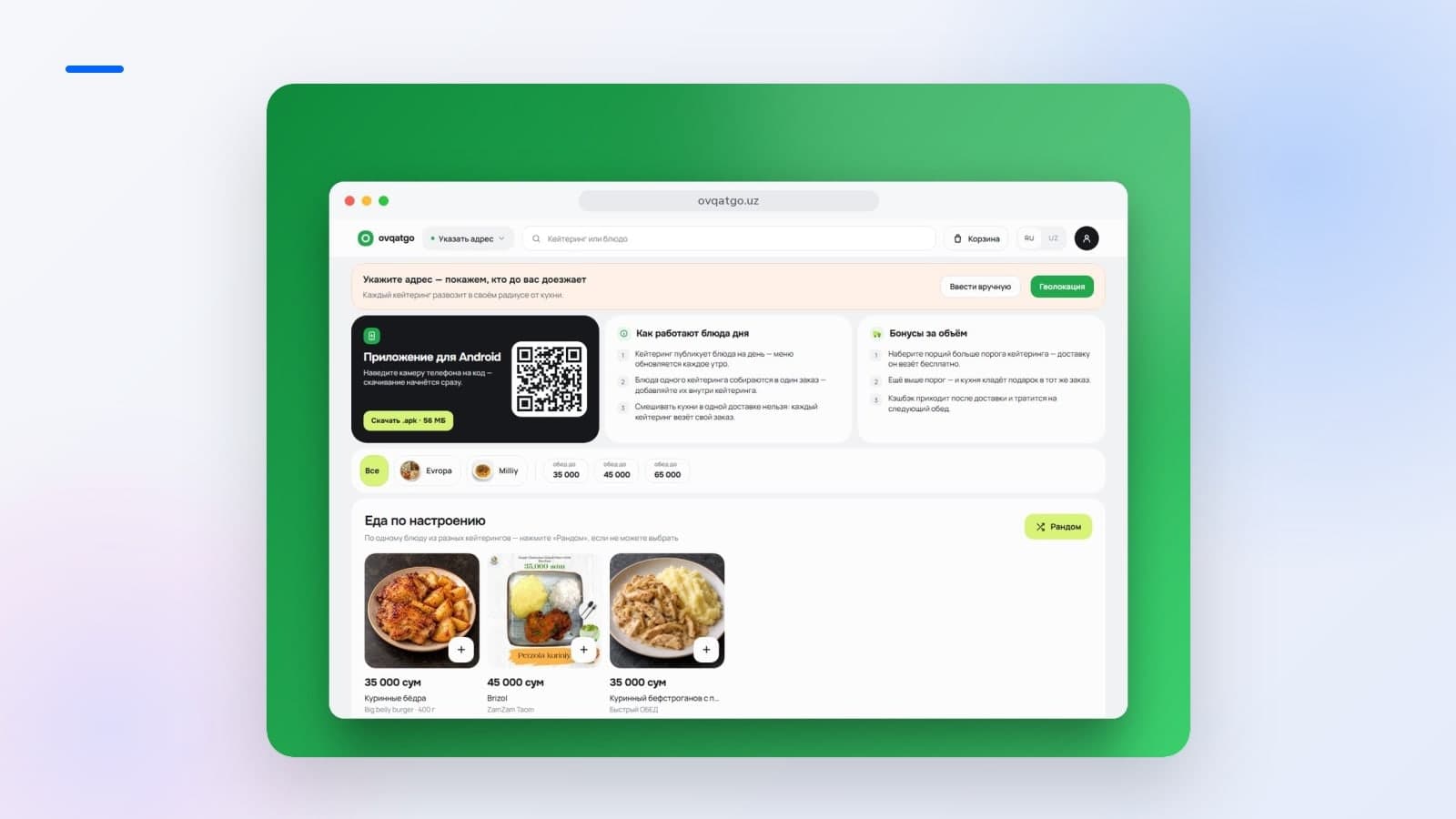
In our own in-house product, the OvqatGo corporate lunch delivery platform in Tashkent, commercial kitchens post daily lunch menus. Customers enter their address, view kitchens in their delivery zone, and place orders. To keep recurring low-ticket payments fast and convenient, we gave users straightforward flexibility: direct online payments via Payme and Click, or cash on delivery to the courier.
For other types of digital platforms, on-site checkout is not always a requirement. For instance, when designing the multilingual catalog website for Tashkent artisan bakery BIOSH, our primary focus was product presentation for retail shoppers and wholesale partners, routing direct purchases to physical partner retail outlets and the Uzum marketplace.
Common Pitfalls When Choosing Payment Solutions
- Relying on a single payment method. If you only support Click, Payme users often abandon their carts instead of paying card-to-card transfer fees.
- Skipping automated fiscalization. Processing digital payments without generating official electronic fiscal receipts violates national tax regulations.
- Cluttering checkout flows. Promoting BNPL installments on items under 100,000 UZS (so'm) is counterproductive: lengthy verification forms only depress checkout completion.
- Checking screenshots manually. Collecting payment slips over Telegram invites human error, ties up staff time, and leaves your business exposed to forged receipts.
Frequently Asked Questions
What is more cost-effective for a website: OCTO or combining Payme and Click?
For new stores, the OCTO aggregator is far more cost-effective because you only fund a single API integration instead of two separate builds. Direct gateways like Payme and Click become cheaper only after reaching steady monthly turnover in the hundreds of millions of UZS (so'm), where fractional percentage point savings offset initial engineering expenses.
How much does it cost to set up online payments on an e-commerce website?
Based on Tashkent development agency rates, building and configuring a single payment gateway costs between 2,500,000 and 6,000,000 UZS (so'm). Payment providers themselves do not charge connection fees; they take a 0.8–2.0% merchant processing fee per successful sale.
Why should an online store offer Uzum Nasiya installments?
Installments lower the purchase barrier for items with an average ticket above 1,000,000 UZS (so'm). Shoppers get financing up to 25–35 million UZS (so'm) with zero down payment, while your store gets paid the complete order amount immediately once the loan is confirmed.
If you are planning to launch online sales, explore our completed implementations under projects or reach out via contacts: we will help you identify the right payment architecture for your average order value and current growth phase.
Sources
- Бренд детской одежды Sabina (Ташкент) · octobank.uz
- Интернет-магазин и сервисный центр Adek.uz (Ташкент) · adek.uz
- Сеть супермаркетов Korzinka.uz · korzinka.uz
- Электронная коммерция и интернет-эквайринг для бизнеса в Узбекистане — Octobank
- Payme Business предлагает бесплатное обслуживание новых офлайн бизнес-партнёров — Gazeta.uz
- Uzum Nasiya: muddatli to'lov — профиль компании и экосистемы — Finteqstan
- Payme vs Click: какую платёжную систему выбрать для сайта — Comingsoon.uz
- Тарифы на обслуживание по системе Click SuperApp — Click.uz