How to Launch a Startup in Uzbekistan: Bot, Website, or Mobile App
A practical guide for entrepreneurs: which MVP format to pick for an Uzbekistan startup, how much the initial launch costs, and how to secure IT Park perks.
When launching a digital startup in Uzbekistan, the safest move is to begin with a Telegram Mini App or a straightforward web service rather than a native mobile application. In our project experience, building a working prototype (MVP) inside Telegram typically runs between 18 and 35 million UZS (so'm) and takes 3–4 weeks, whereas native apps require anywhere from 80 to 180 million UZS (so'm) and up to 5 months of development before you even validate customer demand (ndc.uz). It pays to test your core hypothesis and bring in your first paying users with minimal overhead while leveraging IT Park tax incentives right after company incorporation.
Key Takeaways
- Registering an LLC via my.gov.uz costs 337,500 UZS (so'm) (0.9 BCA with the online discount) and takes as little as 30 minutes.
- IT Park residents enjoy a 0% corporate income tax rate and 0% VAT, with personal income tax on employee salaries lowered to 7.5% instead of 12% (it-park.uz).
- Under Presidential Resolution PP-59, state programs offer collateral-free loans up to 300 million UZS (so'm) and MVP development vouchers up to $50,000 (startupbase.uz).
- Diving straight into native mobile app development for an unproven concept is an expensive misstep; validating via Telegram or the web is 3 to 5 times more affordable.
Choosing the Format: Bot, Web Platform, or Mobile App
The primary job of an MVP is to verify whether people are willing to pay for your solution or return to it regularly. The heavier your tech stack on day one, the longer your time-to-market and the higher the risk of burning through your seed capital with zero traction.
| Format | Development Timeline | Launch Budget | Best Suited For |
|---|---|---|---|
| Telegram Bot or Mini App | 3–4 weeks | 18–35 million UZS (so'm) | B2C services, deliveries, local on-demand utilities, bookings |
| Web Platform | 4–8 weeks | 30–70 million UZS (so'm) | B2B SaaS, directories, aggregators, customer portal systems |
| Mobile App (iOS + Android) | 3–5 months | 80–180 million UZS (so'm) | High-frequency daily products and services relying on device sensors |
Telegram serves as Uzbekistan’s default digital ecosystem. For most domestic B2C offerings, a Mini App replicates the complete mobile experience: product catalogs, shopping carts, live geolocation, and seamless in-app checkouts via Payme or Click. Crucially, your users never have to download a 50 MB package from the App Store or wait around for SMS confirmation codes.
A web platform makes sense if your target audience works from desktop workstations (standard for B2B tools) or when organic search acquisition via Google and Yandex forms the backbone of your marketing. Our MVP development for startups service usually begins with weighing Telegram against a dedicated web platform to ensure your resources go where they will deliver the quickest returns.
Legal Foundation and IT Park Benefits
Once your value proposition is locked down, setting up a legal entity is the next milestone. For tech businesses in Uzbekistan, a limited liability company (LLC / MChJ) is the industry standard.
- Company Registration. The process runs completely online via my.gov.uz. The state fee is 0.9 BCA (337,500 UZS (so'm) with the 10% online discount applied), and approval typically comes through in 30 to 60 minutes.
- Securing IT Park Residency. Founders can apply directly through it-park.uz by submitting a comprehensive business plan. Residency status provides complete exemption from corporate income tax (0%), zero VAT on IT services, zero-duty customs clearance on specialized equipment, and an employee income tax rate capped at 7.5% rather than the standard 12%.
- State Support Programs. Under Presidential Resolution PP-59 (issued February 11, 2026), the Digital Startups initiative (startupbase.uz) offers early-stage teams collateral-free loans up to 300 million UZS (so'm) at the Central Bank benchmark rate + 4%, as well as an R&D Voucher track that covers up to 50% of MVP development expenses (capped at $50,000).
If you are just starting
When you have a sharp concept but no working software or user base yet, keep your entire focus on validating real demand.
- Isolate a single core action. Pinpoint the exact problem people will pay you to solve today. Strip away distraction features like community message boards, gamified badges, and multi-tier user profiles.
- Build an interactive prototype. Investing in deliberate UX/UI design for websites and apps allows you to align user journeys before writing a single line of backend logic. Put a clickable prototype in front of 10 target customers and collect unfiltered feedback.
- Roll out a lean MVP. Go with a Telegram Mini App or a lightweight web solution. In our experience, setting aside 18 to 35 million UZS (so'm) and a 1-month timeline is plenty for this milestone.
- Watch your unit economics. Avoid hiring full-time engineers on payroll before securing your first revenue. Partner with an agency or apply for state development vouchers instead.
A real case: Arzon Apteka
Consumers across Uzbekistan used to waste hours calling and driving around neighborhood pharmacies to track down hard-to-find or reasonably priced medications, while retail chains lacked any centralized online reservation system. The founders launched an MVP centered around a shared medicine catalog with intuitive search functions via Telegram and the web, brought onboard Tashkent’s early pharmacy networks, and secured IT Park residency. The team went on to raise venture funding from Sturgeon Capital alongside domestic funds, evolving into Uzbekistan’s dominant pharmacy marketplace with dedicated mobile applications and hundreds of thousands of active users nationwide (spot.uz).
If your business is already running
If you manage an established offline operation—such as a retail chain, logistics outfit, or wholesale distributor—and want to modernize your workflows or turn an internal tool into a commercial SaaS product, the rollout strategy requires a different playbook.
- Map your current operational stack. Document where your inventory figures and client orders live right now: 1C databases, Excel spreadsheets, or closed Telegram chat groups. Any new digital interface must sync cleanly with these sources via APIs without interrupting daily sales.
- Build an adaptable backend architecture. Structure your backend database and business logic so that customer-facing web portals, internal admin consoles, and future mobile apps can tap into the exact same source of truth down the road.
- Transition your customer base gradually. Never switch off familiar ordering channels overnight. Offer small discounts, priority fulfillment, or bundled perks to incentivize clients to place orders through your new self-service platform.
Based on our past delivery track record, modernizing active business processes onto a unified software platform takes anywhere from 2 to 4 months with budgets spanning 45 to 120 million UZS (so'm), depending heavily on the complexity of legacy integrations.
A real case: JustLink
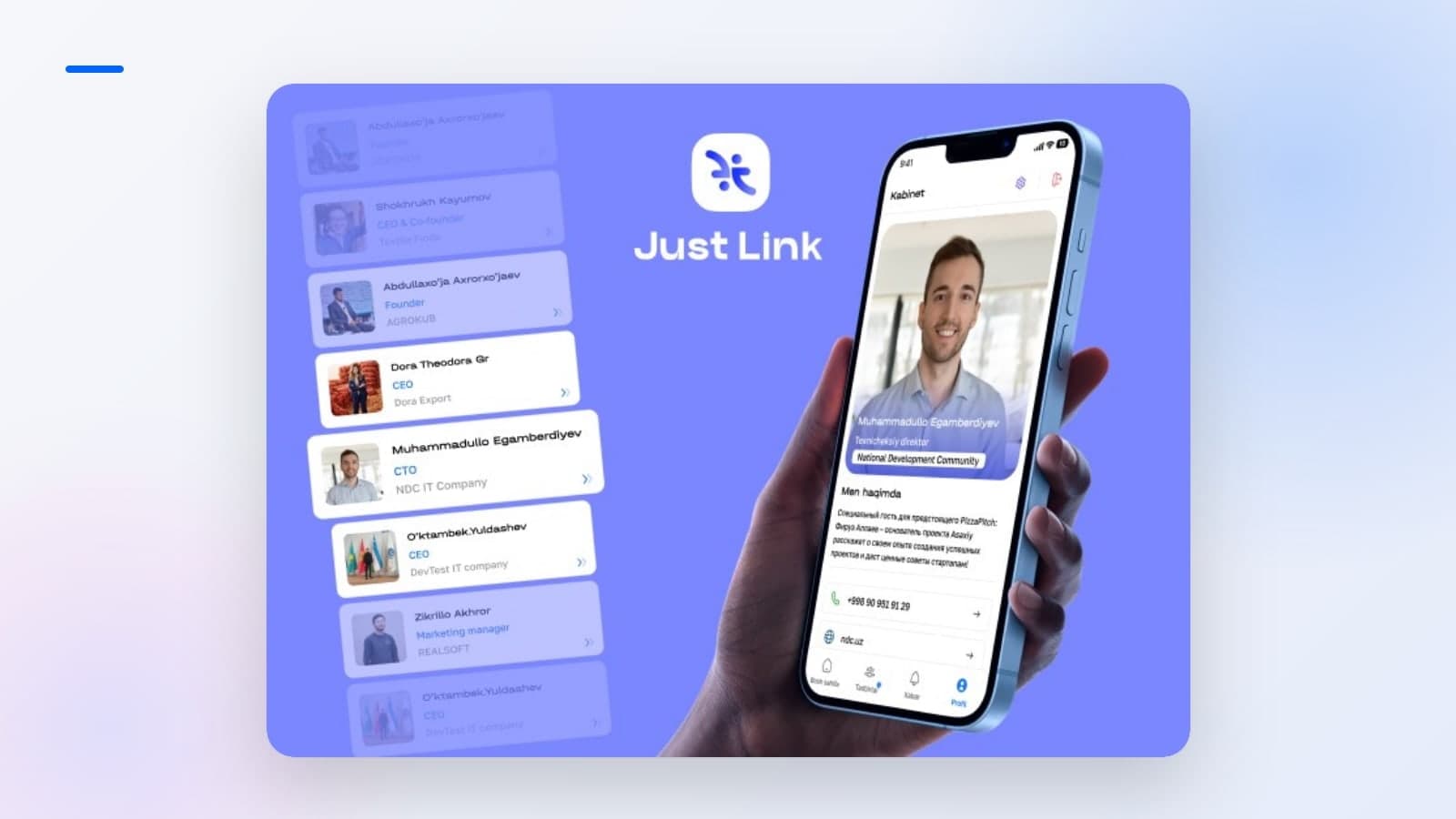
The professional networking platform JustLink required an ecosystem where business connections start with a structured, verified profile rather than cold messaging, delivering an equally seamless experience across web browsers and mobile devices. We mapped out member profiles, search directories, and contact request flows, followed by delivering a responsive web platform and mobile apps sharing a centralized backend and administration system. Today, the product operates smoothly on justlink.uz and across major app stores with a unified user database.
A real case: BILLZ Retail Automation
Back in 2017, founders in Tashkent recognized that local apparel and footwear retailers were managing inventory manually on paper ledgers and Excel spreadsheets, losing up to 30% of potential revenue to administrative oversights. The founding team conducted in-depth interviews with 20 store owners, launched an all-in-one cloud B2B SaaS platform covering POS terminals, inventory control, and Telegram client bots, and closed an initial $150,000 round from Sturgeon Capital. The software expanded to support over 4,000 retail locations across 6 countries, processing upwards of 1.5 million transactions every month. In 2025, TBC Bank Group acquired a majority stake (53%) in the company for up to $12 million, valuing the startup at $20 million (gbc.ge).
Common Pitfalls in Early-Stage Software Projects
- Committing to native mobile apps from the start. Sinking 100 million UZS (so'm) into native iOS and Android builds right out of the gate often leaves nothing in the bank for marketing and product iteration once customer feedback starts rolling in. Full-scale mobile app development becomes appropriate once your unit economics work and users explicitly demand on-device residency.
- Reinventing core infrastructure. Writing your own map search engine or processing transactions through bespoke integrations eats up months of runway. It is far more cost-effective to tap into proven platforms, such as the UzMaps mapping platform with its ready-made geocoding and search APIs tailored for Uzbekistan.
- Developing in isolation. Building an “ideal” product in stealth mode almost always ends with delivering features the market never asked for.
Frequently Asked Questions
How much does it cost to build an MVP for a startup in Tashkent?
Developing a lean MVP as a Telegram Mini App or a focused web application runs between 18 and 35 million UZS (so'm) on average over a 3–4 week timeframe. Engineering a full-scale cross-platform ecosystem with native iOS and Android apps typically requires 80 to 180 million UZS (so'm) and 3–5 months of focused engineering (ndc.uz).
How can a startup join IT Park, and what are the tangible benefits?
Teams apply online via it-park.uz by submitting a company overview and business model plan. Resident status exempts your company from corporate profits tax (0%) and IT service VAT (0%), while lowering payroll income tax on team members to 7.5% instead of 12%, significantly reducing early operational burn.
When does a startup truly require a dedicated mobile app?
A native mobile app becomes an asset once you have a loyal core of active customers, verified product-market fit via Telegram or web browsers, and product requirements that demand hardware capabilities like background push notifications, Bluetooth connectivity, or continuous geolocation tracking. During early validation, a Telegram Mini App reliably fulfills up to 90% of business objectives at a fraction of the budget.
If you have an idea for a tech product or need to migrate an offline business to a robust digital platform, reach out to us through our contacts page. We will assess your workflows, recommend the right architecture to start with, and help you launch cleanly without burning your runway.