Fabric inventory software for sewing workshops: budgets and roll control
How to set up fabric inventory tracking in a garment workshop: roll control by dye-lots, converting kilograms to metres, handling cutting offcuts, and calculating budgets.
Precise fabric tracking in garment manufacturing in Uzbekistan requires specialised solutions supporting roll-level barcoding, fabric density conversion, and strict dye-lot logging. Deploying an industry-ready platform or tailoring a standard inventory system takes from 2 to 8 weeks, with budgets typically ranging between 5,000,000 and 35,000,000 UZS (so'm) depending on operational scale and hardware needs.
In brief
- Generic retail inventory tools lead to inventory discrepancies of up to 8–12% because of conversions from kilograms to linear metres and fabric shrinkage.
- Individual QR or barcodes on every roll prevent cutting dye-lot mismatch by verifying the dye-lot before fabric reaches the spreading table.
- A base electronic licence for "1C:Company Management 8 for Uzbekistan" costs 4,814,000 UZS (so'm), while a 5-user package costs 8,855,000 UZS (so'm) before custom development.
- Dedicated software enables fabric deductions based on actual cutting layouts while returning end-of-roll offcuts back into inventory as usable remnants.
Why generic warehouse software fails in a garment workshop
Standard warehouse software tracks inventory by pieces, boxes, or kilograms. In an apparel factory, this framework quickly breaks down. The primary driver of discrepancies in a garment stockroom is dual units of measurement: knit fabrics are bought in kilograms, but issued to the cutting table in linear metres based on surface density (g/m²) and technical shrinkage (typically 3–7%). As industry research from kulps.dev highlights, standard retail software frequently causes inventory calculation errors of 8–12%.
The second issue is dye-lot shading. Two rolls of the same colour code and article number from distinct dye-lots look identical on warehouse racks. If a cutter mixes them in a single spread, the finished batch of t-shirts or hoodies will be ruined: sleeves will turn out visibly lighter than the body panels. A generic warehouse system discharges fabric using basic First-In, First-Out (FIFO), disregarding vat numbers and shading nuances.
The third challenge is handling cutting table offcuts. After pattern spreading, there are always inter-pattern scraps and end-of-roll remnants measuring from 0.5 to 3 metres. If the software cannot return usable offcuts to the active balance sheet, the shop floor either loses valuable yardage or accumulates untracked fabric scraps across room corners. We previously discussed how raw material logistics integrate into broader operational workflows in our guide to ERP for textile factories in Uzbekistan.
What fabric inventory software must deliver
To eliminate operational loss across the stockroom, software must cover four critical processes.
Roll passports and labelling. During receiving, every roll is weighed, measured, and tagged with an individual barcode or QR code. The digital roll passport logs the supplier, SKU, gross and net weight, actual usable width, density, and dye-lot number.
Dye-lot control at issue. The system generates cutting orders strictly using rolls from matching dye-lots. Stockroom staff scan each roll before dispatching it to the cutting line: if the dye-lot does not match the shift assignment, the system blocks the transfer.
Consumption tracking based on patterns and norms. Fabric is deducted using pattern-specific consumption standards adjusted for actual roll width, not guesswork. During spreading, cutters confirm the actual yardage utilised.
Tracking usable offcuts. End-of-roll remnants are measured directly on the table, receive a child barcode, and return to stock as materials for smaller elements (pockets, facings, waistbands) or pre-production samples.
Options for automating a garment workshop warehouse
Selecting software depends on your number of active sewing lines, order complexity, and accounting integration requirements.
| Solution | Cost (UZS / so'm) | Launch time | Best suited for |
|---|---|---|---|
| Industry cloud SaaS (such as Andaza) | From 5,000,000 to 15,000,000 per year | 1–2 weeks | Small and mid-sized workshops (10 to 50 machinists), fast launch without server overhead |
| 1C:UNF for Uzbekistan with custom adaptations | Licence from 4,814,000 + customisation 12,000,000 – 25,000,000 | 4–8 weeks | Workshops needing advanced cost accounting, in-house bookkeepers, and handheld data terminals |
| Dedicated textile ERP (such as Apoint) | From 25,000,000 to 70,000,000+ | 2–4 months | Large full-cycle plants (knitting, dyeing, cutting, assembly) |
| Bespoke web system or Telegram-bot interface | From 15,000,000 to 35,000,000 | 3–6 weeks | Non-standard shop-floor routines, tracking via tablets and Telegram directly on the floor |
Official pricing from certified partner 1cba.uz sets a base electronic licence for "1C:Company Management 8 for Uzbekistan" at 4,814,000 UZS (so'm), and an office pack for 5 concurrent users at 8,855,000 UZS (so'm). However, standard templates require custom programming: adding fabric roll batches, bin-location management, and handheld barcode scanner workflows. If your stockroom handles distribution and logistics for finished goods, review document compliance in our guide to warehouse automation with electronic consignment notes (e-TTN).
If you are just starting
If your workshop launched recently with 10–25 sewing machines and you purchase fabrics in smaller quantities per production order, you do not need an enterprise-grade ERP right away.
- Stop relying on paper cut books. Create a single master spreadsheet where every incoming roll is logged with article code, colour, dye-lot, supplier weight, and verified yardage.
- Invest in a handheld label printer and scanner. A starter hardware bundle costs roughly 2–4 million UZS (so'm). Apply an incremental serial barcode to the edge of every roll at intake.
- Subscribe to a specialised industry platform. Tashkent-based startup Andaza Soft, a resident of IT Park, developed a dedicated SaaS tool for apparel factories (tikuv fabrikalari) that calculates pattern consumption, balances roll stock, and tracks haberdashery, as outlined on andaza.uz.
- Place floor check scales at the shop-floor entrance. Weigh rolls immediately before spreading and right after cutting. This immediately clarifies how many kilograms entered production and what remains as scrap or end-cuts.
Based on our client engagements, an entry-level implementation budget falls between 5,000,000 and 12,000,000 UZS (so'm), covering a thermal printer, scanner, and a one-year software subscription.
A real case: eliminating fabric shading in a Tashkent workshop
Small and mid-sized garment workshops in Tashkent frequently tracked fabric using loose Excel sheets or foremen's notebooks. This routine triggered untracked yardage leakage, colour mismatches on finished garments from mixed dye-lots, and lost end-of-roll offcuts.
According to developer case studies on andaza.uz, several local workshops implemented Andaza cloud software. They digitised individual roll profiles (dye-lot, width, yardage, weight) and enforced mandatory intake logging for all usable offcuts coming off the cutting table.
As a result, these facilities completely eliminated garment shading defects, slashed uncontrolled yardage waste, and noticeably sped up material kitting for active production batches.
If your business is already running
For factories operating 50 or more sewing machines with steady material flows, manual recordkeeping becomes a choke point. Inventory errors cause cutting table downtime, while stock counts shut down the entire production floor for days.
- Implement bin-location tracking for fabric rolls. Map your storage space into identifiable racks, shelves, and bins. The software assigns each roll a precise location coordinate, preventing material handlers from hunting down specific rolls across stacks.
- Connect warehouse scanners directly to the cutting room. Mobile data terminals (MDT) used by stockroom staff must validate the dye-lot barcode on the roll before approving issue to the spreading table.
- Automate sync with 1C. The warehouse module should send fabric write-offs and cut-piece intake data directly to accounting without double entry. Setting this up requires structured CRM and ERP implementation with bidirectional synchronization.
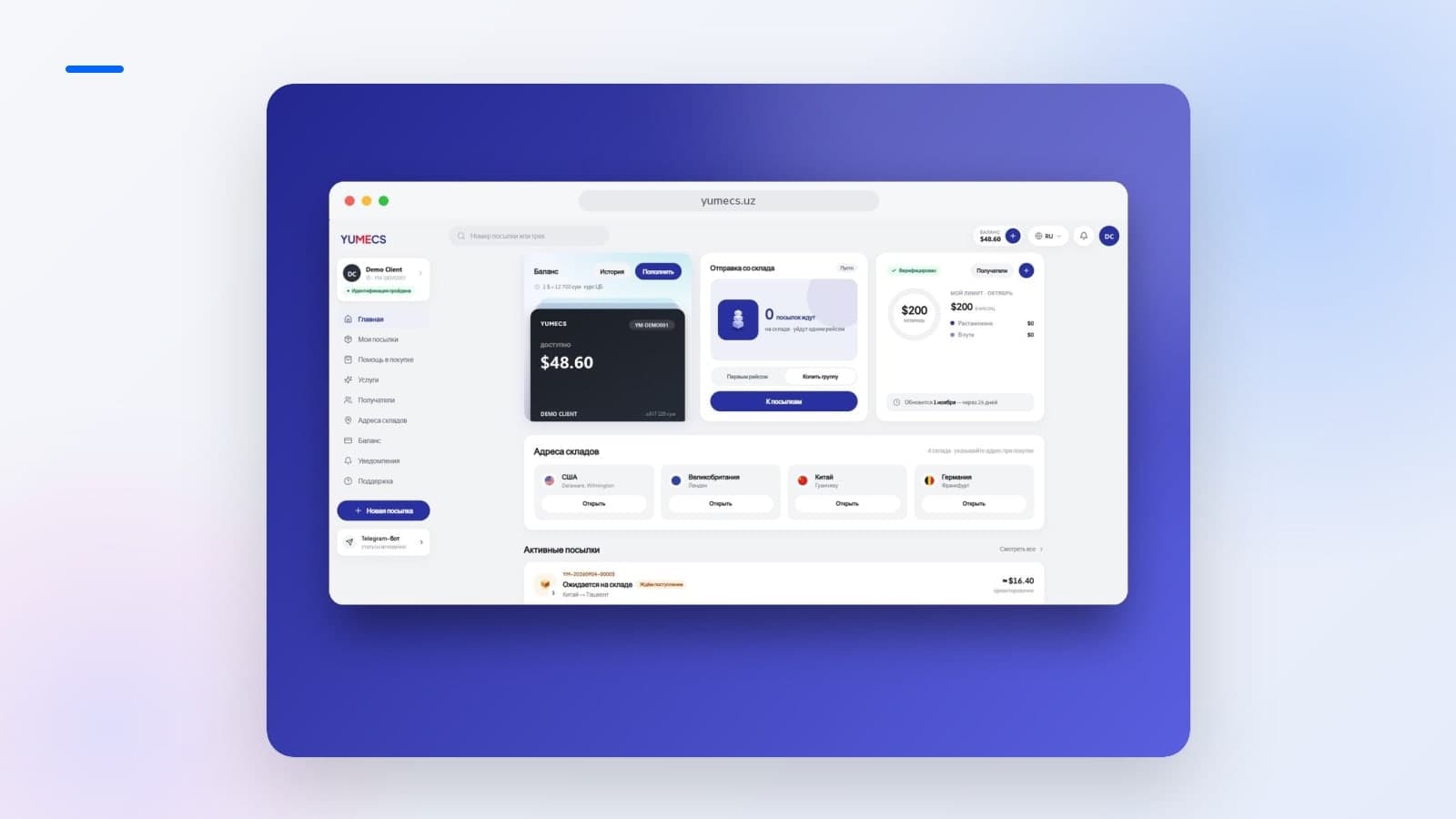
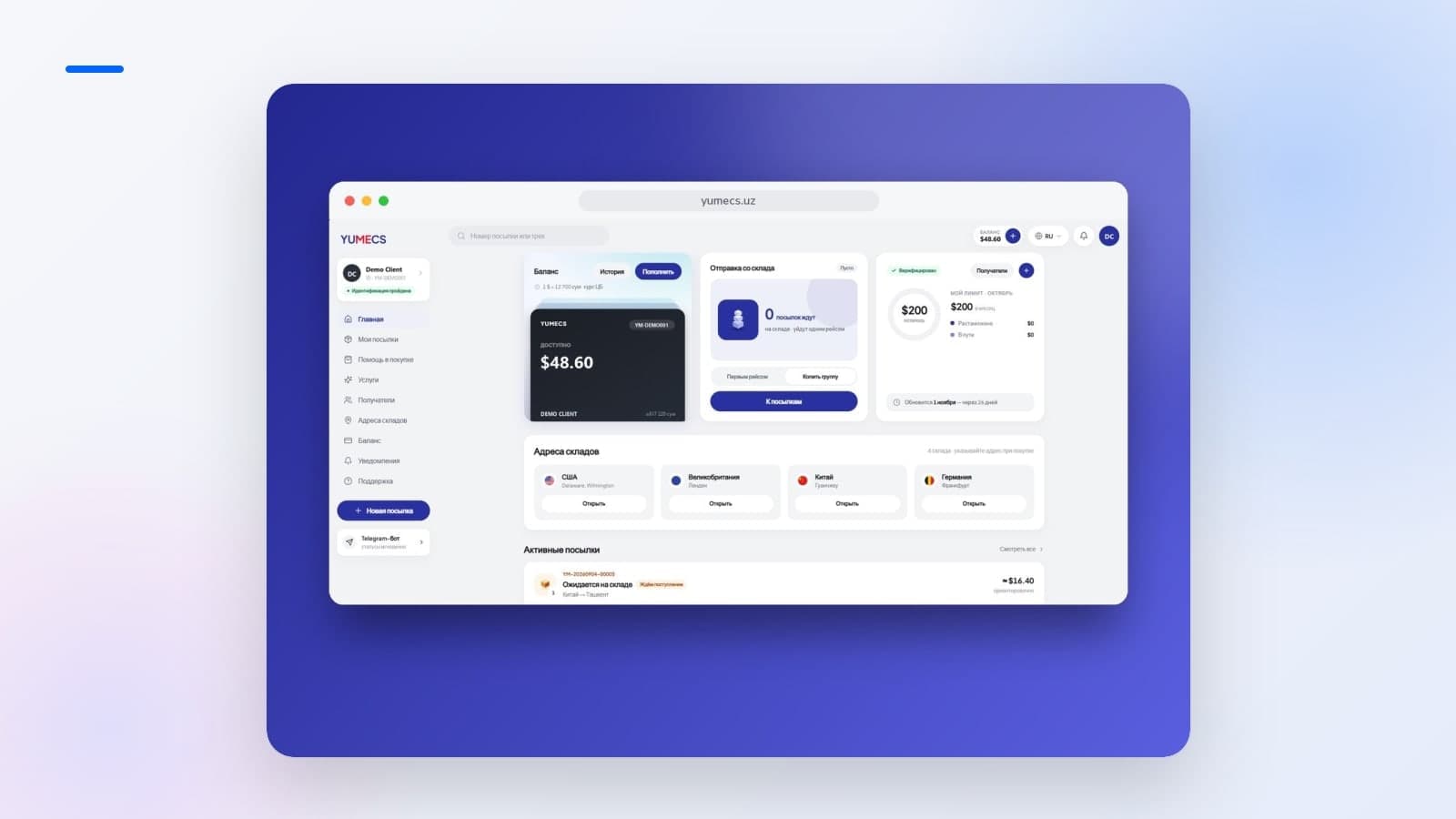
- Automate shortage alerts for production leads. If trims or a specific fabric colour drop below safety thresholds, the system pushes an alert directly to the procurement Telegram channel. In our YUMECS engagement, we set up real-time tracking where internal system statuses automatically notify stakeholders via a Telegram bot, eliminating manual status checks.
Upgrading inventory systems for an established factory typically requires 18,000,000 to 35,000,000 UZS (so'm), including mobile scanner integrations, density-to-metre conversion logic, and team onboarding. Typical roll-out takes 4 to 8 weeks without halting main production lines.
A real case: fabric tracking at the Bonito Kids factory
Bonito Kids (Oltin Mato Group, Tashkent), a large manufacturer of children's knitwear, struggled with inter-department transfer delays between storage and cutting lines, alongside slow manual audits across hundreds of fabric rolls with varying densities and shades.
According to software developer data at apoint.uz, local platform Apoint deployed a specialised ERP module for yarn and fabric tracking with cutting table dispatch logs and QR/RFID tagging across more than 65 textile operations in Uzbekistan, including Bonito Kids, Fayz-M, and Oltin Mato Group.
The system accelerated inventory audits and warehouse material handling by 20–30%, eliminated mixed dye-lot errors, and established end-to-end transparency for cut-part manufacturing costs on every production run.
Common fabric inventory automation mistakes
- Deducting fabric using theoretical average weights. Knitwear density fluctuates between supply batches. Deducting metres based strictly on supplier spec sheets creates massive inventory drift after just ten cuts.
- Ignoring roll width variations. Marker layouts rely on precise spreading widths. If a roll arrives 5 cm narrower, the marker fails and raw material waste spikes. Width must be checked and recorded at intake.
- Treating end remnants as worthless waste. Offcuts measuring 1.5–2 metres left on the table are often written off as scrap, even though they easily supply pocket bags, neckbands, or plackets.
- Introducing complex tools without training cutters. Overly dense digital forms cause workers to skip real-time scanning and batch-enter fabricated scans at shift end, defeating the purpose of automation.
Frequently asked questions
How does inventory software convert knit fabric from kilograms to metres?
The roll passport stores two fundamental values: actual width in metres and fabric density in grams per square metre (g/m²). The system determines linear metre weight using a standard formula: linear metre weight equals usable width multiplied by surface density. At receiving, staff weigh the roll on electronic floor scales, allowing the software to compute exact theoretical yardage adjusted for normal shrinkage rates.
How much does turnkey garment inventory software cost in Uzbekistan?
An entry-level implementation of an off-the-shelf cloud service costs roughly 5–12 million UZS (so'm). End-to-end automation built on 1C with bin storage, connected floor scales, barcode readers, and dedicated cutting workstations typically runs from 18 to 35 million UZS (so'm), depending on customisations and active cutting lines.
Should we buy a ready-made platform or build custom software?
If you run standard cutting and sewing operations for basic knitwear, an existing industry SaaS tool is more than adequate. Custom software or tailored integrations make sense when running commission manufacturing (toll processing), complex sample approval workflows, or deep synchronization between handheld terminals and your internal ERP portal.
If you want to bring complete order to your fabric warehouse, eliminate dye-lot defects, and automate cutting remnant tracking, reach out to our team at NDC. We will help you select the right system, calculate a clear budget, and configure tracking workflows tailored to your shop floor.